MCQ
A wall clock uses a vertical spring-mass system to measure the time. Each time the mass reaches an extreme position, the clock advances by a second. The clock gives correct time at the equator. If the clock is taken to the poles it will:
  • A
    Run slow.
  • B
    Run fast.
  • C
    Stop working.
  • Give correct time.

Answer

Correct option: D.
Give correct time.
Because the time period of a spring-mass system does not depend on the acceleration due to gravity.

Need a full question paper?

Generate a complete, print-ready paper with questions like this in minutes — across 16+ boards, with answer keys.

Start Generating Free

Similar questions

The resistance of a wire is$10\,\Omega $. Its length is increased by $10\%$ by stretching. The new resistance will now be .......... $\Omega$
By what percentage will the transmission range of a $TV$ tower be affected when the height of the tower is increased by $21 \%$ ?
The activity of a sample is $64 × 10^{-5}\, Ci.$ Its half-life is $3\, days$. The activity will become $5 × 10^{-6}\, Ci$ after .........$days$
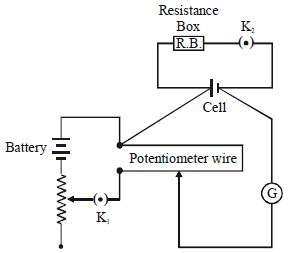
The adjoining figure shows the connections of potentiometer experiment to determine internal resistance of of a leclanche cell. When the cell is on open circuit the balancing length of the potentiometer wire is $3.4\, m$ and on closing the key $K_2$ the balancing length becomes $1.7\, m$ . If the resistance $R$ through which current is drawn is $10\,\Omega $ then the internal resistance of the cell is .............. $\Omega$
Line spectrum was first of all theoretically explained by
Four resistances of $15\; \Omega, 12\; \Omega, 4 \;\Omega$ and $10\; \Omega$ respectively in cyclic order to form Wheats tone's network. The resistance that is to be connected in parallel with the resistance of $10\; \Omega$ to balance the network is .................. $\Omega$
A proton and an $\alpha -$ particle (with their masses in the ratio of $1 : 4$ and charges in the ratio of $1:2$ are accelerated from rest through a potential difference $V$. If a uniform magnetic field $(B)$ is set up perpendicular to their velocities, the ratio of the radii $r_p : r_{\alpha }$ of the circular paths described by them will be
Deuterium is the most common isotope of hydrogen. How many neutrons does it have?
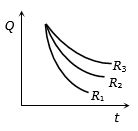
Three identical capacitors are given a charge $Q$ each and they are then allowed to discharge through resistance $R_1, R_2\,$ and $\,R_3$. Their charges, as a function of time shown in the graph below. The smallest of the three resistance is
A microscope is focussed on a coin lying at the bottom of a beaker. The microscope is now raised up by $1 \,cm$. To what depth should the water be poured into the beaker so that coin is again in focus ?........$cm$ (Refractive index of water is $\frac{4}{3}$)