A wave is represented by the equation : $y = a\sin (0.01x - 2t)$ where $a$ and $x$ are in $cm$. velocity of propagation of wave is .... $cm/s$
AIIMS 2000, Easy


Download our appand get started for free
Experience the future of education. Simply download our apps or reach out to us for more information. Let's shape the future of learning together!No signup needed.*
Similar Questions
- 1The frequency of a rod is $200 Hz$. If the velocity of sound in air is $340\,m{s^{ - 1}}$, the wavelength of the sound produced isView Solution
- 2A wave is represented by $x=4 \cos \left(8 t-\frac{y}{2}\right)$, where $x$ and $y$ are in metre and $t$ in second. The frequency of the wave $\left(\right.$ in $^{-1}$ ) is .........View Solution
- 3A source of sound $S$ having frequency $f.$ Wind is blowing from source to observer $O$ with velocity $u$. If speed of sound with respect to air is $C,$ the wavelength of sound detected by $O$ is:View Solution
- 4An air column in a pipe, which is closed at one end, will be in resonance with a vibrating body of frequency $166 \,Hz$, if the length of the air column is .... $m$View Solution
- 5View SolutionIf you set up the seventh harmonic on a string fixed at both ends, how many nodes and antinodes are set up in it
- 6Two cars moving in opposite directions approach each other with speed of $22\, m s^{-1}$ and $16.5 \, m s^{-1}$ respectively. The driver of the first car blows a horn having a frequency $400 \,Hz.$ The frequency heard by the driver of the second car is ..... $Hz$ (velocity of sound is $340 \, m s^{-1}$)View Solution
- 7Beats are produced by two waves ${y_1} = a\sin 1000\,\pi t,$ ${y_2} = a\sin 998\pi t$The number of beats heard/sec isView Solution
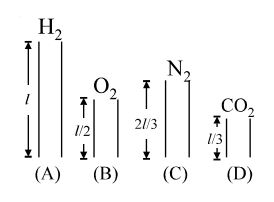
- 8Four open organ pipes of different lengths and different gases at same temperature as shown in figure. Let $f_A$, $f_B$, $f_C$ and $f_D$ be their fundamental frequencies then :[Take ${\gamma _{c{o_2}}} = 7/5$]View Solution
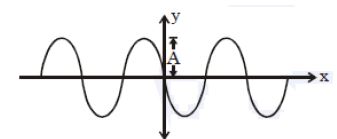
- 9A progressive wave travelling along the positive $x-$ direction is represented by $y(x, t) = A\,sin\,\left( {kx - \omega t + \phi } \right)$. Its snapshot at $t = 0$ is given in the figure For this wave, the phase $\phi $ isView Solution
- 10An observer moves towards a stationary source of sound with a speed $1/5^{th}$ of the speed of sound. The wavelength and frequency of the source emitted are $\lambda $ and $f$ respectively. The apparent frequency and wavelength recorded by the observer are respectivelyView Solution