MCQ
A wave travelling in positive $x-$direction with $A = 0.2\;m$ has a velocity of $360 \;m/sec.$ if $\lambda = 60\;m,$ then correct expression for the wave is
  • A
    $y = 0.2\sin \,\left[ {2\pi \left( {6t + \frac{x}{{60}}} \right)} \right]$
  • B
    $y = 0.2\sin \,\left[ {\pi \left( {6t + \frac{x}{{60}}} \right)} \right]$
  • $y = 0.2\sin \,\left[ {2\pi \left( {6t - \frac{x}{{60}}} \right)} \right]$
  • D
    $y = 0.2\sin \,\left[ {\pi \left( {6t - \frac{x}{{60}}} \right)} \right]$

Answer

Correct option: C.
$y = 0.2\sin \,\left[ {2\pi \left( {6t - \frac{x}{{60}}} \right)} \right]$
c
(c) A wave travelling in positive $x-$direction may be represented as

$y = A\sin \frac{{2\pi }}{\lambda }\,(v\,t - x)$.

On putting values $y = 0.2\sin \frac{{2\pi }}{{60}}(360\,t - x)$

$\Rightarrow$ $y = 0.2\sin 2\pi \,\left( {6\,t - \frac{x}{{60}}} \right)$

Need a full question paper?

Generate a complete, print-ready paper with questions like this in minutes — across 16+ boards, with answer keys.

Start Generating Free

Similar questions

Two vessels separately contain two ideal gases $A$ and $B$ at the same temperature, the pressure of $A$ being twice that of $B.$ Under such conditions, the density of $A$ is found to be $1.5$ times the density of $B.$ The ratio of molecular weight of $A$ and $B$ is
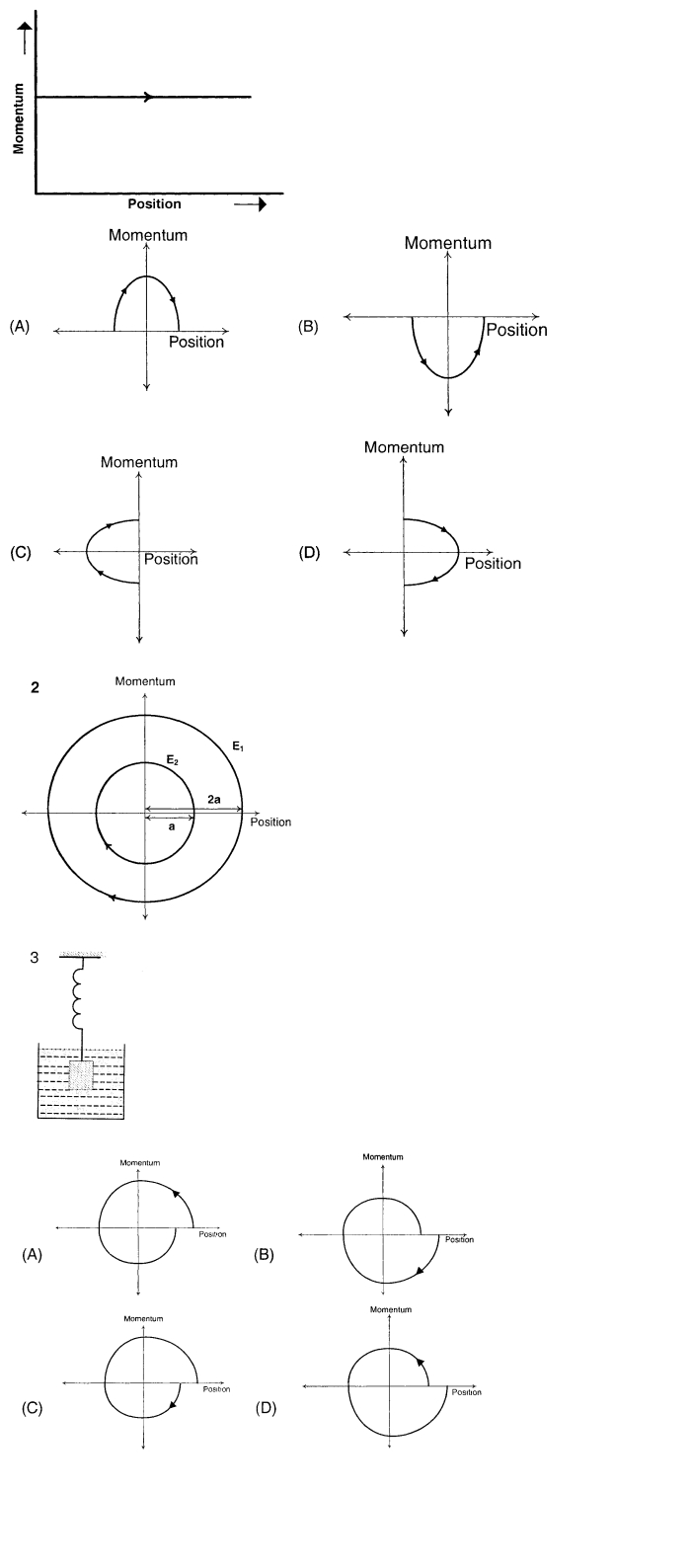
Phase space diagrams are useful tools in analyzing all kinds of dynamical problems. They are especially useful in studying the changes in motion as initial position and momentum are changed. Here we consider some simple dynamical systems in one-dimension. For such systems, phase space is a plane in which position is plotted along horizontal axis and momentum is plotted along vertical axis. The phase space diagram is $x(t)$ vs. $p(t)$ curve in this plane. The arrow on the curve indicates the time flow. For example, the phase space diagram for a particle moving with constant velocity is a straight line as shown in the figure. We use the sign convention in which position or momentum upwards (or to right) is positive and downwards (or to left) is negative. $Image$

$1.$ The phase space diagram for a ball thrown vertically up from ground is

mcq $Image$

$2.$ The phase space diagram for simple harmonic motion is a circle centered at the origin. In the figure, the two circles represent the same oscillator but for different initial conditions, and $E_1$ and $E_2$ are the total mechanical energies respectively. Then $Image$

$(A)$ $ E_1=\sqrt{2} E_2$ $(B)$ $ E_1=2 E_2$

$(C)$ $ E_1=4 E_2$ $(D)$ $ E_1=16 E_2$

$3.$ Consider the spring-mass system, with the mass submerged in water, as shown in the figure. The phase space diagram for one cycle of this system is $Image$

mcq $Image$

Give the answer question $1,2$ and $3.$
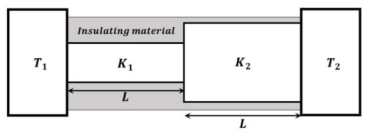
Two conducting cylinders of equal length but different radii are connected in series between two heat baths kept at temperatures $T _1=300 K$ and $T _2=100 K$, as shown in the figure. The radius of the bigger cylinder is twice that of the smaller one and the thermal conductivities of the materials of the smaller and the larger cylinders are $K _1$ and $K _2$ respectively. If the temperature at the junction of the two cylinders in the steady state is $200 K$, then $K _1 / K _2=$ . . . . .
Sound travels in rocks in the form of
$5.74 \;g$ of a substance occuples $1.2\; cm ^{3} .$ Express its density(in $g/cm^3$) by keeping the significant figures in view.
Equal torques act on the discs A and B of the previous problem, initially both being at rest. At a later instant, the linear speeds of a point on the rim of A and another point on the rim of B are $v_A$ and $v_B$ respectively. We have:
A wire is loaded by $6\, kg$ at its one end, the increase in length is $12\, mm.$ If the radius of the wire is doubled and all other magnitudes are unchanged, then increase in length will be ......... $mm$
A disc of radius $20\, cm$ and mass half $kg$ is rolling on an inclined plane. Find out friction force so that disc performs pure rolling.
A body projected vertically from the earth reaches a height equal to earth's radius before returning to the earth. The power exerted by the gravitational force is greatest
If energy $(E)$, velocity $(v)$and force $(F)$ be taken as fundamental quantity, then what are the dimensions of mass