MCQ
A wavelength $0.60 cm$ is produced in air and it travels at a speed of $300 ms^{-1}$. It will be an
  • A
    Audible wave
  • B
    Infrasonic wave
  • Ultrasonic wave
  • D
    None of the above

Answer

Correct option: C.
Ultrasonic wave
c
(c) $n = \frac{v}{\lambda } = \frac{{300}}{{0.6 \times {{10}^{ - 2}}}}Hz$

$ = \frac{3}{6} \times {10^4}Hz = 50,000Hz$
==> Wave is ultrasonic.

Need a full question paper?

Generate a complete, print-ready paper with questions like this in minutes — across 16+ boards, with answer keys.
Start Generating Free

Similar questions

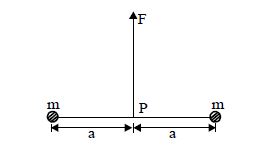
Two particles of mass $m$ each are tied at the ends of a light string of length $2a$ . The whole system is kept on a frictionless horizontal surface with the string held tight so that each mass is at a distance $'a'$ from the centre $P$ (as shown in the figure). Now, the mid-point of the string is pulled vertically upwards with a small but constant force $F$ . As a result, the particles move towards each other on the surface. The magnitude of acceleration, when the separation between them becomes $2x$ , is
A ball of mass $0.5 \mathrm{~kg}$ is attached to a string of length $50 \mathrm{~cm}$. The ball is rotated on a horizontal circular path about its vertical axis. The maximum tension that the string can bear is $400 \mathrm{~N}$. The maximum possible value of angular velocity of the ball in rad/s is,:
A sample of an ideal gas occupies a volume $V$ at a pressure $P$ and absolute temperature $T,$ the mass of each molecule is $m.$ The expression for the density of gas is ($k =$ Boltzmann’s constant)
The maximum and minimum distances of a comet from the sun are $8 \times {10^{12}}\,m$ and $1.6 \times {10^{12}}\,m$. If its velocity when nearest to the sun is $60\, m/s$, what will be its velocity in $m/s$ when it is farthest 
For a solid rod, the Young's modulus of elasticity is $3.2 \times 10^{11}\,Nm ^{-2}$ and density is $8 \times 10^3\,kg\,m ^{-3}$. The velocity of longitudinal wave in the rod will be $......... \times 10^{3}\,ms^{-1}$
Consider the motion of the tip of the minute hand of a clock. In one hour:
  1. The displacement is zero.
  2. The distance covered is zero.
  3. The average speed is zero.
  4. The average velocity is zero.
A solid sphere falls with terminal velocity of $10 \,cm/s$ in the earth's gravitational field. If  it is allowed to fall freely in a region outside the gravitational field of the earth, the terminal  velocity, will be :-
At constant volume, for different diatomic gases the molar specific heat is
A car, starting from rest, accelerates at the rate $f$ through a distance $S$, then continues at constant speed for time $t$ and then decelerates at the rate $\frac{f}{2}$ to come to rest. If the total distance traversed is $15S$, then
There is a relation between the linear acceleration and angular acceleration of a particle in circular motion.