MCQ
A wheel has angular acceleration of $3.0\, rad/s^2$ and an initial angular speed of $2.00\, rad/s$. In a time of $2\, s$ it has rotated through an angle (in radian) of
  • A
    $6$
  • $10$
  • C
    $12$
  • D
    $4$

Answer

Correct option: B.
$10$
b
Given : initial angular speed,

${\omega _0} = 2\,rad/s,\,angular\,acceleration,$

$\alpha  = 3rad/{s^2},time,\,t = 2s$

From the equation of the angular displacement,

$\theta  = {\omega _0}t + \frac{1}{2}\alpha {t^2} = 2 \times 2 + \frac{1}{2} \times 3 \times {\left( 2 \right)^2}$

$ = 4 + 6 = 10\,radians$

Need a full question paper?

Generate a complete, print-ready paper with questions like this in minutes — across 16+ boards, with answer keys.
Start Generating Free

Similar questions

A force defined by $F=\alpha t^2+\beta t$ acts on a particle at a given time $t$. The factor which is dimensionless, if $\alpha$ and $\beta$ are constants, is:
A wall has two layers $A$ and $B$, each made of a different material. Both the layers have the same thickness. The thermal conductivity of the material of $A$ is twice that of $B$. Under thermal equilibrium, the temperature difference across the wall is $36\,^oC$. The temperature difference across the layer $A$ is ......... $^oC$
On a railway curve, the outside rail is laid higher than the inside one so that resultant force exerted on the wheels of the rail car by the tops of the rails will
If force $(F),$ velocity $(V)$ and time $(T)$ are taken as fundamental units, then the dimensions of mass are 
An athlete completes one round of a circular track of radius $R$ in $40 \,sec$. What will be his displacement at the end of $2 \,min$. $20 \,sec$
A liquid of mass m and specific heat $c$ is heated to a temperature $2T.$ Another liquid of mass $m/2$ and specific heat $2c$ is heated to a temperature $T.$ If these two liquids are mixed, the resulting temperature of the mixture is
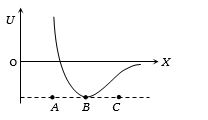
The potential energy $U$ between two molecules as a function of the distance $X$ between them has been shown in the figure. The two molecules are
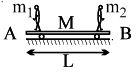
 Two persons of mass $m_1$ and $m_2$ are standing at the two ends $A$ and $B $ respectively, of $a$ trolley of mass $M$ as shown. When the person standing at $A$ jumps from the trolley towards left with urel with respect to the trolley, then
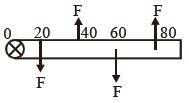
Four equal and parallel forces are acting on a rod (as shown in fig.) at distances of $20 \,cm,  40\, cm, 60\, cm$ and $80\, cm$ respectively from one end of the rod under the influence of  these forces the rod -
In one dimensional motion, instantaneous speed $v$ satisfies $0\le\text{v}<\text{v}_0.$