MCQ
A wheel is at rest. Its angular velocity increases uniformly and becomes $60\ rad/sec$ after $5\ sec$. The total angular displacement is ........ $rad$.
  • A
    $600$
  • B
    $75$
  • C
    $300$
  • $150$

Answer

Correct option: D.
$150$
d
Angular acceleration $\alpha  = \frac{{{\omega _2} - {\omega _1}}}{t} = \frac{{60 - 0}}{5} = 12\ rad/se{c^2}$

Now from $\theta  = {\omega _1}t + \frac{1}{2}\alpha \,{t^2}$= $0 + \frac{1}{2}(12){(5)^2} = 150\,rad.$

Need a full question paper?

Generate a complete, print-ready paper with questions like this in minutes — across 16+ boards, with answer keys.
Start Generating Free

Similar questions

If a man increase his speed by $2 \,m/s$ , his K.E. is doubled, the original speed of the man is
What could be a correct expression for the speed of ocean waves in terms of its wavelength $\lambda $ , the depth $h$ of the ocean, the density $\rho $ of sea water, and the acceleration of free fall $g$ ?
The change in potential energy, when a body of mass m is raised to a height $nR$ from earth's surface is $(R =$ radius of earth$):$
A particle of mass $m$ moving in the $x$ direction with speed $2 v$ is hit by another particle of mass $2 m$ moving in the $y$ direction with speed $v$. If the collision is perfectly inelastic, the percentage loss in the energy during the collision is close to $..........\%$
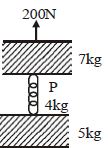
Two blocks of  $7\,\,kg$ and $5\,\,kg$  are connected by a heavy rope of mass $4\,\,kg.$ An upward force of $200\,N$  is applied as shown in the diagram. The tension at the top of heavy rope at point $P$  is ....... $N$ $(g = 10\,\,m/s^2)$
If Gravitational constant is decreasing in time, what will remain unchanged in case of a satellite orbiting around earth
A body of mass $2\ Kg$ moving $($initially$)$ with $10\ m/ s$ is acting upon by a resultant constar which is opposite to its initial velocity. Its speed decreases to $4\ m/ s$ in $1s.$ Then the force:
An object of mass $80 \,kg$ moving with velocity $2 \,ms ^{-1}$ hit by collides with another object of mass $20 \,kg$ moving with velocity $4 \,ms ^{-1}$. Find the loss of energy assuming a perfectly inelastic collision ........... $J$
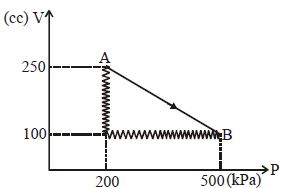
A monoatomic gas is taken along path $AB$ as shown. Calculate change in internal energy of system
The freezing point of the liquid decreases when pressure is increased, if the liquid