MCQ
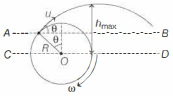
A wheel of radius $R$ is trapped in a mud pit and spinning. As the wheel is spinning, it splashes mud blobs with initial speed $u$ from various points on its circumference. The maximum height from the centre of the wheel, to which a mud blob can reach is
  • A
    $u^{2} / 2 g$
  • $\frac{u^{2}}{2 g}+\frac{g R^{2}}{2 u^{2}}$
  • C
    $0$
  • D
    $R+\frac{u^{2}}{2 g}$

Answer

Correct option: B.
$\frac{u^{2}}{2 g}+\frac{g R^{2}}{2 u^{2}}$
b
$(b)$ Let a mud blob is detached from the circumference of wheel with initial speed $u$ at angle $\theta$ as shown below.

Height upto which mud blob can be thrown is

$h=$ Maximum height of projectile $+$ Height at which mud blob is thrown

$\therefore \quad h=\frac{u^{2} \sin ^{2} \theta}{2 g}+R \cos \theta \quad \dots(i)$

$h$ is maximum when $\frac{d h}{d \theta}=0$

$\Rightarrow \frac{d}{d \theta}\left(\frac{u^{2} \sin ^{2} \theta}{2 g}+R \cos \theta\right)$

$\Rightarrow \frac{u^{2}}{2 g} \cdot 2 \sin \theta \cos \theta-R \sin \theta=0$

$\Rightarrow \quad \frac{u^{2}}{g} \cdot \cos \theta=R \text { or } \cos \theta=\frac{R g}{u^{2}}$

$\Rightarrow \quad \sin ^{2} \theta=1-\frac{R^{2} g^{2}}{u^{2}}$

Substituting these values in Eq $(i)$, we get

$\lambda_{\max } =\frac{u^{2}}{2 g}\left(1-\frac{R^{2} g^{2}}{u^{4}}\right)+R\left(\frac{R g}{u^{2}}\right)$

$=\frac{u^{2}}{2 g}-\frac{R^{2} g}{2 u^{2}}+\frac{R^{2} g}{u^{2}}=\frac{u^{2}}{2 g}+\frac{R^{2} g}{2 u^{2}}$
Need a full question paper?

Generate a complete, print-ready paper with questions like this in minutes — across 16+ boards, with answer keys.

Start Generating Free

Similar questions

The graph shown was obtained from experimental measurements of the period of oscillations $T$ for different masses $M$ placed in the scale pan on the lower end of the spring balance. The most likely reason for the line not passing through the origin is that the
The energy required to take a satellite to a height $‘h’$ above Earth surface (radius of Earth $= 6.4 \times 10^3\,km$ ) is $E_1$ and kinetic energy required for the satellite to be in a circular orbit at this height is $E_2.$ The value of $h$ for which $E_1$ and $E_2$ are equal is
A liquid cools down from ${70^o}C$ to ${60^o}C$ in $5$ minutes. The time taken to cool it from ${60^o}C$ to ${50^o}C$ will be
If opened door of a refrigerator in working condition kept in an insulated room:
An expression of energy density is given by $u=\frac{\alpha}{\beta} \sin \left(\frac{\alpha x}{k t}\right)$, where $\alpha, \beta$ are constants, $x$ is displacement, $k$ is Boltzmann constant and $t$ is the temperature. The dimensions of $\beta$ will be.
Acceleration due to gravity $'g'$ for a body of mass $'m'$ on earth's surface is proportional to (Radius of earth$=R$, mass of earth$=M$)
It is found that $|\text{A}+\text{B}|=|\text{A}|.$ This necessarily implies,
In Poiseuilli's method of determination of coefficient of viscosity, the physical quantity that requires greater accuracy in measurement is
If the body is moving in a circle of radius $ r$ with a constant speed $v$, its angular velocity is
A hot body will radiate heat most rapidly if its surface is