MCQ
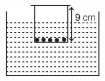
A wide bottom cylindrical massless plastic container of height $9 \,cm$ has $40$ identical coins inside it and is floating on water with $3 \,cm$ inside the water. If we start putting more of such coins on its lid, it is observed that after $N$ coins are put, its equilibrium changes from stable to unstable. Equilibrium in floating is stable if the geometric centre of the submerged portion is above the centre of the mass of the object). The value of $N$ is closed to
  • A
    $6$
  • $10$
  • C
    $16$
  • D
    $24$

Answer

Correct option: B.
$10$
b
(b)

Let $m$ be the mass of each coin. The centre of mass on $N$ coins kept on lid is

$CM =\frac{40 m \times 0+N m \times 9}{(40+N) m}=\frac{9 N}{N+40} \,cm$

The geometric centre of submerged part after keeping $N$ coins will be

$GC =\frac{3(40+N)}{40} \,cm$

For equilibrium, $CM = GC$

$\Rightarrow \quad \frac{9 N}{N+40}=\frac{(40+N) 3}{40}$

$\Rightarrow 3 N^2-480 N+4800=0$

This gives, $N=10.72$, which is closed to $10$ .

Need a full question paper?

Generate a complete, print-ready paper with questions like this in minutes — across 16+ boards, with answer keys.

Start Generating Free

Similar questions

Which of the following group have different dimension
The speed of sound in a gas is $v$. The $\text{rms}$ speed of molecules of this gas is $C.$ If $\gamma=\frac{\text{C}_{\text{p}}}{\text{C}_{\text{v}}},$ then the ratio of $v$ and $C$ is:
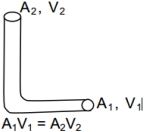
A liquid enter at point $A_{1}$ with speed $3.5 m / s$ and leaves at point $A _{2} .$ Then find out the height attained by the liquid above point $A _{2}$ (in $cm$)
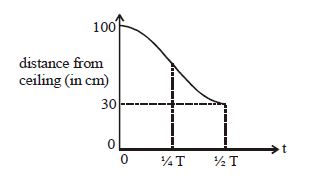
A spring hangs vertically from the ceiling and a mass is attached to its free end. When the mass is pulled down and released, it oscillates vertically with simple harmonic motion of period $T$ . The variation with time $t$ of its distance from the ceiling is as shown. Which statement gives a correct deduction from this graph?
A $1000\,\, kg$ elevator rises from rest in the basement to the fourth floor, a distance of $20\,\, m$. As it passes the fourth floor its speed is $4\,m/sec$. There is a constant frictional force of $500\, N$. The work done by the lifting mechanism is
Measure of two quantities along with the precision of respective measuring instrument  $A = 2.5\,m{s^{ - 1}} \pm 0.5\,m{s^{ - 1}}$, $B = 0.10\,s \pm 0.01\,s$ The value of $AB$ will be
The displacement and the increase in the velocity of a moving particle in the time interval of $t$ to $(t+1) \mathrm{s}$ are $125 \mathrm{~m}$ and $50 \mathrm{~m} / \mathrm{s}$, respectively. The distance travelled by the particle in $(\mathrm{t}+2)^{\mathrm{th}} \mathrm{s}$ is__________ $\mathrm{m}$.
If $R$ is the radius of the earth and $g$ the acceleration due to gravity on the earth's surface, the mean density of the earth is
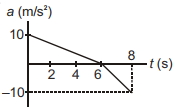
The acceleration-time graph for a particle moving along $x$-axis is shown in figure. If the initial velocity of particle is $-5 \,m / s$, the velocity at $t=8 \,s$ is ....... $m / s$
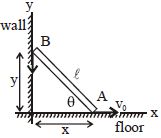
A rigid rod is sliding. At some instant position of the rod is as shown in the figure. End $A$ has constant velocity $v_0$. At $t = 0, y = l$ .