Question
A wind-powered generator converts wind energy into electrical energy. Assume that the generator converts a fixed fraction of the wind energy intercepted by its blades into electrical energy. For wind speed $v$, the electrical power output will be most likely proportional to
Answer

Power $=\mathrm{F} \bullet \mathrm{v}=\mathrm{Fv} F=v\left(\frac{d m}{d t}\right)=v\left\{\frac{d(\rho \times \text {volume})}{d t}\right\}$

$=\rho v\left\{\frac{d(v o l u m e)}{d t}\right\}=\rho v(A v)=\rho A v^{2} \therefore$ Power $P=\rho A v^{3} \quad$ or $P=v^{3}$

Need a full question paper?

Generate a complete, print-ready paper with questions like this in minutes — across 16+ boards, with answer keys.

Start Generating Free

Similar questions

A closed vessel contains $10 g$ of an ideal gas $X$ at $300 \ K$, which exerts $2$ atm pressure. At the same temperature, $80 g$ of another ideal gas $Y$ is added to it and the pressure becomes $6 atm$. The ratio of root mean square velocities of $X$ and $Y$ at $300 \ K$ is
Assuming the nitrogen molecule is moving with $r.m.s.$ velocity at $400\, K$, the de$-$Broglie wavelength of nitrogen molecule is close to$......\mathring {A}$

(Given : nitrogen molecule weight :

$4.64 \times 10^{-26}\, kg ,$ Boltzman constant :

$1.38 \times 10^{-23}\, J / K ,$ Planck constant :

$\left.6.63 \times 10^{-34}\, J . s \right)$

Light rays from a source are incident on a glass prism of index of refraction $\mu $ and angle of prism $\alpha $. At near normal incidence, the angle of deviation of the emerging rays is
Two resistances are connected in two gaps of a meter bridge. The balance point is $20\, cm$ from the zero end. A resistance of $15\, ohms$ is connected in series with the smaller of the two. The null point shifts to $40\, cm$. The value of the smaller resistance in $ohms$ is
A huge circular arc of length $4.4$ $ly$ subtends an angle $'4 {s}'$ at the centre of the circle. How long it would take for a body to complete $4$ revolution if its speed is $8 \;AU\;per\, second \;?$

Given : $1\, {ly}=9.46 \times 10^{15} \,{m},$ $\, {AU}=1.5 \times 10^{11}\, {m}$

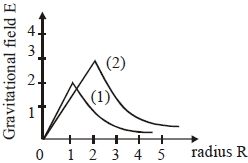
Consider two solid spheres of radii $\mathrm{R}_{1}=1 \;\mathrm{m}$ $\mathrm{R}_{2}=2\; \mathrm{m}$ and masses $\mathrm{M}_{1}$ and $\mathrm{M}_{2},$ respectively. The gravitational field due to sphere $(1)$ and $(2)$ are shown. The value of $\frac{\mathrm{M}_{1}}{\mathrm{M}_{2}}$ is
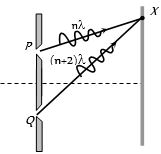
The figure shows a double slit experiment $P$ and $Q$ are the slits. The path lengths $PX $ and $ QX $ are $n\lambda $ and $(n + 2)\lambda $ respectively, where $n $ is a whole number and $\lambda $ is the wavelength. Taking the central fringe as zero, what is formed at $X$
A tunnel is dug along the diameter of earth of mass $'M'$ and then a mass $'m'$ is released a distance $'X'$ from centre so that the time period of oscillation is $T$ . If mass $'4m'$ is released from same point then time period of oscillation will be 
In Young's double slit experiment, the two slits act as coherent sources of equal amplitudeAand wavelength $\lambda$ . In another experiment with the same setup the two slits are sources of equal amplitudeAand wavelength $\lambda$ but are incoherent. The ratio of the intensity of light at the midpoint of the screen in the first case to that in the second case is
The density of a material $A$ is $1500 kg/m^3$ and that of another material $B$ is $2000 kg/m^3$. It is found that the heat capacity of $8$ volumes of $A$ is equal to heat capacity of $12$ volumes of $B$. The ratio of specific heats of $A$ and $B$ will be