MCQ
A wire can sustain the weight of 20kg before breaking. If the wire is cut into two equal parts, each part can sustain a weight of.
  • A
    10kg
  • 20kg
  • C
    40kg
  • D
    80kg.

Answer

Correct option: B.
20kg
As the wire is cut into two equal parts, both have equal cross-sectional areas. Therefore, a weight of 20kg exerts a force of 20g on both the pieces Breaking stress depends upon the material of the wire.
Since 20g of force is exerted on wires with equal cross-sectional areas, both the wires can sustain a weight of 20kg.

Need a full question paper?

Generate a complete, print-ready paper with questions like this in minutes — across 16+ boards, with answer keys.
Start Generating Free

Similar questions

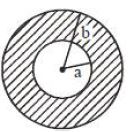
A circular disc of radius $b$ has a hole of radius $a$ at its centre (see figure). If the mass per unit area of the disc varies as $\left( {\frac{{{\sigma _0}}}{r}} \right)$, then the radius of gyration of the disc about its axis passing through the centre is
The motion of a particle represented by $y\ =$ $\sin \omega t - \cos \omega t$ is
Abody is moving uni-directionally under the influence of a source of constant power. Its displacement in time $t$ is proportional to
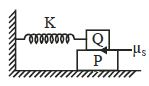
A block $P$ of mass $m$ is placed on a smooth horizontal surface. A block $Q$ of same mass is placed over the block $P$ and the coefficient of static friction between them is ${\mu _S}$. A spring of spring constant $K$ is attached to block $Q$. The blocks are displaced together to a distance $A$ and released. The upper block oscillates without slipping over the lower block. The maximum frictional force between the block is
A stationary object at $4°C$ and weighing $3.5\, kg$ falls from a height of $2000\, m$ on a snow mountain at  $0°C$. If the temperature of the object just before hitting the snow is $0°C$ and the object comes to rest immediately $(g = 10\,m/{s^2})$ and (latent heat of ice$ = 3.5 \times {10^5}\,joule/\sec $), then the object will melt
A point particle is held on the axis of a ring of mass $m$ and radius $r$ at a distance $r$ from its centre $C$. When released, it reaches $C$ under the gravitational attraction of the ring. Its speed at $C$ will be
In $\text{SHM:}$
The motion of a particle is described by the equation $x = a + b{t^2}$ where $a = 15\, cm$ and $b = 3 \,cm/s^2$. Its instantaneous velocity at time $3\, sec$ will be........$cm/sec$
The masses and radii of the earth and moon are ${M_1},\,{R_1}$ and ${M_2},\,{R_2}$ respectively. Their centres are distance d apart. The minimum velocity with which a particle of mass $m$ should be projected from a point midway between their centres so that it escapes to infinity is
Dimensional formula of specific heat capacity is: