MCQ
A wire having a linear mass density $9.0 \times 10^{-4} \;{kg} / {m}$ is stretched between two rigid supports with a tension of $900\; {N}$. The wire resonates at a frequency of $500\;{Hz}$. The next higher frequency at which the same wire resonates is $550\; {Hz}$. The length of the wire is $...... {m}$
  • A
    $50$
  • B
    $100$
  • $10$
  • D
    $2$

Answer

Correct option: C.
$10$
c
$\mu=9.0 \times 10^{-4}\, \frac{{kg}}{{m}}$

${T}=900\, {N}$

${V}=\sqrt{\frac{{T}}{\mu}}=\sqrt{\frac{900}{9 \times 10^{-4}}}=1000 \,{m} / {s}$

${f}_{1}=500 \,{Hz}$

${f}=550$

$\frac{{nV}}{2 \ell}=500 \ldots . \text { (i) }$

$\frac{({n}+1) {V}}{2 \ell}=500 \ldots(ii)$

$(ii)\, (i)$ $\frac{{V}}{2 \ell}=50$

$\ell=\frac{1000}{2 \times 50}=10$

Need a full question paper?

Generate a complete, print-ready paper with questions like this in minutes — across 16+ boards, with answer keys.

Start Generating Free

Similar questions

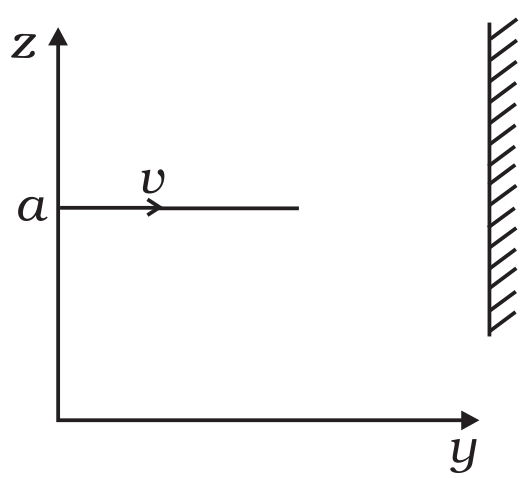
A particle of mass $m$ is moving in $yz-$plane with a uniform velocity $v$ with its trajectory running parallel to $+ve\ y-$axis and intersecting $z-$axis at $z = a.$ The change in its angular momentum about the origin as it bounces elastically from a wall at $y =$ constant is:
A stone tied to $180 cm$ long string at its end is making 28 revolutions in horizontal circle in every minute. The magnitude of acceleration of stone is $\frac{1936}{ x }\,ms ^{-2}$. The value of $x.........\left(\text { Take } \pi=\frac{22}{7}\right)$
Heat is being supplied at a constant rate to the sphere of ice which is melting at the rate of $0.1 \,gm / s$. It melts completely in $100 \,s$. The rate of rise of temperature thereafter will be ............ $^{\circ} C / s$
Consider the following statements.
$A.$ The coefficient of linear expansion has dimension $K^{-1}$.
$B.$ The coefficient of volume expansion has dimension $K^{-1}$.
$K$ is the force constant of a spring. The work done in increasing its extension from ${l_1}$ to ${l_2}$ will be
Woollen clothes are used in winter season because woolen clothes
A body is thrown at angle $30^{\circ}$ to the horizontal with the velocity of $30\; m / s$. After $1\;sec$, its velocity will be (in $m/s$) $\left(g=10\; m / s ^{2}\right)$
In a stationary wave,
  1. All the particles of the medium vibrate in phase.
  2. All the antinodes vibrate in phase.
  3. The alternate antinodes vibrate in phase.
  4. All the particles between consecutive nodes vibrate in phase.
The Mean Free Path $\ell$ for a gas molecule depends upon diameter, $d$ of the molecule as
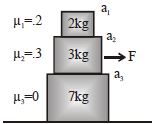
Find the acceleration of $a_1, a_2$ and $a_3$. If $10\,N$ force $F$ is applied on $3\,kg$ block :-