MCQ
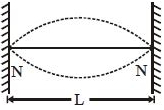
A wire is stretched between two rigid supports vibrates in its fundamental mode with a frequency of $50\,\, Hz$ . The mass of the wire is $30\,\, g$ and its linear density is $4\, \times \, 10^{-2}\,\, kg/m$ . The speed of the transverse wave at the string is  ...... $ms^{-1}$
  • A
    $25$
  • B
    $50$
  • $75$
  • D
    $100$

Answer

Correct option: C.
$75$
c
Here, mass of the wire, $M=30 \mathrm{\,g}=30 \times 10^{-3} \mathrm{\,kg}$

Mass per unit length of the wire.

$\mu=4 \times 10^{-2} \mathrm{\,kg} \mathrm{m}^{-1}$

$\therefore $ length of the wire, $L=\frac{M}{\mu}$

$=\frac{30 \times 10^{-3} \mathrm{\,kg}}{4 \times 10^{-2} \mathrm{\,kgm}^{-1}}=0.75 \mathrm{\,m}$

For the fundamental mode $\frac{\lambda}{2}=L$

$\Rightarrow \lambda=2 \mathrm{L}=2 \times 0.75=1.5 \mathrm{\,m}$

Speed of the transverse wave.

$\mathrm{v}=\mathrm{n} \lambda=\left(50 \mathrm{\,s}^{-1}\right)(1.5 \mathrm{\,m})=75 \mathrm{\,ms}^{-1}$

Need a full question paper?

Generate a complete, print-ready paper with questions like this in minutes — across 16+ boards, with answer keys.

Start Generating Free

Similar questions

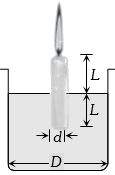
A candle of diameter $ d$ is floating on a liquid in a cylindrical container of diameter $D $  $(D>>d)$  as shown in figure. If it is burning at the rate of $2$ cm/hour then the top of the candle will
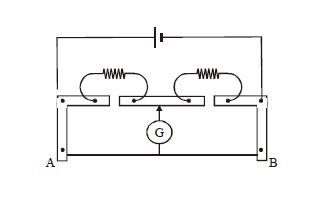
A meter bridge set up as shown to determine end correction at $A$ and $B$. When a resistance of $15\ \Omega$ is used in left gap and of $20\ \Omega$ in right gap, then null point comes at a distance $42\ cm$ from $A$. When these resistances are interchanged null point comes at a distance $57\ cm$ from $A$. Values of end corrections are
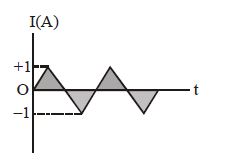
An alternating current of frequency $200\,rad/sec$ and peak value $1\,A$ as shown in the figure, is applied to the primary of a transformer. If the coefficient of mutual induction between the primary and the secondary is $1.5\,H$ , the voltage induced in the secondary will be.....$V$
A student performs an experiment of measuring the thickness of a slab with a vernier calliper whose $50$ divisions of the vernier scale are equal to $49$ divisions of the main scale. He noted that zero of the vernier scale is between $7.00\; cm$ and $7.05 \;cm$ mark of the main scale and $23^rd$ division of the vernier scale exactly coincides with the main scale. The measured value of the thickness of the given slab using the calliper will be
When a particle of mass $m$ moves on the $x$-axis in a potential of the form $V(x)=\mathrm{kx}^2$ it performs simple harmonic motion. The corresponding time period is proportional to $\sqrt{\frac{\mathrm{m}}{\mathrm{k}}}$, as can be seen easily using dimensional analysis. However, the motion of a particle can be periodic even when its potential energy increases on both sides of $\mathrm{x}=0$ in a way different from $\mathrm{kx}^2$ and its total energy is such that the particle does not escape to infinity. Consider a particle of mass $\mathrm{m}$ moving on the $x$-axis. Its potential energy is $V(x)=\alpha x^4(\alpha>0)$ for $|x|$ near the origin and becomes a constant equal to $\mathrm{V}_0$ for $|x| \geq X_0$ (see figure). $Image$

$1.$ If the total energy of the particle is $E$, it will perform periodic motion only if

$(A)$ $E$ $<0$ $(B)$ $E$ $>0$ $(C)$ $\mathrm{V}_0 > \mathrm{E}>0$ $(D)$ $E > V_0$

$2.$ For periodic motion of small amplitude $\mathrm{A}$, the time period $\mathrm{T}$ of this particle is proportional to

$(A)$ $\mathrm{A} \sqrt{\frac{\mathrm{m}}{\alpha}}$ $(B)$ $\frac{1}{\mathrm{~A}} \sqrt{\frac{\mathrm{m}}{\alpha}}$ $(C)$ $\mathrm{A} \sqrt{\frac{\alpha}{\mathrm{m}}}$ $(D)$ $\mathrm{A} \sqrt{\frac{\alpha}{\mathrm{m}}}$

$3.$ The acceleration of this particle for $|\mathrm{x}|>\mathrm{X}_0$ is

$(A)$ proportional to $\mathrm{V}_0$

$(B)$ proportional to $\frac{\mathrm{V}_0}{\mathrm{mX}_0}$

$(C)$ proportional to $\sqrt{\frac{\mathrm{V}_0}{\mathrm{mX}_0}}$

$(D)$ zero

Give the answer qustion $1,2$ and $3.$

A telescope has an objective lens of focal length $ 200 \,cm$ and an eye piece with focal length $2 \,cm$. If this telescope is used to see a $50$ meter tall building at a distance of $2 \,km$, what is the height of the image of the building formed by the objective lens......$cm$
A circular loop of radius $0.3\,cm$ lies parallel to a much bigger circular loop of radius $20\,cm$. The centre of the smaller loop is on the axis of the bigger loop. The distance between their centres is $15\,cm$. If a current of $2.0\,A$ flows through the smaller loop, then the flux linked with bigger loop $.............\times 10^{-11} weber$
Three long straight wires are connected parallel to each other across a battery of negligible internal resistance. The ratio of their resistances are $3 : 4 : 5$. What is the ratio of distances of middle wire from the others if the net force experienced by it is zero
For a real object, which of the following can produced a real image
At curie point, a ferro magnetic material becomes