A wire is suspended by one end. At the other end a weight equivalent to $20\, N$ force is applied. If the increase in length is $1.0\, mm,$ the ratio of the increase in energy of the wire to the decrease in gravitational potential energy when load moves downwards by $1\, mm,$ will be
Medium


Download our appand get started for free
Experience the future of education. Simply download our apps or reach out to us for more information. Let's shape the future of learning together!No signup needed.*
Similar Questions
- 1In a wire of length $L,$ the increase in its length is $l.$ If the length is reduced to half, the increase in its length will beView Solution
- 2A rubber pipe of density $1.5 \times {10^3}\,N/{m^2}$ and Young's modulus $5 \times {10^6}\,N/{m^2}$ is suspended from the roof. The length of the pipe is $8 \,m$. What will be the change in length due to its own weightView Solution
- 3A steel wire of length ' $L$ ' at $40^{\circ}\,C$ is suspended from the ceiling and then a mass ' $m$ ' is hung from its free end. The wire is cooled down from $40^{\circ}\,C$ to $30^{\circ}\,C$ to regain its original length ' $L$ '. The coefficient of linear thermal expansion of the steel is $10^{-5} { }^{\circ}\,C$, Young's modulus of steel is $10^{11}\, N /$ $m ^2$ and radius of the wire is $1\, mm$. Assume that $L \gg $ diameter of the wire. Then the value of ' $m$ ' in $kg$ is nearlyView Solution
- 4A string of area of cross-section $4\,mm ^{2}$ and length $0.5$ is connected with a rigid body of mass $2\,kg$. The body is rotated in a vertical circular path of radius $0.5\,m$. The body acquires a speed of $5\,m / s$ at the bottom of the circular path. Strain produced in the string when the body is at the bottom of the circle is $\ldots . . \times 10^{-5}$. (Use Young's modulus $10^{11}\,N / m ^{2}$ and $g =10\,m / s ^{2}$ )View Solution
- 5Work done by restoring force in a string within elastic limit is $-10 \,J$. Maximum amount of heat produced in the string is .......... $J$View Solution
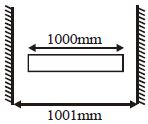
- 6$A$ rod of length $1000\, mm$ and coefficient of linear expansion $a = 10^{-4}$ per degree is placed symmetrically between fixed walls separated by $1001\, mm$. The Young’s modulus of the rod is $10^{11} N/m^2$. If the temperature is increased by $20^o C$, then the stress developed in the rod is ........... $MPa$View Solution
- 7When load of $5\,kg$ is hung on a wire then extension of $3\,m$ takes place, then work done will be ....... $joule$View Solution
- 8View SolutionWhen a spiral spring is stretched by suspending a load on it, the strain produced is called
- 9View SolutionWhich of the following statements is correct
- 10A copper wire of length $4.0m$ and area of cross-section $1.2\,c{m^2}$ is stretched with a force of $4.8 \times {10^3}$ $N.$ If Young’s modulus for copper is $1.2 \times {10^{11}}\,N/{m^2},$ the increase in the length of the wire will beView Solution