MCQ
A wire of length $2m$ is made from $10\ cm^3$ of copper. A force $F$ is applied so that its length increases by $2\ mm.$ Another wire of length $8m$ is made from the same volume of copper. If the force $F$ is applied to it, its length will increase by:
  • A
    $0.8\ cm$
  • B
    $1.6\ cm$
  • C
    $2.4\ cm$
  • $3.2\ cm$

Answer

Correct option: D.
$3.2\ cm$

Need a full question paper?

Generate a complete, print-ready paper with questions like this in minutes — across 16+ boards, with answer keys.

Start Generating Free

Similar questions

Two capillary of length $L $ and $2L$  and of radius $R$  and $2R$  are connected in series. The net rate of flow of fluid through them will be (given rate of the flow through single capillary, $X = \pi P{R^4}/8\eta L)$
What is the ratio of specific heats for a diatomic gas?
A cylindrical block of wood (density $= 650\, kg\, m^{-3}$), of base area $30\,cm^2$ and height $54\, cm$, floats in a liquid of density $900\, kg\, m^{-3}$ . The block is depressed slightly and then released. The time period of the resulting oscillations of the block would be equal to that of a simple pendulum of length ..... $cm$ (nearly)
Three particles each of mass $m$ are kept at vertices of an equilateral triangle of side $L.$ Th gravitational potential energy possessed by the system is:
The rotation of earth about its axis is:
  1. Periodic motion.
  2. Simple harmonic motion.
  3. Periodic but not simple harmonic motion.
  4. Non$-$periodic motion.
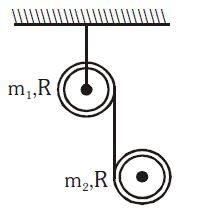
In the given figure linear acceleration of solid cylinder of mass $m_2$ is $a_2$. Then angular acceleration $\alpha_2$ is (given that there is no slipping).
Find the amount of work done to increase the temperature of one mole of an ideal gas by $30^o\ C$ if it is expanding under the condition  .... $J$

$V\propto {T^{\frac{2}{3}}}$ $[R = 1.99\  cal/mol-K]$

Two water pipes $P$ and $Q$ having diameter $2 \times 10^{-2} \,m$ and $4 \times 10^{-2} \,m$ respectively are joined in series with the main supply line of water. The velocity of water flowing in pipe $P$ is ........
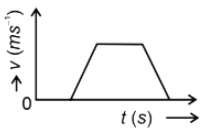
The velocity $(v)-$ time $(t)$ plot of the motion of a body is shown below:

(image)

The acceleration $(a)-$ time $(t)$ graph that best suits this motion is :

A wire of length $L$ and cross-sectional area $A$ is made of a material of Young's modulus $Y.$ It is stretched by an amount $x$. The work done is