A wire of length $5\,m$ and radius $1\,mm$ has a resistance of $1\, ohm$. What length of the wire of the same material at the same temperature and of radius $2\,mm$ will also have a resistance of $1\, ohm$ .............. $m$
Easy


Download our appand get started for free
Experience the future of education. Simply download our apps or reach out to us for more information. Let's shape the future of learning together!No signup needed.*
Similar Questions
- 1View SolutionWhich device can convert all electrical energy into heat
- 2$n$ identical bulbs, each designed to draw a power $p$ from a certain voltage supply, are joined in series across that supply. The total power which they will draw isView Solution
- 3If the balance point is obtained at the $35^{th} cm$ in a meter bridge the resistances in the left and right gaps are in the ratio ofView Solution
- 4A potential difference of $V$ is applied at the ends of a copper wire of length $l$ and diameter $d$. On doubling only $d$, drift velocityView Solution
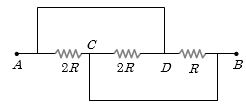
- 5What is the equivalent resistance between $A$ and $B$View Solution
- 6Two cells of $emfs$ $E_1$ and $E_2$ and internal resistances $r_1$ and $r_2$ are connected in parallel. The $emf$ and internal resistance of the equivalent source isView Solution
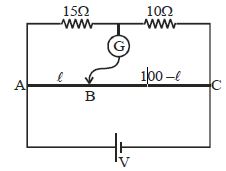
- 7In the meter bridge shown, the length $AB$ for which the deflection in galvanometer is zero will be ............. $cm$View Solution
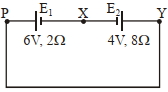
- 8A cell $E _{1}$ of $emf 6 V$ and internal resistance $2 \Omega$ is connected with another cell $E _{2}$ of $emf 4 V$ and internal resistance $8 \Omega$ (as shown in the figure). The potential difference across points $X$ and $Y$ is............ $V$View Solution
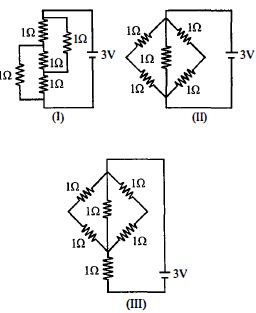
- 9The figure shows three circuits $I, II$ and $III$ which are connected to a $3\,V$ battery. If the powers dissipated by the configurations $I, II$ and $III$ are $P_1 , P_2$ and $P_3$ respectively, thenView Solution
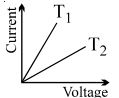
- 10The current in a metallic conductor is plotted against voltage at two different temperatures $T_1$ and $T_2$. Which is correctView Solution