A wire of length $L$ and radius $r$ is clamped rigidly at one end. When the other end of the wire is pulled by a force $f$, its length increases by $l$. Another wire of same material of length $2 L$ and radius $2 r$ is pulled by a force $2 f$. Then the increase in its length will be
JEE MAIN 2023, Medium
Download our app for free and get started
$\frac{2 f }{\pi(2 r )^2}= Y \frac{\ell^{\prime}}{2 L }$
$\Rightarrow \frac{2}{1}=\frac{2 \ell^{\prime}}{\ell} \Rightarrow \ell^{\prime}=\ell$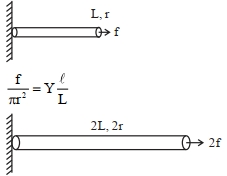

Download our appand get started for free
Experience the future of education. Simply download our apps or reach out to us for more information. Let's shape the future of learning together!No signup needed.*
Similar Questions
- 1The work done in increasing the length of a $1$ $metre$ long wire of cross-section area $1\, mm^2$ through $1\, mm$ will be ....... $J$ $(Y = 2\times10^{11}\, Nm^{-2})$View Solution
- 2A steel rod of length $1\,m$ and cross sectional area $10^{-4}\,m ^2$ is heated from $0^{\circ}\,C$ to $200^{\circ}\,C$ without being allowed to extend or bend. The compressive tension produced in the rod is $........\times 10^4\,N$ (Given Young's modulus of steel $=2 \times 10^{11}\,Nm ^{-2}$, coefficient of linear expansion $=10^{-5}\, K ^{-1}$.View Solution
- 3The relation between $\gamma ,\,\eta $ and $K$ for a elastic material isView Solution
- 4View SolutionShearing stress causes change in
- 5View SolutionThe longitudinal strain is only possible in
- 6A copper wire of length $4.0m$ and area of cross-section $1.2\,c{m^2}$ is stretched with a force of $4.8 \times {10^3}$ $N.$ If Young’s modulus for copper is $1.2 \times {10^{11}}\,N/{m^2},$ the increase in the length of the wire will beView Solution
- 7Two wire $A$ and $B$ are stretched by same force. If, for $A$ and $B, Y_A: Y_B=1: 2, r_A: r_B=3: 1$ and $L_A: L_B=4: 1$, then ratio of their extension $\left(\frac{\Delta L_A}{\Delta L_B}\right)$ will be .............View Solution
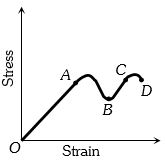
- 8View SolutionA graph is shown between stress and strain for a metal. The part in which Hooke's law holds good is
- 9An Indian rubber cord $L$ metre long and area of cross-section $A$ $metr{e^2}$ is suspended vertically. Density of rubber is $D$ $kg/metr{e^3}$ and Young's modulus of rubber is $E$ $newton/metr{e^2}$. If the wire extends by $l$ metre under its own weight, then extension $l$ isView Solution
- 10The breaking stress of a wire of length $L$ and radius $r$ is $5$ $kg - wt/{m^2}$. The wire of length $2l$ and radius $2r$ of the same material will have breaking stress in $kg - wt/{m^2}$View Solution