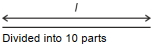
A wire of length ' $r$ ' and resistance $100 \Omega$ is divided into $10$ equal parts. The first $5$ parts are connected in series while the next $5$ parts are connected in parallel. The two combinations are again connected in series. The resistance of this final combination is:
NEET 2024, Medium


Download our appand get started for free
Experience the future of education. Simply download our apps or reach out to us for more information. Let's shape the future of learning together!No signup needed.*
Similar Questions
- 1$A$ constant voltage is applied between the two ends of a uniform metallic wire. Some heat is developed in it. The heat developed is doubled ifView Solution
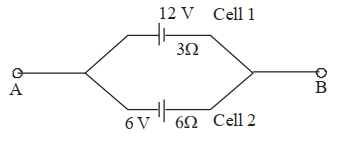
- 2Two cells are connected between points $A$ and $B$ as shown. Cell $1$ has emf of $12\,V$ and internal resistance of $3\,\Omega$. Cell $2$ has emf of $6\,V$ and internal resistance of $6\,\Omega$. An external resistor $R$ of $4\,\Omega$ is connected across $A$ and $B$. The current flowing through $R$ will be $.............A$.View Solution
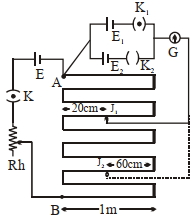
- 3In the given circuit of potentiometer, the potential difference $E$ across $AB$ ( $10\, m$ length) is larger than $E _{1}$ and $E _{2}$ as well. For key $K _{1}$ (closed), the jockey is adjusted to touch the wire at point $J_{1}$ so that there is no deflection in the galvanometer. Now the first battery $\left( E _{1}\right)$ is replaced by second battery $\left( E _{2}\right)$ for working by making $K _{1}$ open and $K _{2}$ closed. The galvanometer gives then null deflection at $J _{2}$. The value of $\frac{ E _{1}}{ E _{2}}$ is $\frac{ a }{ b },$ where $a =$ ...............View Solution
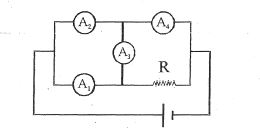
- 4Four ammeters with identical internal resistance $r$ and a resistor $R$ are connected to a current source as given. if reading of $A_1$ and $A_2$ is $3\ A$ and $5\ A$ respectively then the reading $A_4$ is ............. $A$View Solution
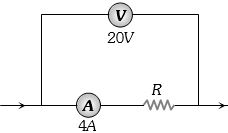
- 5In the diagram shown, the reading of voltmeter is $20\, V$ and that of ammeter is $4\, A$. The value of $R$ should be (Consider given ammeter and voltmeter are not ideal)View Solution
- 6A copper wire has a square cross-section, $2.0\, mm$ on a side. It carries a current of $8\, A$ and the density of free electrons is $8 \times {10^{28}}\,{m^{ - 3}}$. The drift speed of electrons is equal toView Solution
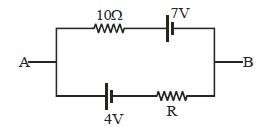
- 7In the following circuit if $V_A -V_B = 6\,V$ then the value of resistance $R$ (in $ohm$) is ............... $\Omega$View Solution
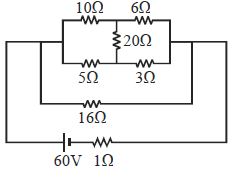
- 8The current from the cell for the given circuit is ................ $\mathrm{A}$View Solution
- 9The resistance of a wire is $R$. It is bent at the middle by $180^o$ and both the ends are twisted together to make a shorter wire. The resistance of the new wire isView Solution
- 10You are given three bulbs of $25$, $40$ and $60\, watt$. Which of them has lowest resistanceView Solution