A wire of resistance $R_{1}$ is drawn out so that its length is increased by twice of its original length.The ratio of new resistance to original resistance is.
JEE MAIN 2022, Easy
Download our app for free and get started
$R _{1}=\rho \frac{ L _{1}}{ A _{1}}$
$R _{2}=\rho\left(\frac{3 L _{1}}{ A _{1} / 3}\right)=9 \rho \frac{ L _{1}}{ A _{1}}$
$\therefore \frac{ R _{2}}{R _{1} }=9$

Download our appand get started for free
Experience the future of education. Simply download our apps or reach out to us for more information. Let's shape the future of learning together!No signup needed.*
Similar Questions
- 1Four equal resistance dissipated $5 \,W$ of power together when connected in series to a battery of negligible internal resistance. The total power dissipated in these resistance when connected in parallel across the same battery would be ........... $W$View Solution
- 2View SolutionAn electric heater kept in vacuum is heated continuously by passing electric current. Its temperature
- 3A wire $50\, cm$ long and $1\;mm^2$ in cross -section carries a current of $4\; A$ when connected to a $2\; V$ battery. The resistivity of the wire isView Solution
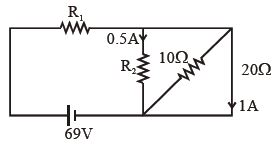
- 4In the circuit shown in the given figure the resistance $R_1$ and $R_2$ are respectivelyView Solution
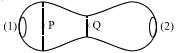
- 5Ametallic conductor of irregular cross-section is as shown in the figure. Aconstant potential difference is applied across the ends $(1)$ and $(2)$. Then :View Solution
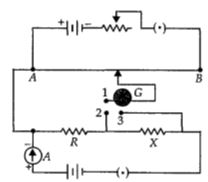
- 6A potentiometer circuit is set up as shown. The potential gradient, across the potentiometer wire, is $k$ $volt/cm$ and the ammeter, present in the circuit, reads $1.0\,\, A$ when two way key is switched off. The balance points, when the key between the terminals $(i)$ $1$ and $2$ $(ii)$ $1$ and $3,$ is plugged in, are found to be at lengths $l_1$ and $l_2$ respectively. The magnitudes, of the resistors $R$ and $X,$ in $ohms$, are then, equal, respectively, toView Solution
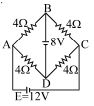
- 7The given figure shows $a$ network of resistances and $a$ battery. Which of the two batteries is getting charged?View Solution
- 8A $60\, watt$ bulb carries a current of $0.5\, amp$. The total charge passing through it in $1$ hour is ............ $coulomb$View Solution
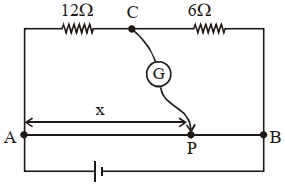
- 9Consider a $72\, cm$ long wire $AB$ as shown in the figure. The galvanometer jockey is placed at $P$ on $A B$ at a distance $x cm$ from $A$. The galvanometer shows zero deflection.View Solution
The value of $x,$ to the nearest integer, is ..... $cm$
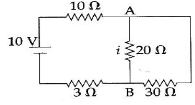
- 10In the electrical circuit shown in the figure, the current $i$ through the side $AB$ isView Solution