MCQ
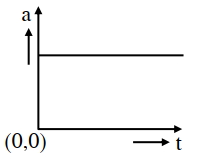
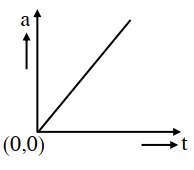
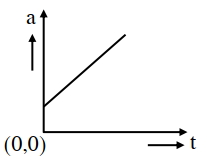
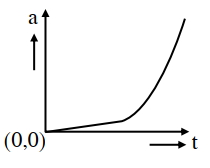
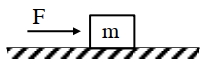
A wooden block, initially at rest on the ground, is pushed by a force which increases linearly with time $t$. Which of the following curve best describes acceleration of the block with time :
  • A


  • C

  • D

Answer

Correct option: B.

b
$\mathrm{F}=\mathrm{ma} \Rightarrow \mathrm{a}=\frac{\mathrm{F}}{\mathrm{m}}=\frac{\mathrm{kt}}{\mathrm{m}}$

a vs $t$ will be straight line passing through origin. Since option $(2)$.
Need a full question paper?

Generate a complete, print-ready paper with questions like this in minutes — across 16+ boards, with answer keys.

Start Generating Free

Similar questions

In a experiment to measure the height of a bridge by dropping a stone into water underneath, if the error in the measurement of times is $0.1\;s$ at the end of $2\;s$, then the error in the estimation of the height of the bridge will be
The correct statement of the law of equipartition of energy is:
A particle is dropped under gravity from rest from a height $h{\,}(g = 9.8\,m/{\sec ^2})$ and it travels a distance $9h/25$ in the last second, the height $h$ is......... $m$
Pick the correct options.
  1. All electrons have magnetic moment.
  2. All protons have magnetic moment.
  3. All nuclei have magnetic moment.
  4. All atoms have magnetic moment.
A transverse wave of amplitude $0.5\, m$ and wavelength $1\, m$ and frequency $2\, Hz$ is propagating in a string in the negative $x-$direction. The expression for this wave is
Heat energy of $184\,kJ$ is given to ice of mass $600\,g$ at $-12^{\circ}\,C$, Specific heat of ice is $2222.3\,J\,kg ^{-1^{\circ}}\,C ^{-1}$ and latent heat of ice in $336\,kJ / kg ^{-1}$

$(A)$ Final temperature of system will be $0^{\circ} C$.

$(B)$ Final temperature of the system will be greater than $0^{\circ} C$.

$(C)$ The final system will have a mixture of ice and water in the ratio of $5: 1$.

$(D)$ The final system will have a mixture of ice and water in the ratio of $1: 5$.

$(E)$ The final system will have water only.

Choose the correct answer from the options given below:
70 calories of heat are required to raise the temperature of 2 mole of an ideal gas at constant pressure from 30° C to 35° C. The amount of heat required to raise the temperature of the same gas through the same range at constant volume is:
  1. 30 calories.
  2. 50 calories.
  3. 70 calories.
  4. 90 calories.

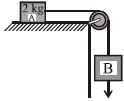
The coefficient of static friction, $\mu _s$ between block $A$ of mass $2\,kg$ and the table as shown in the figure is $0.2$. What would be the maximum mass value of block $B$ so that the two blocks $B$ so that the two blocks do not move? The string and the pulley are assumed to be smooth and masseless ....... $kg$ $(g = 10\,m/s^2)$
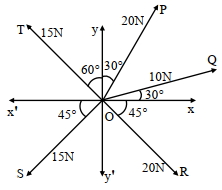
The resultant of these forces $\overrightarrow{O P}, \overrightarrow{O Q}, \overrightarrow{O R}, \overrightarrow{O S}$ and $\overrightarrow{{OT}}$ is approximately $\ldots \ldots {N}$.

[Take $\sqrt{3}=1.7, \sqrt{2}=1.4$ Given $\hat{{i}}$ and $\hat{{j}}$ unit vectors along ${x}, {y}$ axis $]$
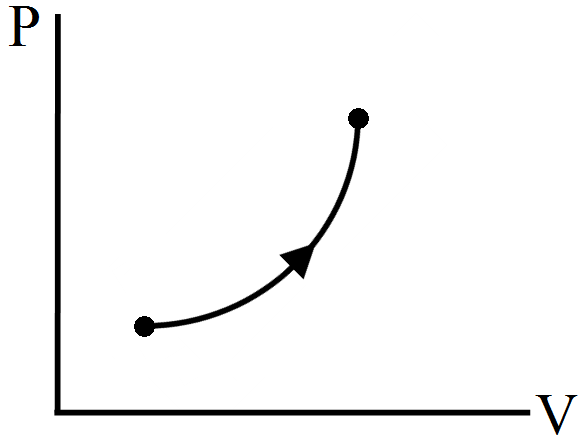
One mole of ideal gas goes through process $P= 2V^2/(1+V^2)\,Pa$ then change in temperature of gas when volume changes from $V= 1\,m^3$ to $2\,m^3$ is