MCQ
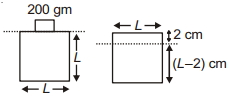
A wooden cube just floats inside water with a $200 \,gm$ mass placed on it. When the mass is removed, the cube floats with its top surface $2 \,cm$ above the water level. the side of the cube is ......... $cm$
  • A
    $6$
  • B
    $8$
  • $10$
  • D
    $12$

Answer

Correct option: C.
$10$
c
(c)

Mass $\times g=$ Volume of part of cube $\times \rho \times g$

$\Rightarrow 200 \times g=L^2\left(2 \times \rho_w \times g\right)$

$\Rightarrow 100=L^2 \quad\left\{\because \rho_w=1\right\}$

$\Rightarrow 10 \,cm =L$

From the two figures we can see that the $200 \,gm$ block is provided with required buoyant force but a part of cube which is afloat in $2^{\text {nd }}$ figure.
Need a full question paper?

Generate a complete, print-ready paper with questions like this in minutes — across 16+ boards, with answer keys.
Start Generating Free

Similar questions

Due to which property of water, tiny particles of camphor dance on the surface of water
An object moves at a constant speed along a circular path in a horizontal plane with centre at the origin. When the object is at $x =+2\,m$, its velocity is $-4 \hat{ j }\, m / s$. The object's velocity $(v)$ and acceleration $(a)$ at $x =-2\,m$ will be
If a particle is moving on a circular path with constant speed, then the angle between the direction of acceleration and its position vector w.r.t. centre of circle will be ............ 
The equation of motion of a projectile is $y = Ax -Bx^2$ where $A$ and $B$ are the constants of motion. The horizontal range of the projectile is
The expansion coefficients a, ẞ and y of a solid are related to its volume :
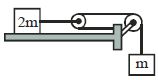
Consider the situation shown in figure. All the surfaces are smooth. The tension in the string connected to $2\,m$ is
A disc is rotating with angular velocity $\vec{\omega}$. A force $\vec{F}$ acts at a point whose position vector with respect to the axis of rotation is $\vec{r}$. The power associated with torque due to the force is given by ..........
Two loops $P$ and $Q$ are made from a uniform wire. The radii of $P$ and $Q$ are ${r_1}$ and ${r_2}$ respectively, and their moments of inertia are ${I_1}$ and ${I_2}$ respectively. If $\frac{{{l_2}}}{{{l_1}}}$ = $4$ then $\frac{{{r_2}}}{{{r_1}}}$ equals
A particle is moving such that its position coordinates $(x, y)$  are

$(2\, m, 3 \,m)$ at time $t = 0$

$(6\,m,7\,m) ,$ at time $ t=2 \,s$ and

$ (13\,m,14\,m),$ at $ t=5\,s$.

Average velocity vector $\vec v_{av}$ from $ t=0$ to $t= 5 $ is
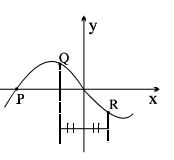
At a certain moment, the photograph of a string on which a harmonic wave is travelling to the right is shown. Then, which of the following is true regarding the velocities of the points $P, Q$ and $R$ on the string.