Question
A wool blanket keeps our body warm. By wrapping the same blanket over the ice, it keeps the ice cold. How would you explain this contradiction?

Answer

Wool is a bad conductor of heat. Apart from this, wool traps air inside it self and air is a bad conductor, hence no heat can be lost through convection. Woollen blanket keep the body warm by preventing heat loss from our body and hence our body remains warm.
In the case of ice, heat from outside is prevented from reaching the ice by the blanket and thus the ice remains cold.

Need a full question paper?

Generate a complete, print-ready paper with questions like this in minutes — across 16+ boards, with answer keys.
Start Generating Free

Similar questions

Give the geometrical meaning of $(i)$ scalar product $(ii)$ cross product of two vectors.
The charge on a proton is $+1.6 \times 10^{-19} \mathrm{C}$ and that on an electron is $-1.6 \times 10^{-19} \mathrm{C}$. Does it mean that the electron has a charge $3.2 \times 10^{-19} \mathrm{C}$ less than the charge of a proton?
In a head-on collision between two particles, is it necessary that the particles will acquire a common velocity at least for one instant?
What are the conditions under which a rocket fired from the earth, launches an artificial satellite of earth?
A particle starting from rest moves with constant acceleration. If it takes $5.0s$ to reach the speed $18.0km/h$ find:
  1. The average velocity during this period.
  2. The distance travelled by the particle during this period.
Is a 'single isolated force' possible in nature?
A body starts from rest and travels in straight line with a uniform acceleration of $5 \mathrm{~m} / \mathrm{s}^2$ for 5 seconds. What is the velocity and distance travelled in this time?
A two metre long tube contains $0.8 \times 10^3$ $kg / m ^3$ the tube is filled with a liquid of high density and is tilted and rested against a wall so that the vertical height of the upper surface of the liquid from the bottom of the tube remains 1.8 m . If the atmospheric pressure $1.01 \times 10^5 N / m ^2$ then find the total pressure at the bottom of the tube.
Why do real gases deviate from ideal gases in their behaviour?
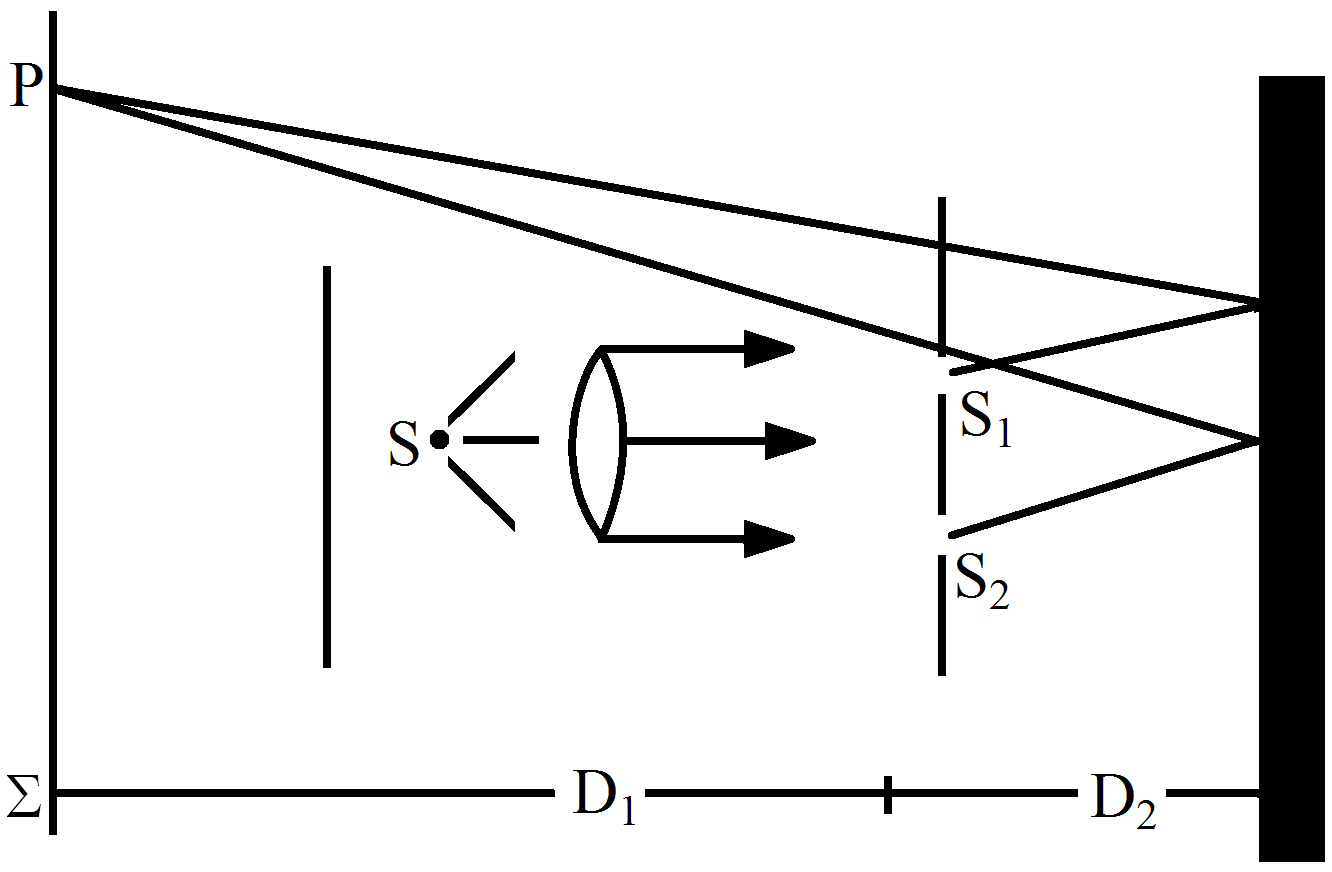
A double slit $S_1-S_2$ is illuminated by a coherent light of wavelength $\boldsymbol{\lambda}$. The slits are separated by a distance d . A plane mirror is placed in front of the double slit at a distance $D_1$ from it and a screen $\sum$ is placed behind the double slit at a distance $D_2$ from it (figure 17- $E_2$ ). The screen $E$ receives only the light reflected by the mirror. Find the fringewidth of the interference pattern on the screen.