MCQ
$A$ $\xrightarrow{{KOBr}}$ $CHBr_3$

Here $A$ is nothing but :

  • Isopropyl alcohol
  • B
    Methanol
  • C
    Ethanoic acid
  • D
    $n-$ Butyl alcohol

Answer

Correct option: A.
Isopropyl alcohol
a

Need a full question paper?

Generate a complete, print-ready paper with questions like this in minutes — across 16+ boards, with answer keys.

Start Generating Free

Similar questions

Transition element makes complex compound due to 
Which of the following compound have magnetic moment $\sqrt {15}\, B.M.$ ?
Complexes formed in the following methods are :

$(I)$ Mond's process for purification of nickel
$(II)$ Removal of unreacted $AgBr$ from photographic plate
$(III)$ Removal of lead poisoning from the body

$I$ $-$ $II$  $-$ $III$

Osmotic pressure of $0.1\,M$ aqueous solution of $MgCl_2$ at $300\,K$ is $4.92\,atm$. What will be the percentage ionization of the salt ? ........... $\%$
General formula for carbohydrates is
How many geometrical isomers are possible for complex $[Mab(AB)_2]^{n \pm}$ ?
$R - C{H_2} - C{H_2}OH$ can be converted into $RC{H_2}C{H_2}COOH.$ The correct sequence of the reagents is
Given below are two statements: one is labelled as Assertion $(A)$ and the other is labelled as Reason $(R)$. Assertion $(A)$: The total number of geometrical isomers shown by $\left[\mathrm{Co}(\mathrm{en})_2 \mathrm{Cl}_2\right]^{+}$complex ion is three

Reason $(R)$: $\left[\mathrm{Co}(\mathrm{en})_2 \mathrm{Cl}_2\right]^{+}$complex ion has an octahedral geometry.

In the light of the above statements, choose the most appropriate answer from the options given below :

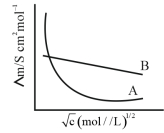
Following figure shows dependence of molar conductance of two electrolytes on concentration. $\Lambda \stackrel{0}{ m }$ is the limiting molar conductivity.The number of Incorrect statement(s) from the following is $...........$

$(A)$ $\Lambda \stackrel{0}{ m }$ for electrolyte $A$ is obtained by extrapolation

$(B)$ For electrolyte B, vx $\Lambda m$ vs $\sqrt{ c }$ graph is a straight line with intercept equal to $\Lambda \stackrel{0}{ m }$

$(C)$ At infinite dilution, the value of degree of dissociation approach zero for electrolyte $B$.

$(D)$ $\Lambda \stackrel{0}{ m }$ for any electrolyte $A$ or $B$ can be calculated using $\lambda^{\circ}$ for individual ions.
Phosphorus pentachloride in the solid exists as