Question
A Young's double slit experiment is performed with white light:

Answer

  1. The central fringe will be white.
  2. There will not be a completely dark fringe.
  1. The fringe next to the central will be violet.
Explanation:
The superposition of all the colours at the central maxima gives the central band a white colour. As we go from the centre to corner, the fringe colour goes from violet to red. There will not be a completely dark fringe, as complete destructive interference does not take place.

Need a full question paper?

Generate a complete, print-ready paper with questions like this in minutes — across 16+ boards, with answer keys.
Start Generating Free

Similar questions

The battery connections required to forward bias a pn junction are ____________:
Resistance of the conductor depends upon:
Magnetic effect of current was discovered by(a) Faraday(b) Oersted(c) Ampere(d) Bohr
       
An unknown resistance $R_1$ is connected in series with a resistance of $10 W$. This combinations is connected to one gap of a metre bridge while a resistance $R_2$ is connected in the other gap. The balance point is at $50 \ cm$. Now, when the $10 W$ resistance is removed the balance point shifts to $40 \ cm$. The value of $R_1$ is $($in $ohm)$
Hysterisis is the phenomenon of lagging of:
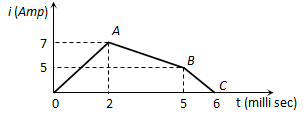
The current through a $4.6 H$ inductor is shown in the following graph. The induced emf during the time interval $t = 5\ \ce{milli-sec}$ to $6\ \ce{milli-sec}$ will be
Which of the following will change the time period as they are taken to moon?
  1. A simple pendulum.
  2. A physical pendulum.
  3. A torsional pendulum.
  4. A spring-mass system.
Ray optics fails when(a) The size of the obstacle is 5 cm(b) The size of the obstacle is 3 cm(c) The size of the obstacle is less than the wavelength of light(d) (a) and (b) both


Young’s double slit experiment is performed with light of wavelength 550 nm. The separation between the slits is 1.10 mm and screen is placed at distance of 1 m. What is the distance between the consecutive bright or dark fringes (a) 1.5 mm(b) 1.0 mm(c) 0.5 mm(d) None of these
       
The magnetic susceptibility of any paramagnetic material changes with absolute temperature T as(a) Directly proportional to T(b) Remains constant(c) Inversely proportional to T(d) Exponentially decaying with T