Question
A Young's double slit experiment uses a monochromatic source. The shape of the interference fringes formed on a screen is (a) Straight line(b) Parabola(c) Hyperbola(d) Circle
       

Answer

(c) Hyperbola

Need a full question paper?

Generate a complete, print-ready paper with questions like this in minutes — across 16+ boards, with answer keys.
Start Generating Free

Similar questions

Two vertical plane mirrors are inclined at an angle of 60° with each other. A ray of light travelling horizontally is reflected first from one mirror and then from the other. The resultant deviation is(a) 60°(b) 120°(c) 180°(d) 240°
       
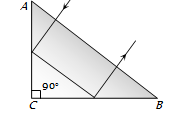
A ray of light incident normally on an isosceles right angled prism travels as shown in the figure. The least value of the refractive index of the prism must be
The coercivity of a small magnet where the ferromagnet gets demagnetized is $3 \times 10^3 Am^{–1}.$ The current required to be passed in a solenoid of length $10\ cm$ and number of turns $100,$ so that the magnet gets demagnetized when inside the solenoid, is:
The light of wavelength 6328 Å is incident on a slit of width 0.2 mm perpendicularly, the angular width of central maxima will be(a) 0.36°(b) 0.18 °(c) 0.72°  (d) 0.09°
       
Which color band in the resistor is having highest tolerance?
The electric flux on a Gaussian spherical surface of radius 15 cm, drawn with a point charge as the centre, is ф. If the radius of this surface is tripled, then the electric flux passing through the surface will be:
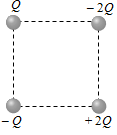
Four charges are placed on corners of a square as shown in figure having side of $5\ cm$. If $Q$ is one microcoulomb, then electric field intensity at centre will be
By properly combining two prisms made of different materials, it is possible to:
Assertion  : If the temperature of a semiconductor is increased then it's resistance decreases.
Reason      : The energy gap between conduction band and valence band is very small(a) If both assertion and reason are true and the reason is the correct explanation of the assertion.(b) If both assertion and reason are true but reason is not the correct explanation of the assertion.(c) If assertion is true but reason is false.(d) If the assertion and reason both are false.


Which is not true with respect to the cathode rays(a) A stream of electrons(b) Charged particles(c) Move with speed same as that of light(d) Can be deflected by magnetic fields