MCQ
A zero vector has:
  • Any direction
  • B
    No direction
  • C
    Many direction
  • D
    None of these

Answer

Correct option: A.
Any direction


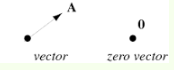
Zero vector, is a vector of length 0, and thus has all components equal to zero. It is the additive identity of the additive group of vectors.

Thus, it has zero magnitude and arbitrary direction.

Need a full question paper?

Generate a complete, print-ready paper with questions like this in minutes — across 16+ boards, with answer keys.
Start Generating Free

Similar questions

The number of arbitrary constants in the particular solution of a differential equation of third order is:
Let $f ( x )$ be a quadratic polynomial with leading coefficient $1$ such that $f(0)=p, p \neq 0$ and $f(1)=\frac{1}{3}$. If the equation $f(x)=0$ and $fofofof (x)=0$ have a common real root, then $f(-3)$ is equal to $........$
Let $f(x)=x^3$ be a function with domain $\{0,1,2,3\}$. Then domain of $f^{-1}$ is:
$f\left( x \right) = \int {\frac{{dx}}{{{{\sin }^6}\,x}}} $ is a polynomial of degree 
A player $X$ has a biased coin whose probability of showing heads is $p$ and a player $Y$ has a fair coin . They start playing a game with their own coins and play alternately . The player who throws a head first is a winner. If $X$ starts the game, and the probability of winning the game by both the players is equal, then the value of $'p'$ is
$\sin \left\{ {{{\tan }^{ - 1}}\left( {\frac{{1 - {x^2}}}{{2x}}} \right) + {{\cos }^{ - 1}}\left( {\frac{{1 - {x^2}}}{{1 + {x^2}}}} \right)} \right\}$ is equal to
Let $A=\{1,2,3\}, B=\{4,5,6,7\}$ and let $f=\{(1,4),(2,5)$, $(3,6)\}$ be a function from $A$ to $B$. Based on the given information, $f$ is best defined as
If$f(x) = \left\{ \begin{array}{l}\frac{{|x - a|}}{{x - a}},{\rm{when\,\,}}\,x \ne a\\\,\,\,\,\,\,\,\,\,\,\,\,\,\,1,{\rm{when\,\,}}\,x = a\end{array} \right.$,then
$\int_{}^{} {{{\sin }^{ - 1}}(3x - 4{x^3})dx = } $
Let $S=\left\{E, E_{2} \ldots . E_{8}\right\}$ be a sample space of random experiment such that $P\left(E_{n}\right)=\frac{n}{36}$ for every $n =1,2 \ldots .$. Then the number of elements in the set $\left\{ A \subset S : P ( A ) \geq \frac{4}{5}\right\}$ is