Question
A1. Simple Factual Activities:
Complete the following sentences using the information given in the passage:
(1) The langur baby was listless and _______________.
(2) The writer's parents and sisters had come out on the veranda and _______________.

    The changed circumstances and the sudden unexpected attack from unknown quarters forced the langur to drop the baby from the sloping roof over the veranda. The baby was listless and appeared to be dead. As its body started to slide down, the excitement of the pack of dogs grew manifold at the prospect of a good kill and meal. Keeping the dogs at bay with the stick, I managed to catch hold of the baby langur’s tail just as it tipped over the edge of the tiled roof. The baby appeared inert and lifeless. It was indeed a male baby.
   By this time, my parents and sisters had come out on to the veranda and were witnessing my rescue operation. Some of our neighbours had also gathered in the distance.
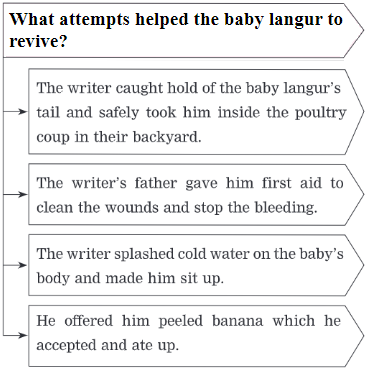
    I took the baby langur to our backyard and gently laid him on the floor inside the poultry coop. His body was full of deep bite marks and scratches. Blood was oozing from some of the wounds. The baby remained motionless. My father provided first aid to clean the wounds and stop the bleeding. I was relieved to find out that the baby was breathing, even though his breaths were shallow.
   Splashes of cold water made the baby stir and after a few shaky attempts, he sat up. He was in state of shock and started trembling like a leaf in the wind. His two little twinkling eyes welled up with tears and he started to sob with a muffled cry - just like a human child would after experiencing trauma. I offered him a peeled banana which he
accepted with his unsteady hand and began taking hesitant bites.

A2. Complex Factual Activities:
Complete the following web and describe the condition of wounded baby langur:
 Image
A3. Activities based on Vocabulary:
Match the words in column 'A' with their meanings in column 'B':

 Column 'A'Column 'B'
 (1) shaky (a) rose to the surface
 (2) welled up (b) made the sound quieter
 (3) prospect (c) unsteady
 (4) muffled (d) future benefit

A4. Activities based on Contextual Grammar:
(1) He was in a state of shock. (Past Perfect Tense.)
(2) I took the baby langur to our backyard. (Past Perfect Tense.)
A5. Personal Response:
(1) Complete the following :"
Image

Answer

A1. Simple Factual Activities:
(1) The baby langur's eyes welled up with tears.
(2) The unexpected attack forced the langur to drop the baby from the sloping roof over the veranda.
A2. Complex Factual Activities:

Image
A3. Activities based on Vocabulary:
(1) shaky - unsteady
(2) welled up - rose to the surface
(3) prospect - future benefit 
(4) muffled - made the sound quieter
A4. Activities based on Contextual Grammar:
(1) He had been in a state of shock.
(2) I had taken the baby langur to our backyard.
A5. Personal Response:
Image

Need a full question paper?

Generate a complete, print-ready paper with questions like this in minutes — across 16+ boards, with answer keys.

Start Generating Free

Similar questions

A1. Simple Factual Activities:
State who/what:
(1) Colours the entire sky.
(2) Takes new shapes with every passing moment,
(3) Makes trees dance.
(4) Changes its forın according to the dictates of the sun and the wind.

     We saw small bits of grass peeping through the small cracks in a concrete pavement. It left us thinking : however impossible things may look, there is always an opening...
     We saw a tree bare of all leaves in the cold winter months. We thought its chapter was over. But three months passed, spring set in and the tree was back to its green majesty once again, full of leaves, flowers, birds and life. What if we too had the conviction that, however difficult things are right now, it will not remain so for ever. Remember, this too shall pass.
     We saw an army of ants lugging a fly which was at least ten times the ant’s size. The ants organized themselves around the fly, lifted it on frail feelers and carried it to quite a distance. Their teamwork and perseverance were impressive. What if we too are consistent, organized, focused...Spider webs are delicate, yet very strong. A rainbow colours the entire sky. Oysters take in a grain of sand they open up with a pearl. Innumerable stars shine across the infinite sky. Clouds take new shapes with every passing moment. The wind makes trees dance with unhindered passion. Water, without hint of ego, changes its form according to the dictates of the sun and the wind. When we see a caterpillar turn into a butterfly, a flower turn into a fruit, we experience the alchemy of nature... we touch it and become gold ourselves.

A2. Complex Factual Activities:
(1) What are the alchemies of nature mentioned in the extract?
A3. Activities based on Vocabulary:
Match the pairs of antonyms:

 WordsAntonyms
 (1) impossible (a) easy
 (2) difficult (b) strong
 (3) delicate (c) forget
 (4) remember (d) possible

A4. Activities based on Contextual Grammar:
Identify the tenses:
(1) We saw an army of ants
(2) We experience the alchemy of nature
A5. Personal Response:
(1) 'Nature is our best teacher'-Explain.

A1. Simple Factual Activities:
Complete the following web: 
Image

To see a world in a grain of sand
     And a heaven in a wild flower,
Hold infinity in the palm of your hand
      And eternity in an hour
    We instinctively turn to outdoor activities and nature as a way of relaxing and enhancing our wellbeing. Nature soothes and nurtures. Nature fulfils and motivates. Nature whispers and commands.
    Are you listening?
    When I do, it leaves me in complete awe.
    We have a hibiscus plant in our garden. Every fortnight a flower blooms on it big, bright and tender. Through the day it smiles with the sun and dances with the wind, but as evening approaches, it starts wilting. The morning after, it withers completely and by evening it falls and becomes one with the earth again. The flower comes to life only for a day, yet it does so in full splendour. What if we too lived our life, however short, to its fullest?
    We went to a rocky beach and saw the spread of the majestic ocean and the rocks alongside, carved, sculpted and shaped by the water. Water is so gentle, rock so hard, yet, as the water flows over it every day, for years, the rock gives in. It takes the shape that the water commands. Our problems are so colossal and we are so small, yet if we persist.... 

A2. Complex Factual Activities:
The writer explains the contrast features of 'water' and 'rock' in the text. Write all the features of both water and rock in the given table: 
A3. Activities based on Vocabulary:
Match the pairs of antonyms.

 Words Antonyms
 (1) gentle (a) small
 (2) colossal (b) long
 (3) short (c) quit
 (4) persist (d) hard

A4. Activities based on Contextual Grammar:
Frame Wh-questions to get the underlined parts as answers:
(1) The flower comes to life only for a day.
(2) We saw the spread of the majestic ocean.
A5. Personal Response:
(1) Explain the line Nature whispers and commands.'

A1. Simple Factual Activity:
Complete the following sentences:
(1) The writer's house was in  _______________.
(2) The officer's club was _______________.

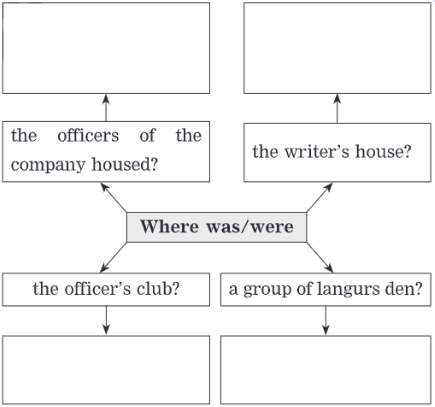
     My father was a medical professional working for a private company in Raniganj in West Bengal. The officers of the company were housed in individual bungalows inside a large campus. Our house was in a corner of the campus. The officer’s club was adjacent to the boundary wall of our garden. The compound was luxurious with green grass, colourful flowers and a host of tall and majestic trees. The seasonal vegetables in the kitchen gardens of the households and the magnificent trees constantly attracted squirrels and many species of birds; a group of langurs had even made their den in an aswatha tree nearby. They had all become a part and parcel of our existence and daily life.
     A small incident on a Saturday afternoon left a profound effect on me and unfolded before my eyes a whole new dimension to the wonders of God’s creation. It was a few days into the Puja vacation. Just like for any other child, the holidays provided an opportunity for me to become engrossed in various magazines and storybooks published specially for children in the festive season.
     After a hearty lunch, my parents and my younger sisters lay down for an afternoon nap and I settled down with a storybook. The quiet afternoon presented the perfect backdrop for reading an adventure story. The silence was occasionally broken by the sound of my family snoring, the intermittent chirping of house sparrows, the harsh cawing of a crow the shrill call of a kite flying high above the ground. Minutes ticked by. I became deeply absorbed in the book.

A2. Complex Factual Activities:
Complete the web describing the campus where writer's family lived:
Image
A3. Activities based on Vocabulary:
Match the synonyms:

Column 'A'

Column 'B'

(1) a part and parcel of

(a) get into a comfortable position

(2) to be engrossed in

(b) penned up a new aspect

(3) settle down with

(c) to be essential or integral part of something

(4) chanceunfolded a new dimension

(d) was completely occupied in


A4. Activities based on Contextual Grammar: 
(1) The compound was luxurious with green grass. (Choose the correct question tag.) 
(a) doesn't it?  (b) does it? (c) wasn't it? (d) was it?
(2) The writer's house was in a corner of the ampus.
(Make 'Wh-question' to get underlined part as an answer.) 
A5. Personal Response :
(1) Describe the surroundings where you live.

A1. Simple Factual Activity:
Complete the following sentences with the help of the information from the passage:
(1) Dr. Stephen Hawking was born on _______________.
(2) Courage is the quality _______________.

    Exactly 300 years after the death of the great scientist Galileo, Dr Stephen Hawking was born in Oxford, London on the eighth day of January 1942. Little did his parents know that one day their little boy would be hailed as one of the greatest scientists
of this century. Neither could anybody imagine that his mind would soar up into space like light. More importantly, none could predict that he would be the very epitome of courage.
    Courage is a wonderful thing. It is that quality, which makes people not lose heart when faced with a great calamity. It would not be an exaggeration to say that Dr Stephen Hawking, a living legend of Cosmology, is the very personification of courage
and hope. Except his mind, his whole body is bound to a wheelchair, thanks to a cruel quirk of fate. Yet, he is one of the greatest scientists of this century.
     An average child, Stephen grew up to be a normal teenager, full of mischief and lots of love for music and mathematics. Even though his father wanted him to study medicine, he was bent on studying mathematics. The University of Oxford, at that time, did not have a course in mathematics so he opted to study physics instead. 

A2. Complex Factual Activity:
(1) What do you know about Dr. Stephen Hawking from this passage? 
A3. Activities based on Vocabulary:
Classify the following words into verbs, adjectives and nouns:
whole, know, little, predict, calamity, legend, mind, physics, great, imagine, wonderful, cruel, courage, faced, grew, heart, fate, course.people.
A4. Activities based on Contextual Grammar:
Make the following sentences exclamatory:
(i) Courage is truly a wonderful thing.
(ii) He was very clumsy.
A5. Personal Response:
(1) Do you think, that courage is a wonderful thing? Why do you think so?
A1. Simple Factual Activities:
Name the following: 
(1) The warrior mentioned in the passage -
(2) Native place of Mary Kom -
(3) Mary Kom's parents -
(4) The sportsperson who won gold medal in Asian games-

   There had to be one successful story if Indians were to survive in sports and we have that story now. Enough has been said about this great warrior who conquered the world. This warrior is none other than Mary Mangte Kom-the Komqueror and the Komrade. She is famed as a five times World Boxing Champion and the only boxer to win a medal in every one of the six world championships. In the 2012 Olympics, she became the first Indian woman boxer to qualify and win a bronze medal in the 51
kg flyweight category of Boxing.
     Kom was born in Kangthei village, Moirang Lamkhai in Churachandpur district of rural Manipur in eastern India. She came from a poor family. Her parents, Mangte Tonpa Kom and Mangte Akham Kom were tenant farmers who worked in jhum fields.
Kom grew up in humble surroundings, helping her parents with farm related chores, going to school and learning athletics initially and later boxing simultaneously. Her father was a keen wrestler in his younger age.
     She had an eager interest in athletics since childhood and the success of Dingko Singh a fellow Manipuri returned from the 1998 Bangkok Asian games with a gold medal, Kom recollects, had inspired many youngsters in Manipur to try boxing
and she too thought of giving it a try.
     Mary Kom’s career started in 2000 after her victory in the Manipur State women’s boxing championship and the regional championship in West Bengal. In 2001, she started competing at international level. She was only 18 years old when she made her international debut at the first AIBA Women’s World Boxing Championship in United States, winning a silver medal in the 48 kg weight category. Her greatness is reinforced by the way she apoligized to the whole nation for not being able to win the Gold. She is a legend for sure and an idol for all the sportswomen to look up to.

A2. Complex Factual Activities:
(1) Mary Kom's exceptional achievement is that _______________.
(2) Mary Kom's parents made their living by _______________.
A3. Activities based on Vocabulary:
Fill in the blanks by selecting words or phrases from the passage :
(1) My younger sister has so much _______________ in dancing and singing.
(2) Tanaji Malusare was a great _______________ in history.
A4. Activities based on Contextual Grammar:
Do as directed: 
(1) Mary Kom was a warrior. She was a boxer. (Use 'as well as')
(2) Her father was a keen wrestler in his younger age. (Pick out and rewrite two adjectives from the given sentence.)
A5. Personal Response:
(1) Describe your favourite sportswoman.
A1. Simple Factual Activities:
Name the following: 
(1) Two discoverers of New lands.
(2) Two conquerers of the peak of Mt. Everest.

     The history of men’s progress from the darkness of ignorance to the glorious light of knowledge and enlightenment is full of chapters that tell of extraordinary men and women. These men and women worked with great courage, commitment, dedication and singleness of purpose in their effort to attain what seemed to be unattainable. These men and women were driven in their effort to uncover the truth and mystery of the universe with an indomitable spirit which characterises the human spirit. And this is the spirit that drove Columbus and Vasco de Gama to sail to the unknown seas, Robert Peary to race to the Pole, Sir Ronald Ross to fight against malaria, Hillary and Tenzing to reach the top of Everest, and Armstrong and his team to go to the moon. 
     One great woman who dedicated her life to the cause of science and to the welfare of humanity is Madame Curie, the discoverer of radium. The mere statement that Madame Curie discovered the radium will never tell the true story of the extraordinary courage, determination and singleness of purpose that this noble woman showed in the face of extreme poverty, pain and suffering that comes along with such condition.
     Born Maria Sklodowska in Warsaw, Poland on November, 7 1867, Marie Curie’s childhood dream was to study science in Paris, but her father could not afford the expense for this. So Maria took a job as a governess and saved a little money. With that little money she finally went to Sorbonne, the University of Paris, to study science. Her father could send her only a small amount and her life in the university was a disheartening experience in poverty and hunger. She lived only on bread, butter and tea, and she often fainted for lack of food. In spite of all this she pursued her studies indomitably and she topped her class with Honours in Physics and Mathematics.
     It was at the university that she met a Frenchman, Pierre Curie, a brilliant but poor scientist. Then they together began to work in a shabby laboratory. Soon, their friendship turned into love and in less than a year, in July, 1895, they were married. The couple then took a flat in Paris with scarcely any furniture in it except their books, a lamp, a white wooden table and two chairs.
      After the birth of a daughter, Irene, the next year, Marie and Pierre set up a laboratory in a wooden shed near their flat, It had a leaky skylight and an earthen floor. Here Marie, after her daily household work, settled down to study.

A2. Complex Factual Activities:
(1) What information do you get about Marie's early life? 
A3. Activities based on Vocabulary:
Find out the words from the passage which mean:
(1) unbeatable
(2) discouraging
(3) hardly
(4) illiteracy
A4. Activities based on Contextual Grammar:
(1) Her father could not afford the expenses of her education in Paris. (Make it affirmative.)
(2) Marie took a job as a governess and saved a little money. (Rewrite using 'by' + ing.)
A5. Personal Response:
(1) Describe your favourite scientist. 
A1. Simple Factual Activity:
Complete the following sentences with the help of the passage:
(1) Specific goals make it easier to _______________.
(2) It is important to create goals that are _______________.

SMART goals have a specific rubric:
    Specific: Involves identifying a specific area for improvement. The more specific the area, the more refined the achievement of one’s goal can be. It makes it easier to set parameters and work towards the goal. For exaxmple, if it is building a house, what exactly is the capacity required and how long can it stretch ?
    Measurable: Quantifying goals provides specific ways to track progress against goals. This makes it easy to benchmark performance throughout the goal period, including areas to improve. While playing football, one’s exact role and position has to be clearly defined.
     Achievable: Setting goals that can be completed in the designated period of time. Often, these goals may act like stepping stones to help meet broader goals that further define a career. As students, we can’t become a President, a Prime Minister, but can hope to reach those heights in future.
      Realistic: It is important to create goals that are within one’s current skill set or area of expertise. Building expertise takes time, so expecting to become an expert in a short amount of time is unrealistic. Being realistic will make it easy to be successful at attaining goals. If defensive and not aggressive, the goal perhaps lacks realism. We must have the clear picture in mind and must have the ability to adhere to that picture.

A2. Complex Factual Activities:
(1) How does quantifying goals help us?
A3. Activities based on Vocabulary:
Find from the passage adjectives for the following:
(1) area
(2) period
(3) role
(4) stones 
A4. Activities based on Contextual Grammar:
Underline the Present Participles/ Infinitives: 
(1) It makes it easier to set parameters.
(2) These goals may act like stepping stones to help broader goals.
A5. Personal Response:
(1) Why is it necessary that our goals should be realistic?
A1. Simple Factual Activities:
Say whether the following statements are True or False:
(1) The baby langur sensed the presence of his mother.
(2) The mother langur was sitting on the floor of the coop.
(3) The writer cuddled the baby langur tightly in his bosom.
(4) The writer's attention was fixed on the revival of the baby langur.

    My attention was fixed on the revival of the baby langur. Suddenly, I had an uncanny feeling of being watched. I turned away from the coop and looked up. There sat the mother langur on our kitchen roof, watching every move I made. She simply sat there quietly, as if convinced that no harm was being done to her child.
   Meanwhile, the baby sensed the presence of his mother and started to sob and cry a little louder. I retreated from the door of the coop to allow the mother access to her baby.
    Immediately, the mother descended on the floor of the coop and picked up the baby in her arms. She gave the baby a thorough body inspection to check his injuries and then cuddled him tightly in her bosom. The baby found great solace in her caring arms. The mother sat still with the baby in her lap for a few minutes. It was almost as if she was pondering over her options and trying to figure out how she could keep the baby safe from further assault.

A2. Complex Factual Activities:
Complete the following:
(1) Mother langur simply sat quietly because _______________.
(2) The baby langur started to sob and cry because _______________.
 
A3. Activities based on Vocabulary:
Match the words in column 'A' with their meanings in column 'B':

 Column 'A'Column 'B'
 (1) to figure out (a) to find comfort and peace.
 (2) to ponder over (b) the act of checking with complete attention and care.
 (3) to find solace (c) to be able to think until you solve the problem.
 (4) thorough inspection (d) think over something deeply.

A4. Activities based on Contextual Grammar:
Do as directed:
(1) I turned away from the coop and looked up.
(Begin the sentence with - Turning ... and rewrite it.) 
(2) She gave the baby a thorough body inspection.
(Change the sentence into passive voice. Begin with The baby...)
A5. Personal Response:
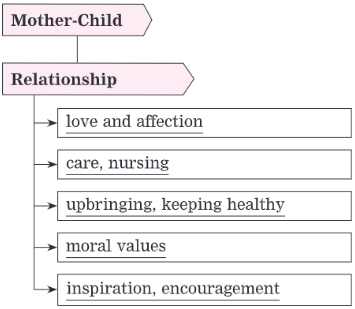
(1) What is your mother's state of mind during your illness?

A1. Simple Factual Activity:
Complete the sentences with the help of the information in the passage:
(1) For reducing weight, exercise, diet and stress- free thoughts should be _______________.
(2) Vision, wishes, intentions and dreams spark off imagination and encourage us _______________.

    Time-bound: Establish time parameters around each goal, as it will help increase focus and accountability. To reduce weight we know how to go about it. But without consistent time - bound action, it never becomes a reality. It may be exercise, diet and stress-free thoughts. All these have to be practised and implemented without hesitation, doubt or indifference, but within a deadline.
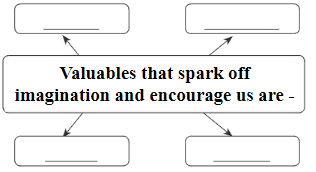
    Visions, wishes, intentions and dreams are all valuable. They spark off imagination and encourage us to define where we want to reach. In order to get there, however, we need to bring life images, down to earth and plan to execute our strategies. The quality and quantity of energy we put forth, directly impact the results. Life is something like a trumpet. If we don’t put anything in, we can’t get anything out.
     Success is a walk in the dark. Finding the right footing, precisely mastering the skills and getting to the next place, all depend on how we approach and
tackle the problem. The best way to get from where we are, to where we want to be is to find the footing of our next step. When we take the next step, it should support and hold us without a crack.

A2. Complex Factual Activity:

Complete the web: 
Image
A3. Activities based on Vocabulary:
Write antonyms for the following words :
(1) wrong ×
(2) decrease × 
(3) discourage × 
(4) light × 
A4. Activities based on Contextual Grammar:
(1) Establish time parameters around each goal. (Rewrite the sentence beginning with 'Let' and change the sentence into passive voice.)
(2) If we don't put anything in, we can't get anything out. (Rewrite the sentence using 'unless' in the beginning.)
A5. Personal Response:
(1) Write any four qualities of a successful person.
A1. Simple Factual Activity:
Who said to whom?
(1) "The bird has flown!"
(2) "The Pipalnagar Bank is about to collapse."

     ‘What’s that?’ said Kamal Kishore, sitting up suddenly. ‘Which bank?’
     ‘Why the Pipalnagar bank of course. I hear they have stopped paying employees. Don’t tell me you have an account there, Mr. Kishore?’
     ‘No, but my neighbour has!’ he exclaimed; and he called out over the low partition to the keeper of the barber shop next door. ‘Deep Chand, have you heard the latest? The Pipalnagar Bank is about to collapse. You’d better get your money out as soon as you can!’
     Deep Chand who was cutting the hair of an elderly gentleman, was so startled that his hand shook and he nicked his customer’s right ear. The customer yelped with pain and distress: pain, because of the cut and distress because of the awful news he
had just heard. With one side of his neck still unshaven, he sped across the road to the general merchant’s store where there was a telephone. He dialled Seth Govind Ram’s number. The Seth was not at home. Where was he, then? The Seth was holidaying in Kashmir. Oh, was that so? The elderly gentleman did not believe it. He hurried back to the barber’s shop and told Deep Chand: ‘The bird has flown! Seth Govind Ram has left town. Definitely, it means a collapse.’ And then he dashed out of the shop, making a beeline for his office and chequebook.
    The news spread through the bazaar with the rapidity of forest fire. From the general merchant’s it travelled to the shop, circulated amongst the customers, and then spread with them in various directions, to the betel-seller, the tailor, the free vendor, the jeweller, the beggar sitting on the pavement.   

A2. Complex Factual Activity:
Complete the web :
Image
A3. Activities based on Vocabulary:
Match the column with their meanings:

WordsMeanings
 (1) beeline (a) state of being upset
 (2) pavement (b) the direct route
 (3) nicked (c) the road for the people to walk
 (4) distress (d) cut slightly

A4. Activities based on Contextual Grammar:
Do as directed:
(1) Mr Kishore said, "Deep Chand, have you heard the latest?" (Change into indirect speech.)
(2) The bird has flown. (Rewrite the sentence using Past Perfect Tense)
A5. Personal Response:
(1) Do you think that rumour spreads faster than fire? Support your answer in two to three lines.