Question
A1.Simple Factual Activities:
Complete the web :

Image

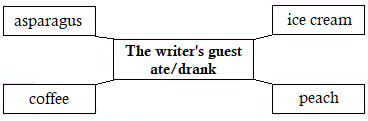
    The asparagus appeared. I watched her thrust them down her throat in large mouthfuls. At last, she finished.
   “Coffee ?” I said.
   “Yes, just an ice cream and coffee,” she answered. I was past caring now, so I ordered coffee for myself and an ice cream and coffee for her.
   “You know, there’s one thing I thoroughly believe in,” she said, as she ate the ice cream. “One should always get up from a meal feeling one could eat a little more.”
   “Are you still hungry?” I asked faintly.
   “Oh, no, I’m not hungry. You see, I don’t eat luncheon. I have a cup of coffee in the morning and then dinner, but I never eat more than one thing for luncheon. I was speaking for you.”
   “Oh, I see.” Then a terrible thing happened. While we were waiting for the coffee, the head waiter came up to us bearing a large basket full of huge peaches. But surely peaches were not in season then? Lord knew what they cost! I knew a little later, for my guest going on with her conversation, absent-mindedly took one.

A2. Complex Factual Activity:

(i) 'Then a terrible thing happened.' Describe the narrator's emotions at this point in the story. Why does he not express this emotion?.
A3. Activity based on Vocabulary:
Mateh the columns :

'A''B'
(i) bead(a) peaches
(ii) terrible(b) mouthfuls
(iii) huge(c) waiter
(iv) large(d) thing

A4. Activities based on Contextual Grammar:
Rewrite the following in reported speech :
(i) "I'm not in the least hungry," my guest sighed, "but if you insist, I don't mind having some asparagus."
A5. Personal Response:
(i) " 'I was past caring now'. Explain why, in your view, the narrator feels this way.

Answer

A1.Simple Factual Activities:
Image
A2. Complex Factual Activity:
(i)  At this point in the story, the writer had given up all hopes that he could pay the bill. He was resigned to his fate. He had mentally decided on different methods to save his reputation. He does not express this emotion because the lady had already eaten a lot of expensive food; the damage was already done. Besides, he did not want to look mean in her eyes.
A3. Activity based on Vocabulary:

'A''B'
(1) head(c) waiter
(2) terrible(d) thing
(3) huge(a) peaches
(4) large(b) mouthfuls

A4. Activities based on Contextual Grammar:
(i) My guest told me with a sigh that she was not in the least hungry, but that if I insisted, she wouldn't mind having some asparagus. asparagus.
A5. Personal Response:
(i) The writer had been worried from the beginning that he would not be able to pay the bill. To add to that. his guest had ordered some of the most expensive items on the menu. He had now glven up all hopes of being able to pay the bill. Hence, he says that he was past caring now.

Need a full question paper?

Generate a complete, print-ready paper with questions like this in minutes — across 16+ boards, with answer keys.

Start Generating Free

Similar questions

A1. Simple Factual Activities:
Fill in the blanks:
(i) Arjan Singh held the post of AOC for ................ years.
(ii) Arjan Singh took over the reins of the IAF on ................. .

     For his role in successfully leading the squadron in combat, he was awarded the Distinguished Flying Cross (DFC) in 1944. On August 15, 1947, he achieved the unique honour of leading a fly-past of over a hundred IAF aircraft over the Red Fort in Delhi.
   After his promotion to the rank of Wing Commander, he attended the Royal Staff College at the UK.Immediately after Indian independence, he commanded Ambala in the rank of Group Captain. In 1949, he was promoted to the rank of Air Commodore and took over as Air Officer Commanding (AOC) of an operational command, which later came to be known as Western Air Command.
   Singh had the distinction of having the longest tenure as AOC of an operational base, initially from 1949-1952 and then again from 1957-1961. After his promotion to the rank of Air Vice Marshal, he was appointed as the AOC-in-C of an operational command.
  Towards the end of the 1962 war, he was appointed as the Deputy Chief of the Air Staff and he became the Vice Chief of the Air Staff in 1963. He was the overall
commander of the joint air training exercise “Shiksha” held between IAF, RAF (Royal Air Force) and RAAF (Royal Australian Air Force)."
   On August 1, 1964, in the rank of Air Marshal, the Marshal of the Air Force Arjan Singh took over reins of IAF, at a time when it was still rebuilding itself and was gearing up to meet new challenges.

A2. Complex Factual Activities:
(i) Describe the uphill task that Singh faced when he took over as Air Marshal.
A3. Activities based on Vocabulary:Give the complete forms of the following:
(i) IAF (ii) RAF (iii) AOC (iv) RAAF
A4. Activities based on Contextual Grammar: 
(i) After his promotion to the rank of Wing Commander, he attended the Royal Staff College at the UK. (Rewrite using the verb form of the underlined word.)
(ii) He was the overall commander of the joint air training exercise 'Shiksha'.(Rewrite using the noun 'command".)
A5. Personal Response:
(i) Describe briefly a brave person whom you have met.
A1. Simple Factual Activities:
Match the years with the events in the life of Arjan Singh:

 EventYear
(1) Appointed Deputy Chief of Air Staff (a) 1947
(2) Selected for the Empire Pilot Training Course (b) 1962
(3) Promoted to the rank of Air Commodore (c) 1949
(4) Led a fly-past over the Red Fort (d) 1963

   For his role in successfully leading the squadron in combat, he was awarded the Distinguished Flying Cross (DFC) in 1944. On August 15, 1947, he achieved the unique honour of leading a fly-past of over a hundred IAF aircraft over the Red Fort in Delhi.
   After his promotion to the rank of Wing Commander, he attended the Royal Staff College at the UK.Immediately after Indian independence, he commanded Ambala in the rank of Group Captain. In 1949, he was promoted to the rank of Air Commodore and took over as Air Officer Commanding (AOC) of an operational command, which later came to be known as Western Air Command.
   Singh had the distinction of having the longest tenure as AOC of an operational base, initially from 1949-1952 and then again from 1957-1961. After his promotion to the rank of Air Vice Marshal, he was appointed as the AOC-in-C of an operational command.
  Towards the end of the 1962 war, he was appointed as the Deputy Chief of the Air Staff and he became the Vice Chief of the Air Staff in 1963. He was the overall
commander of the joint air training exercise “Shiksha” held between IAF, RAF (Royal Air Force) and RAAF (Royal Australian Air Force)."
   On August 1, 1964, in the rank of Air Marshal, the Marshal of the Air Force Arjan Singh took over reins of IAF, at a time when it was still rebuilding itself and was gearing up to meet new challenges.

A2. Complex Factual Activities:
Complete the following:
(i) On 15th August 1947, Arjan Singh achieved the unique honour of .................... .
(ii) He had the distinction of having the longest tenure as ...................... .
(iii) Immediately after Indian independence, he commanded ....................... .
(iv) He was the overall commander of the joint air .................... .
A3. Activities based on Vocabulary:
Replace the underlined words/phrases with the appropriate ones, to retain the proper meaning:
(be the epitome of. gear up, a brief stint, play a major role, in recognition of, take over reins)
(i) Our school cricket team got ready for the final match against P.Q.R.High School.
(ii) After the murder of King Duncan, Macbeth took over the control of Scotland.
A4. Activities based on Contextual Grammar: 
(i) After his promotion to the rank of Wing Commander, he attended the Royal Staff College at the UK. (Rewrite using the verb form of the underlined word.)
(ii) He was the overall commander of the joint air training exercise 'Shiksha'.(Rewrite using the noun 'command".)
A5. Personal Response:
(i) Describe briefly a brave person whom you have met.

A1. Simple Factual Activities:
Complete the following :
Image

    Ten years later, when we were designing the first Macintosh computer, it all came back to me. And we designed it all into the Mac. If I had never dropped in on that course in college the Mac would have never had multiple typefaces or for that matter even proportionally spaced fonts.
   And since Windows just copied Mac, it’s likely no personal computer would have them. Of course it was impossible to connect the dots looking forward when I was in college. But it was very clear looking backwards 10 years later.
   You can’t connect the dots looking forward; you can only connect them looking backwards. So you have to trust that the dots will somehow connect in your future. You have to trust in some things - your gut,destiny, life, karma, whatever. This approach has never let me down, and it has made all the difference in my life.

A2. Complex Factual Activities:
Say how:
(i) You can connect dots.
A3. Activities based on Vocabulary:
Match the words/phrases in column A with their meanings in column B:

(A)(B)
 (i) gut (a) Macintosh computer.
 (ii) destiny (b) having several parts.
 (iii) Mac (c) the power believed to control events.
 (iv) multiple (d) courage and determination.

A4. Activities based on Contextual Grammar:
(i) It was impossible to connect the dots looking forward.(Pick out the verbs and say if they are finite or non-finite.)
(ii) It was very clear.(Rewrite as an exclamatory sentence.)
A5. Personal Response:
(i) Write about something which you learned in the past and which has helped you in the present.

A1.Simple Simple l Factual Activities:
Fill in the blanks:
(i) Dr Kalam's message made an Impact on the writer because of its .............. and the ............... it posed became his silent motivation.
(ii) The .............. of .............. lies in the answer to the question 'What can I give?'
 
  ‘Turning to me, he asked, ‘What is the reverse of “What can I give ?”
  Circumspectly I replied, ‘What can I...take ?’ ‘Yes,’ he said, ‘and that is the thought which is responsible for all the wrong we see around us. We think that we can take from the environment and destroy it indiscriminately; we think of what we can take from other humans, leading us to corruption and inequity. This attitude of taking and taking even
destroys families. To keep this planet liveable and the human race thriving, we have to replace this attitude of ‘what can I take’ with the goodness of ‘what can I give’.
  The gravity of the message struck me. This challenge became my silent motivation.
  Three years later, in 2012, this idea became a reality as our What Can I Give movement, through which Dr Kalam tried to combat corruption, environmental degradation and social evils.
   It is important that we ask ourselves this question for in the answer lies the truth of humanity. So go ahead and question yourself.
   What can I give ?
   The answers will be astounding.  

A2. Complex Factual Activity:
Rearrange the letters to form sensible words:

(i) To keep this planet liveable and the human race thriving, we have to replace this attitude of 'what can I take with the goodness of 'what can I give.
(ii) Dr Kalam tried to combat corruption, environmental degradation and social evils.
A3. Activities based on Vocabulary:
From the passage write one word for:
(i) without making a difference :
(ii) in a cautious way :
A4. Activities based on Contextual Grammar:
Write what the underlined auxiliaries indicate:

(i) What can I give?
(ii) We have to replace this attitude ....
A5. Personal Response:
(i) Why is there an urgent need to replace 'What can I take' with 'What can I give'
A1.Simple Simple l Factual Activities:
The following incidents in Stephen Hawking's life are given in jumbled order. Arrange the incidents in proper sequence as per their order of occurrence in Hawking's life:"
(i) Hawking authored 'A Briefer History of Time' that contained the newest developments.
(ii) Hawking's book 'A Brief History of Time' spent more than four years atop the London Sunday Times'.
(iii) Hawking's book The Universe in a Nutshell' offered an illustrated guide to cosmology's big theories.
(iv) Hawking published the book 'A Brief History of Time that offered an overview of space and time

   Stephen Hawking (born January 8, 1942) is a British scientist, professor and author who has done groundbreaking work in physics and cosmology, and whose books have helped to make science accessible to everyone. At the age of 21, while studying cosmology at the University of Cambridge, he was diagnosed with amyotrophic lateral sclerosis (ALS). Part of his life story was depicted in the 2014 film ‘The Theory of
Everything.’
  Over the years, Stephen Hawking has written or co-written a total of 15 books. A few of the most noteworthy include: The Grand Design, The Universe in a Nutshell, The Theory of Everything.
   In 1988 Hawking catapulted to international prominence with the publication of A Brief History of Time. The short, informative book became an account of cosmology for the masses and offered an overview of space and time, the existence of God and the future.The work was an instant success, spending more than four years atop the ‘London Sunday Times’ bestseller list. Since its publication, it has sold millions of
copies worldwide and been translated into more than 40 languages.
   ‘A Brief History of Time’ also wasn’t as easy to understand as some had hoped. So in 2001, Hawking followed up his book with ‘The Universe in a Nutshell,’ which offered a more illustrated guide to cosmology’s big theories.
   In 2005, Hawking authored the even more accessible ‘A Briefer History of Time,’ which further simplified the original work’s core concepts and touched upon the newest developments in the field like String theory.  

A2. Complex Factual Activity:
Complete the table with relevant information about Hawking:

BooksFilms


A3. Activity based on Vocabulary:
Find out the antonyms from the passage for the following:

(i) worst 
(ii) exclude 
(iii) duplicate 
(iv) oldest
A4. Activities based on Contextual Grammar:
(i) He was diagnosed with amyotrophic lateral sclerosis. (Rewrite using the present perfect tense of the underlined part.)
(ii) It has sold millions of copies worldwide and been translated into more than 40 languages.(Change into a simple sentence)
A5. Personal Response:
(i) Stephen Hawking was a versatile personality. Justify.

A1. Simple Factual Activities:
Complete the following:

(i) Arjan Singh became a Squadron Leader at the age of ...................... .
(ii) Arjan Singh was the first Indian pilot to be awarded the ...................... .

   Commending his role in the war, Y B Chavan, the then Defence Minister had written: “Air Marshal Arjan Singh is a jewel of a person, quite efficient and firm; unexcitable but a very able leader.”
   In 1944, the Marshal had led a squadron against the Japanese during the Arakan Campaign, flying close air support missions during the crucial Imphal Campaign and later assisted the advance of the Allied Forces to Yangoon (formerly Rangoon).
   In recognition of his feat, he was awarded the Distinguished Flying Cross (DFC) on the spot by the Supreme Allied Commander of South East Asia, the first Indian pilot to have received it. Singh was selected for the Empire Pilot training course at Royal Air Force
(RAF) Cranwell in 1938 when he was 19 years old. He retired from service in 1969.
   Singh was born on April 15, 1919, in Lyalpur (now Faislabad, Pakistan), and completed his education at Montgomery (now Sahiwal, Pakistan). His first assignment on being commissioned was to fly Westland Wapiti biplanes in the North-Western Frontier Province
as a member of the No.1 RIAF Squadron.
   After a brief stint with the newly formed No. 2 RIAF Squadron where the Marshal flew against the tribal forces, he later moved back to No.1 Sqn as a Flying Officer to fly the Hawker Hurricane. He was promoted to the rank of Squadron Leader in 1944.

A2. Complex Factual Activities:
(i) Explain what enabled Arjan Singh to win the DFC award.
A3. Activities based on Vocabulary:
Complete the table:

 VerbAdjectiveNoun
(1) recognise................ ................
(2) educate ................ ................
(3) promote ................ ................
(4) move ................ ................

A4. Activities based on Contextual Grammar: 
(i) In 1944, the Marshal had led a squadron against the Japanese during the Arakan Campaign. (Change the voice.)
(ii) His first assignment on being commissioned was to fly Westland Wapiti biplanes in the North- Y Western Frontier Province.(Rewrite as a complex sentence.)
A5. Personal Response:
(i) Name any four qualities that you think a leader must have.

A1.Simple Simple l Factual Activities:
Choose the correct alternatives and fill in the blanks:
(i) Whenever the narrator hears the piece of Bach, he remembers ................. .(Einstein/the hostess)
(ii) The hostess was ................. with the narrator. (happy/angry)
(iii) Finally, the narrator ................. the concert. (enjoyed/did not enjoy)
(iv) Einstein was ................ with the narrator.(pleased/displeased)

   I was amazed that this great man was paying complete attention to me so that I could learn something new. It was as if I was the most important person in his world. Suddenly, he got up and turned off the gramophone.
  “Now young man”, he said, “We’re ready to listen to Bach.”
   We went down and sat in the hall. “Just allow yourself to listen”, he said, “that’s all there is to it.”
    I have heard that piece many times since that day. But I am never alone. I am sitting beside a small man with a shock of untidy hair and a pipe in his mouth.He has eyes that are unusually warm. When the concert ended, I too was able to clap-sincerely. Our hostess came towards us. We both stood up.
   “I’m so sorry, Dr Einstein”, she said, giving me a cold look, “that you missed so much.”
   “I’m sorry too”, he said, “My young friend here and I, however, were engaged in the greatest activity of which a human being is capable.”
   She looked puzzled. “Really?” she said. “And what is that ?”
   Einstein smiled and put his arm across my shoulders.“Opening up the frontiers of beauty.”

A2. Complex Factual Activity:
(i) The narrator's memory has an image of Einstein as ........................... .
(ii) The greatest act towards human beings is ........................ .
A3. Activity based on Vocabulary:
Choose the correct meaning in the context of the passage:

(i) down:
(a) southwards (b) downstairs (c) soft feathers
(ii) piece:
(a) a thing
(b) an example of artistic workmanship
(c) musical composition
A4. Activities based on Contextual Grammar:
(i) I was the most important person in the world. (Rewrite in the comparative and positive degree.)
(ii) "I'm so sorry, Dr. Einstein," she said. (Rewrite using the indirect form of narration.)
A5. Personal Response:
(i) Why, do you think, did the lady look 'puzzled'?
A1.Simple Factual Activities:
Complete the following :
(i) They decided to have luncheon at _________  at _________ on a _________.

  I answered that I would meet my friend at Foyot’s on Thursday at half-past twelve. She was, in appearance,imposing rather than attractive and she gave me the impression of having more teeth, white and large and even, than were necessary for any practical purpose.She was talkative, but since she seemed to want to talk about me, I was prepared to be an attentive listener.
  I was startled when the menu was brought, for the prices were a great deal higher than I had thought. But she reassured me.
  “I never eat anything for luncheon,” she said.
  “Oh, don’t say that!” I answered generously.
   “I never eat more than one thing. I think people eat far too much nowadays. A little fish, perhaps. I wonder if they have any salmon.”
   Well, it was early in the year for salmon and it was not on the menu, but I asked the waiter if there was any. Yes, a beautiful salmon had just come in-it was the first they had had. I ordered it for my guest. The waiter asked her if she would have something while it was being cooked. “No,” she answered, “I never eat more than one thing. Unless you had a little caviar. I never mind caviar.”
   I knew I could not afford caviar, but I could not very well tell her that. For myself, I chose the cheapest dish on the menu and that was a mutton chop. 
   “I think you’re unwise to eat meat,” she said. “I don’t believe in overloading my stomach.” 
A2. Complex Factual Activity:
Who said these words/sentences? Under what circumstances?

Words/
Sentences
Who
said?
Under what circumstances?
 (i) I never eat anything       for luncheon.  
 (ii) I don't belicve in               overloading  my stomach.  

A3. Activity based on Vocabulary:
Choose the correct options from the brackets and fill in the blanks:
(reassured, imposing, generously, unwise)
(i) The crow was _______ to sing. 
(ii) The king decided to distribute his wealth among his subjects ________.
(iii) I was _______ when I saw that I remembered all that I had revised.
(iii) The monument was really very ________ .
A4. Activities based on Contextual Grammar:
Change the voice of the following sentences :
(i) She reassured me.
(ii) I ordered it for my guest.
A5. Personal Response:
(i) Are you careful in your eating habits?

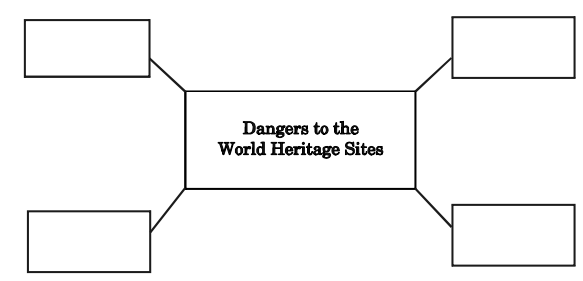
As of 2009, there are 890 World Heritage Sites that are located in 148 countries (map). 689 of these sites are cultural and include places like the Sydney Opera House in Australia and the Historic Center of Vienna in Austria 176 are natural and feature such locations as the U.S.'s Yellowstone and Grand Canyon National Parks. 25 of the World Heritage Sites are considered mixed i.e. natural and cultural Peru's Machu Picchu is one of these. Italy has the highest number of World Heritage Sites with 44. India has 36 (28 cultural, 7 natural and 1 mixed) World Heritage Sites. The World Heritage Committee has divided the world's countries into five geographic zones which include (1) Africa, (2) Arab States, (3) Asia Pacific (including Australia and Oceania), (4) Europe and North America and (5) Latin America and the Caribbean.
WORLD HERITAGE SITES IN DANGER
Like many natural, historic and cultural sites around the world, many World Heritage Sites are in danger of being destroyed or lost due to war, poaching, natural disasters like earthquakes, uncontrolled urbanization, heavy tourist traffic and environmental factors like air pollution and acid rain.

A1. Match the World Heritage Sites given in Column 'A' with the names of

the countries given in Column 'B' :
Column 'AColumn 'B
World Heritage SitesCountries
(i) Machu Picchu(a) Australia
(ii) Sydney Opera House(b) Austria
(iii) Yellowstone National Park(c) The U.S.
(iv) Historic Centre of Vienna(d) Peru
A2. Complete the following web :
Image

A3. Classify the following words in the given table :
(natural, allocate, protect, heavy)
AdjectivesVerbs
A4. Do as directed :
(i) Pick out the subordinate clause and name it :
There are 890 World Heritage Sites that are located in 148 countries.
(ii) World Heritage Sites are in danger.
(Frame a Verbal Question)

A5. How can we preserve our Historical monuments ?
A1.Simple Simple l Factual Activities:
Name the following from the passage:
(i) The great personalities from India:
(ii) The two centres of global peace and brotherhood:

   My journey from the great land of Lord Buddha, Guru Nanak and Mahatma Gandhi; India to Norway is a connect between the two centres of global peace and brotherhood, ancient and modern.
   Friends, the Nobel Committee has generously invited me to present a “lecture.” Respectfully, I am unable to do that. Because, I am representing here the sound of silence. The cry of innocence. And, the face of invisibility. I represent millions of those
children who are left behind and that’s why I have kept an empty chair here as a reminder.
   I have come here only to share the voices and dreams of our children - because they are all our children - (gesture to everyone in the audience). I have looked into their frightened and exhausted eyes.I have held their injured bodies and felt their broken spirits.
   Twenty years ago, in the foothills of the Himalayas, I met a small, skinny child labourer. He asked me: “Is the world so poor that it cannot give me a toy and a book, instead of forcing me to take a gun or a tool?”
   I met with a Sudanese child-soldier. He was kidnapped by an extremist militia. As his first training lesson, he was forced to kill his friends and family. He asked me: “What is my fault?” 

A2. Complex Factual Activity:

(i) Explain the reason why a chair is kept empty on the podium by Shri Satyarthi.
A3. Activities based on Vocabulary:
 Find the odd man out:
(i) dream, tiny, militia, expenditure
(ii) compassion, liberty, children, pessimism
A4. Activities based on Contextual Grammar:
Pick out the verbs from the following sentences and state their tense:
(i) I met a small, skinny child labourer.
(ii) I am representing here the sound of silence.
A5. Personal Response:
(i) "Write any two efforts that you can make to enrol deprived children/out of school children into a school. One is given for you:
i.c. will persuade parents of such children to send them to school.