Question
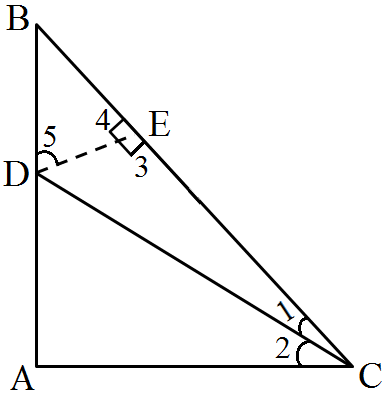
ABC is a right triangle such that AB = AC and bisector of angle C intersects the side AB at D. Prove that AC + AD = BC.
Answer

Given in right angled $\triangle\text{ABC},\text{AB}= \text{AC}\text{ and }\text{CD}$ is the bisector of $\angle\text{C}.$ contruction draw $\text{DE}\ \bot\ \text{BC}.$

to prove $\text{AC}+\text{AD}= \text{BC}$

proof in right angled $\triangle\text{ABC},\text{AB}=\text{AC}\text{ and }\text{BC}$ is a hypotenuse [given]

$\angle1=\angle2$ [given,$\text{CD}$ isthe bisector of $\angle\text{C}$]

$\text{DC}=\text{DC}$ [common sides]

$\therefore\ \triangle\text{DAC}\cong\triangle\text{DEC}$ [by AAS congruence rule]

$\Rightarrow\ \text{DA}=\text{DE}.$ [by CPCT]...(i)

$\text{and}\ \text{AC}=\text{EC}$ ...(ii)

$\text{ln}\ \triangle\text{ABC},\ \text{AB}=\text{AC}$

$\angle\text{C}=\angle{B}$  

[angle opposite to equal sides are equal]...(iii)

Again,in $\triangle\text{ABC},\ \angle\text{A}+\angle\text{B}+\angle\text{C}= 180^\circ$

[by angle sum property of a triangle]

 $\Rightarrow\ 90^\circ+\angle\text{B}+\angle\text{B}=180^\circ$

$\Rightarrow\ 2\angle\text{B}=180^\circ-90^\circ$[from Eq.(iii)]

$\Rightarrow\ 2\angle\text{B}=90^\circ$

$\Rightarrow\ \angle\text{B}=45^\circ$

$\text{ln}\ \triangle\text{BED},\ \angle5=180^\circ-\big(\angle\text{B}+\angle{4}\big)$ 

[by angle sum property of a triangle]

$=180^\circ-(45^\circ+90^\circ)$

$=180^\circ-135^\circ=45^\circ$

$\therefore\ \angle\text{B}=\angle{5}$

$\Rightarrow\ \text{DE}=\text{BE}\ [\because$ sides opposite to equal angle are equal$]$ ...(iv)

from Eqs. (i) and (iv),

$\text{DA}=\text{DE}=\text{BE}$ ...(v)

$\because\text{BC}=\text{CE}+\text{EB}$ 

$=\text{CA}+\text{DA}$ [from Eqs. (ii) and (v)]

$\therefore\text{AD}+\text{AC}=\text{BC}$ Hence proved.

Need a full question paper?

Generate a complete, print-ready paper with questions like this in minutes — across 16+ boards, with answer keys.
Start Generating Free

Similar questions

PQRS is a trapezium having PS and QR as parallel sides. A is any point on PQ and B is a point on SR such that AB || QR. If area of $\triangle\text{PBQ}$ is 17cm2, find the area of $\triangle\text{ASR}.$
Using factor theorem, factorize the following polynomials:
x3 - 3x2 - 9x - 5
A hollow sphere of internal and external radii 2cm and 4cm respectively is melted into a cone of base radius 4cm. Find the height and slant height of the cone.
The angle between two altitudes of a parallelogram through the vertex of an obtuse angle of the parallelogram is 60º. Find the angles of the parallelogram.
Prove that the perimeter of a triangle is greater than the sum of its altitudes.
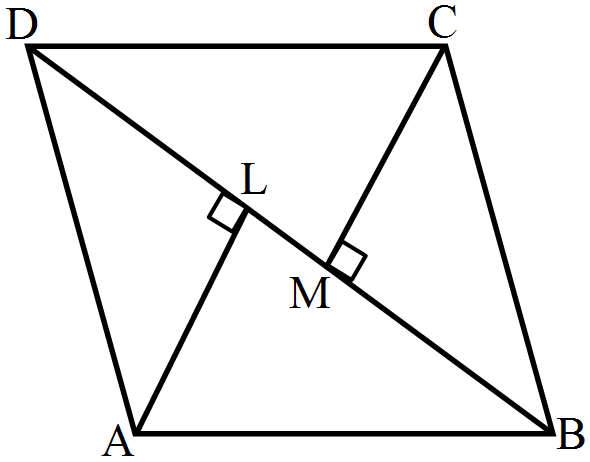
In the given figure, ABCD is a quadrilateral in which diagonal BD = 64cm, $\text{AL}\bot\text{BD}$ and $\text{CM}\bot\text{BD}$ such that AL = 16.8 and CM = 13.2cm. Calculate the area of the quadrilateral ABCD.

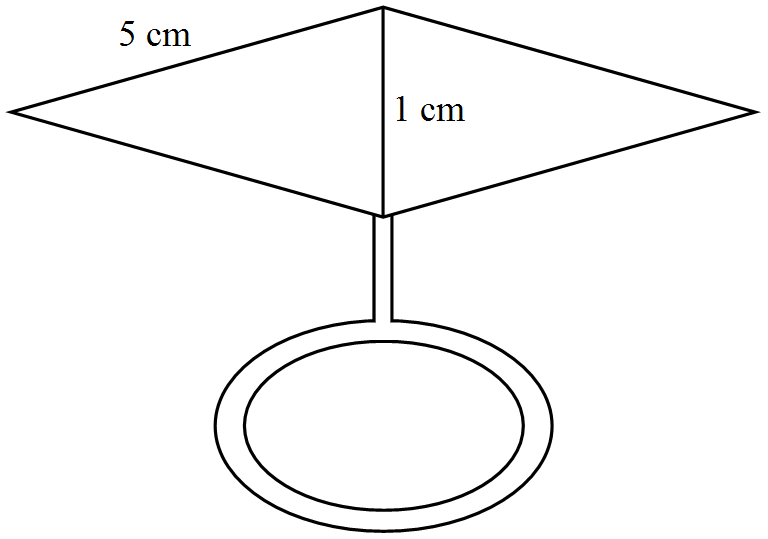
Find the area of the of the blades of the magnetic compass shown in Fig. below
$\big($ Take $\sqrt{11}=3.32\big).$

A survey conducted by an organisation for the cause of illness and death among the women between the ages 15-44 (in years) worldwide, found the following figures (in %) :

S.No.

Causes

Female fatality rate (%)

1

Reproductive health conditions

31.8

2

Neuropsychiatric conditions

25.4

3

Injuries

12.4

4

Cardiovascular conditions

4.3

5

Respiratory conditions

4.1

6

Other causes

22.0

  1. Represent the information given above graphically.
  2. Which condition is the major cause of women's ill health and death worldwide?
  3. Try to find out, with the help of your teacher, any two factors which play a major role in the cause in (ii) above being the major cause.
Given an arc of a circle, complete the circle.
Find the length of 13.2kg of copper wire of diameter 4mm, when 1 cubic cm of copper weighs 8.4gm.