Question
ABC is a Triangle. D is a point on Ab such that $\text{AD}=\frac{1}{4}\text{AD}$ and E is a point on AC such that $\text{AE}=\frac{1}{4}\text{AC.}$ prove that $\text{DE}=\frac{1}{4}\text{BC}.$
Answer

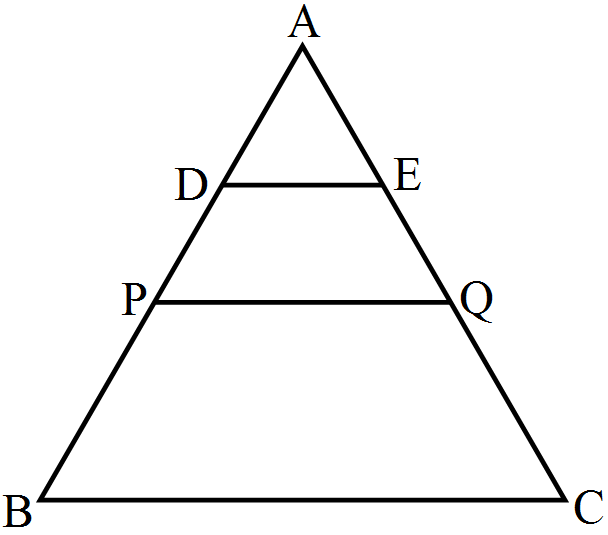
$\triangle\text{ABC}$ is given with D a point on AB such that $\text{AD}=\frac{1}{4}\text{AB}.$

Also, E is point on AC such that $\text{AE}=\frac{1}{4}\text{AC}.$
We need to prove that $\text{DE}=\frac{1}{4}\text{BC}$
Let P and Q be the mid points of AB and AC respectively.
it is given that
$\text{AD}=\frac{1}{4}\text{AB}$ and $\text{AE}=\frac{1}{4}\text{AC}$
But, we have taken P and Q as the mid points of AB and AC respectively.
therefore, D and E are the mid-points of AP and AQ respectively.
in $\triangle\text{ABC},$ P and Q are the mid-points of AB and AC respectively.
Theorem states, the line segment joining the mid-points of any any two sides of a triangle is parallel to the third side and equal to half of it.
Therefore, we get PQ || BC and $\text{PQ}=\frac{1}{2}\text{BC}\ ...(\text{i})$
in $\triangle\text{APQ},$ D and E are the mid-point of AP and AQ respectively.
Therefore, we get DE || PQ and $\text{DE}=\frac{1}{2}\text{PQ}\ ...(\text{ii})$
From (i) and (ii), we get:
$\text{DE}=\frac{1}{4}\text{BC}$
Hence proved.

Need a full question paper?

Generate a complete, print-ready paper with questions like this in minutes — across 16+ boards, with answer keys.
Start Generating Free

Similar questions

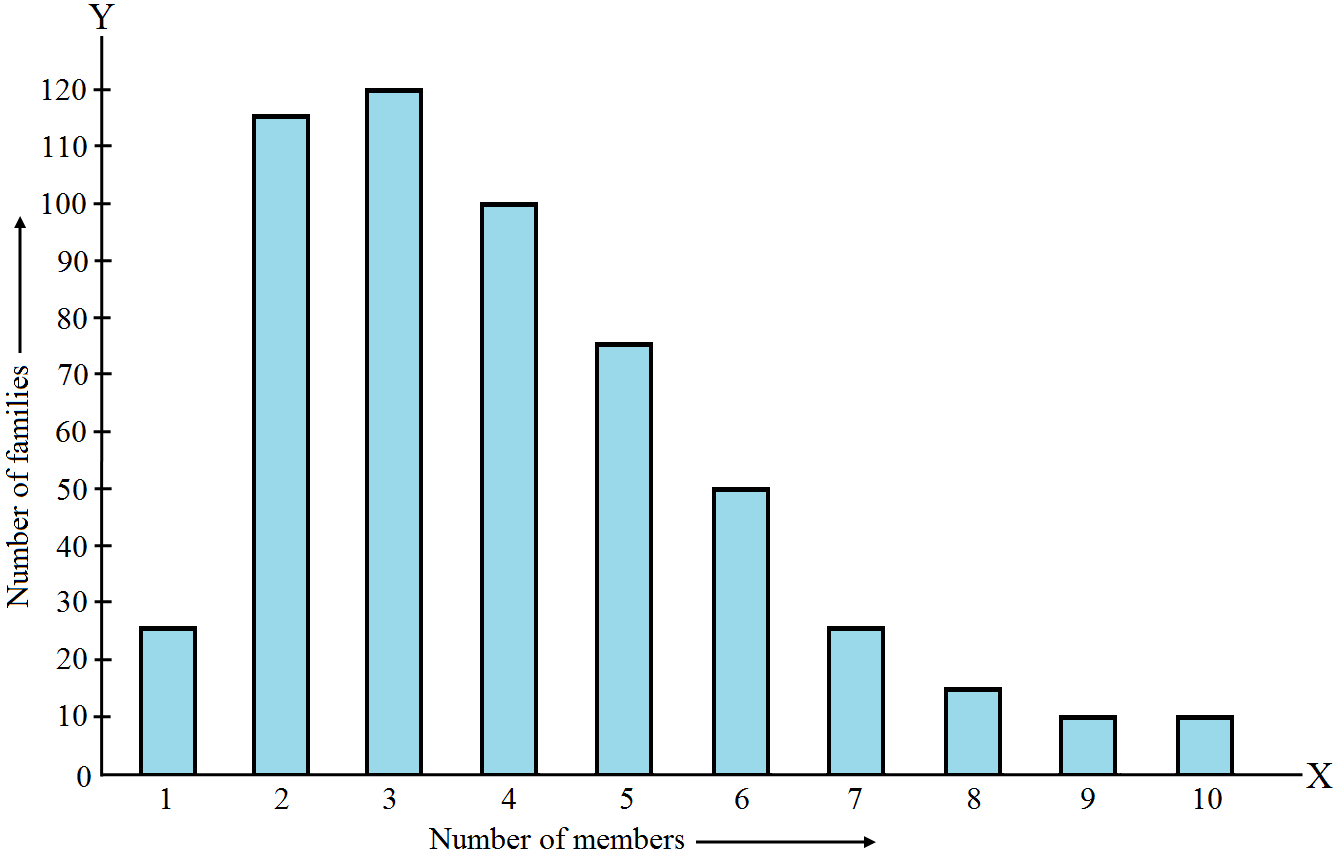
Read the bar graph given in figure and answer the following questions:
  1. What is the information given by the bar graph?
  2. What is the number of families having 6 members?
  3. How many members per family are there in the maximum number of families? Also tell the number of such families.
  4. What are the number of members per family for which the number of families are equal? Also, tell the number of such families?
​​​​​​​
On the plane of a graph paper draw X' OX and YOY' as coordinate axes and plot each of the following points.
  1. A(5, 3)
  2. B(6, 2)
  3. C(-5, 3)
  4. D(4, -6)
  5. E(-3, -2)
  6. F(-4, 4)
  7. G(3, -4)
  8. H(5, 4)
  9. I(0, 6)
  10. J(-3, 0)
  11. K (0, -2)
  12. O(0, 0)
Three vertices of a rectangle ABCD are A(3, 1), B(-3, 1) and C(-3, 3). plot these points on a graph paper and find the coordinates of the fourth vertex D. Also find the area of rectangle ABCD.
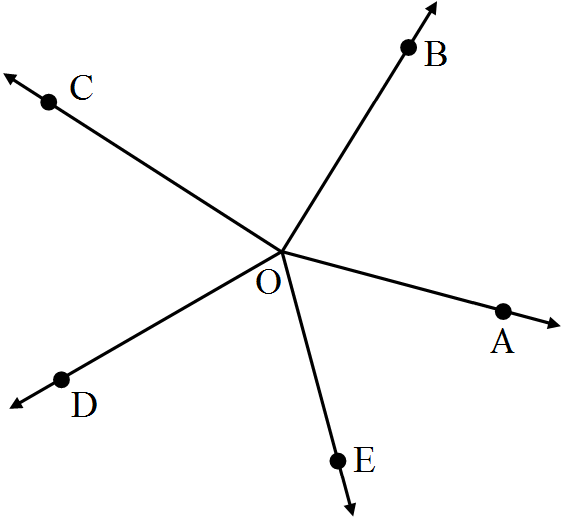
In figure, rays OA, OB, OC, OD and OE have the common end point O. Show that $\angle\text{AOB}+\angle\text{BOC}+\angle\text{COD}+\angle\text{DOE}+\angle\text{EOA}=360^\circ.$

ABC is an isoscles triangle in which AC = BC. AD are respectively two altitudes to sides BC and BC. prive that AE = BD.
1cm3 of gold is drawn into a wire 0.1mm in diameter. Find the length of the wire.
Plot the points A(2, 5), B(-2, 2) and C(4, 2) on a graph paper. Join AB, BC and AC. Calculate the area of $\triangle\text{ABC}.$
Construct a triangle XYZ in which $\angle\text{Y}=30^\circ,$ $\angle\text{Z}=90^\circ$ and XY + YZ + ZX = 11cm.
Read the following statement:
An equilateral triangle is a polygon made up of three line segments out of which two line segments are equal to the third one and all its angles are 60° each. Define the terms used in this definition which you feel necessary. Are there any undefined terms in this? Can you justify that all sides and all angles are equal in a equilateral triangle.
The perimeter of a triangular field is 240dm. If two of its sides are 78dm and 50dm, find the length of the perpendicular on the side of length 50dm from the opposite vertex.