MCQ
$ABC$ is a triangle in which angle $C$ is a right angle. If the coordinates of $A$ and $B$ be $(-3, 4)$ and $(3, -4)$ respectively, then the equation of the circumcircle of triangle $ABC$ is
  • A
    ${x^2} + {y^2} - 6x + 8y = 0$
  • ${x^2} + {y^2} = 25$
  • C
    ${x^2} + {y^2} - 3x + 4y + 5 = 0$
  • D
    None of these

Answer

Correct option: B.
${x^2} + {y^2} = 25$
b
(b) $AB$ must be diameter because semi-circle subtends right angle to circumference.

Therefore, find the equation of circle as the line joining the points $A( - 3,\;4)$ and $B(3,\; - 4)$ as diameter.

Need a full question paper?

Generate a complete, print-ready paper with questions like this in minutes — across 16+ boards, with answer keys.

Start Generating Free

Similar questions

If $1,\omega ,{\omega ^2},{\omega ^3}.......,{\omega ^{n - 1}}$ are the $n,{n^{th}}$ roots of unity, then $(1 - \omega )(1 - {\omega ^2}).....(1 - {\omega ^{n - 1}})$ equals
Let $G$ be a circle of radius $R>0$. Let $G_1, G_2, \ldots, G_n$ be $n$ circles of equal radius $r>0$. Suppose each of the $n$ circles $G_1, G_2, \ldots, G_n$ touches the circle $G$ externally. Also, for $i=1,2, \ldots, n-1$, the circle $G_i$ touches $G _{ i +1}$ extemally, and $G _{ n }$ touches $G _1$ externally. Then, which of the following statements is/are $TRUE$ ?

$(A)$ If $n =4$, then $(\sqrt{2}-1) r < R$

$(B)$ If $n =5$, then $r < R$

$(C)$ If $n =8$, then $(\sqrt{2}-1) r < R$

$(D)$ If $n =12$, then $\sqrt{2}(\sqrt{3}+1) r > R$

Coefficient of ${t^{12}}$  in ${\left( {1 + {t^2}} \right)^6}\left( {1 + {t^6}} \right)\left( {1 + {t^{12}}} \right)$ is-
If $C_0+C_1+C_2+\ldots+C_n=256$, then ${ }^{2 n} C_2$ is equal to:
The straight line $y=m x+c$ cuts the circle $x^2+y^2=a^2$ in real points if:
${11^2} + {12^2} + {13^2} + {.......20^2} = $
One side of a rectangle lies along the line $4x + 7y + 5 = 0.$ Two of its vertices are $(-3, 1)$ and $(1, 1)$. Then the equations of other three sides are
The equation of the tangent to the parabola ${y^2} = 4ax$ at point $(a/{t^2},\;2a/t)$ is
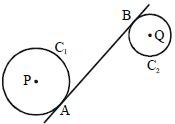
In the figure shown, radius of circle $C_1$ be $ r$ and that of $C_2$ be $\frac{r}{2}$ , where $r= \frac {1}{3} PQ,$ then length of $AB$ is (where $P$ and $Q$ being centres of $C_1$ $\&$ $C_2$ respectively)
arg $(\bar{\text{z}})$ is equal to: