Question
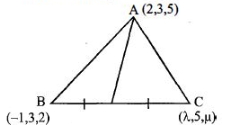
$ABC$ is triangle in a plane with vertices $A(2, 3, 5), B (-1 , 3, 2)$ and $C\left( {\lambda ,5,\mu } \right)$ . lf the median through $A$ is equally inclined to the coordinate axes, then the value of $\left( {{\lambda ^3}+{\mu ^3} + 5} \right)$ is
Answer

b
$DR'$ of $AD$ are $\frac{{\lambda  - 1}}{2}\,\, - 2,4 - 3,\frac{{\mu  + 2}}{2}\, - 5$

i.e. $\frac{{\lambda  - 5}}{2}\,\,,1,\frac{{\lambda  - 8}}{2}\,\,$

$\because$ This median is making equal angles with coordinate axes, therefore,

$\frac{{\lambda  - 5}}{2}\,\, = 1 = \frac{{\mu  - 8}}{2}\,$

$ \Rightarrow \lambda  = 7\,\,\& \,\,\mu  = 10$

$\therefore {\lambda ^3} + {\mu ^3} = 5 = 1348$

Need a full question paper?

Generate a complete, print-ready paper with questions like this in minutes — across 16+ boards, with answer keys.

Start Generating Free

Similar questions

Let the coefficients of the middle terms in the expansion of $\left(\frac{1}{\sqrt{6}}+\beta x\right)^{4},(1-3 \beta x)^{2}$ and $\left(1-\frac{\beta}{2} x\right)^{6}, \beta>0$, respectively form the first three terms of an $A.P.$ If $d$ is the common difference of this $A.P.$, then $50-\frac{2 d}{\beta^{2}}$ is equal to.
The number of $7$ digit numbers which can be formed using the digits $1, \,2, \,3, \,2,\ ,3,\, 3,\, 4$ is
If $\vec{a}$ and $\vec{b}$ are vectors in space given by $\vec{a}=\frac{\hat{i}-2 \hat{j}}{\sqrt{5}}$ and $\vec{b}=\frac{2 \hat{i}+\hat{j}+3 \hat{k}}{\sqrt{14}}$, then the value of $(2 \vec{a}+\vec{b}) \cdot[(\vec{a} \times \vec{b}) \times(\vec{a}-2 \vec{b})]$ is
If $1,\omega ,{\omega ^2}$ are the cube roots of unity, then $\Delta = \left| {\,\begin{array}{*{20}{c}}{1\,\,\,\,}&{{\omega ^n}}&{{\omega ^{2n}}}\\{{\omega ^n}\,\,}&{\,\,\,{\omega ^{2n}}\,\,}&1\\{{\omega ^{2n}}\,}&{1\,\,}&{{\omega ^n}}\end{array}} \right|$=
Let $S=\left\{p_{1}, p_{2} \ldots \ldots, p_{10}\right\}$ be the set of first ten prime numbers. Let $\mathrm{A}=\mathrm{S} \cup \mathrm{P}$, where P is the set of all possible products of distinct element of S . Then the number of all ordered pairs ( $x, y$ ), $x \in S$, $y \in A$, such that $x$ divides $y$, is ______________ .
$\int_{ - \pi /2}^{\pi /2} {\sqrt {\frac{1}{2}(1 - \cos 2x)} } \,dx = $
The minimum value of $\left( {{x^2} + {{250} \over x}} \right)$ is
The number of ordered pairs $(a, b)$ of positive integers such that $\frac{2 a-1}{b}$ and $\frac{2 b-1}{a}$ are both integers is
Let $\vec a = 2\hat i + \hat j - 2\hat k$ and $\vec b = \hat i + \hat j$ . Let $\vec c$ be vector such that $\left| {\vec c - \vec a} \right| = 3,\;\left| {\left( {\vec a \times \vec b} \right) \times \vec c} \right| = 3$ and the angle between $\vec c$ and $\vec a \times \vec b$ be $30^\circ $ . Then $\vec a \cdot \vec c$ is equal to :
The solution of the equation $(x + 1) + (x + 4) + (x + 7) + ......... + (x + 28) = 155$ is