Question
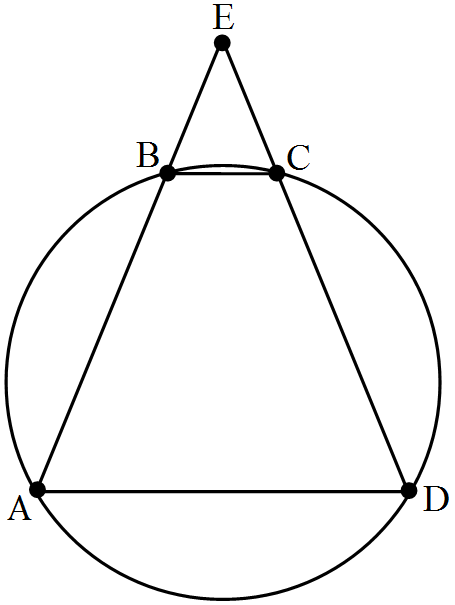
$\text{ABCD}$ ia a cyclic quadrilateral in which $BA$ and $CD$ when produced meet in $E$ and $EA = ED$. Prove that:
$i. AD \| BC$.
$ii. EB = EC$.

Answer


Given $ABCD$ is a cyclic quadrilateral in which $EA = ED$ To prove:
$i. AD \| BC$.
$ii. EB = EC$.
Proof:
$i.$ Since $EA = ED$
Then, $\angle\text{EAD}=\angle\text{EDA}\dots(1) [$Oppo. angles to equal sides$]$
Since, $\text{ABCD}$ is a cyclic quadrilateral
Then, $\angle\text{ABC}+\angle\text{ADC}=180^\circ$
But $\angle\text{ABC}+\angle\text{EBC}=180^\circ [$Linear pair of angles$]$
Then, $\angle\text{ADC}=\angle\text{EBC}\dots(2)$
Compare equations $(1)$ and $(2)$
$\angle\text{EAD}=\angle\text{EBC}\dots(3)$
Since, corresponding angles are equal
Then, $BC \| AD$
$ii.$ From equation $(3)$
$\angle\text{EAD}=\angle\text{EBC}\dots(3)$
Similarly $\angle\text{EDA}=\angle\text{ECB}\dots(4)$
Compare equations $(1)(3)$ and $(4)$
$\angle\text{EBC}=\angle\text{ECB}$
$\Rightarrow \text{EB}=\text{EC} [$Opposite angles to equal sides$]$

Need a full question paper?

Generate a complete, print-ready paper with questions like this in minutes — across 16+ boards, with answer keys.

Start Generating Free