Question
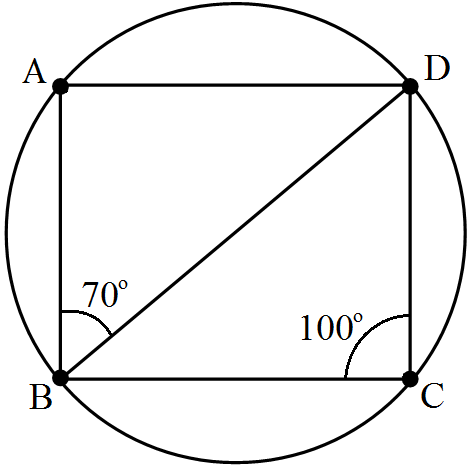
$ABCD$ is a cyclic qudrilateral in which: $\angle\text{BCD}=100^\circ$ and $\angle\text{ABD}=70^\circ$ find $\angle\text{ADB}.$
Answer


Since, $ABCD$ is a cyclic quadrilateral.
Then, $\angle\text{BAD}+\angle\text{BCD}=180^\circ$
$\Rightarrow\angle\text{BAD}+100^\circ=180^\circ$
$\Rightarrow\angle\text{BAD}=180^\circ-100^\circ=80^\circ$ In by angle sum property
$\angle\text{ABD}+\angle\text{ADB}+\angle\text{BAD}=180^\circ$
$\Rightarrow70^\circ+\angle\text{ADB}+80^\circ=180^\circ$
$\Rightarrow\angle\text{ADB}=180^\circ-70^\circ-80^\circ=30^\circ$ 

Need a full question paper?

Generate a complete, print-ready paper with questions like this in minutes — across 16+ boards, with answer keys.
Start Generating Free

Similar questions

Find five rational numbers between $1$ and $2.$
The bisectors of base angles of a triangle cannot enclose a right angle in any case.
In a $\triangle\text{ABC},$ if $\angle\text{A}=120^\circ$ and $\text{AB}=\text{AC}.$ Find $\angle\text{A}$ and $\angle\text{C}.$
The daily minimum temperatures in degrees Celsius recorded in a certain arctic region are as follows:
$-12.5, -10.8, -18.6, -8.4, -10.8, -4.2, -4.8, -6.7, -13.2, -11.8, -2.3, 1.2, 2.6, 0, -2.4, 0, 3.2, 2.7, 3.4, 0, -2.4, -2.4, 0, 3.2, 2.7, 3.4, 0, -2.4, -5.8, -8.9, -14.6, -12.3, -11.5, -7.8, -2.9.$
Represent them as frequency distribution table taking $-19.9$ to $-15$ as the first class interval.
A square is inscribed in an isosceles right triangle so that the square and the triangle have one angle common. Show that the vertex of the square opposite the vertex of the common angle bisects the hypotenuse.
A wall $15\ m$ long, $30\ cm$ wide and $4\ m$ high is made of bricks, each measuring $(22cm \times 12.5cm \times 7.5cm)$. If $\frac{1}{12}$ of the total volume of the wall consists of mortar, how many bricks are there in the wall?
Give a method to find the centre of a given circle.
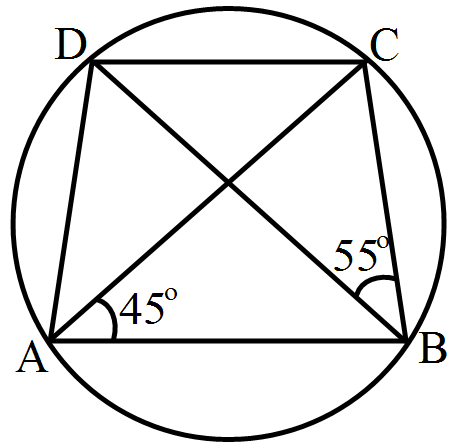
In the given figure, $ABCD$ is a cyclic quadrilateral in which $AC$ and $BD$ are its diagonals. If $\angle\text{DBC}=55^\circ$ and $\angle\text{BAC}=45^\circ,$ find $\angle\text{BCD}.$
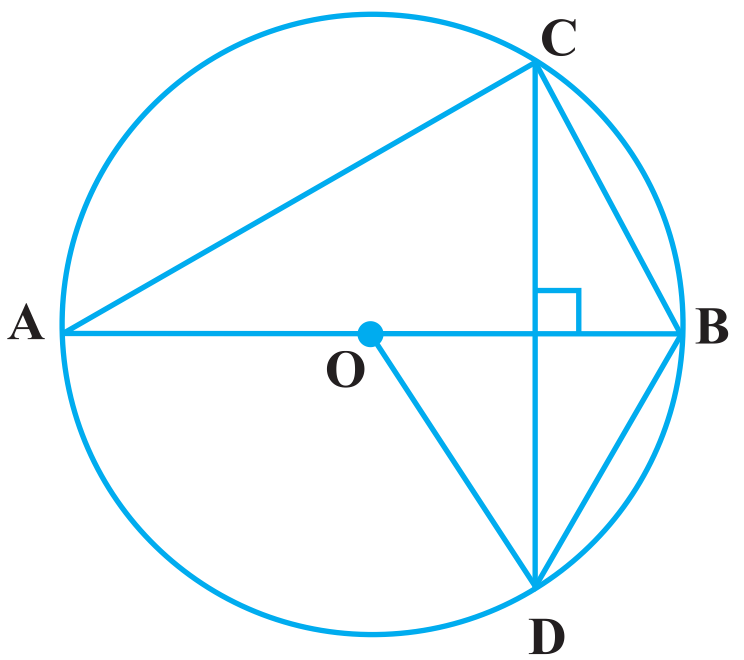
In Fig. $O$ is the centre of the circle, $BD = OD$ and $\text{CD}\bot\text{AB}.$ Find $\angle\text{CAB}.$
In the following, using the remainder theorem, find the remainder when $f(x)$ is divided by $g(x)$ and verify the by actual division: $f(x) = x^4 - 3x^2 + 4, g(x) = x - 2$