Question
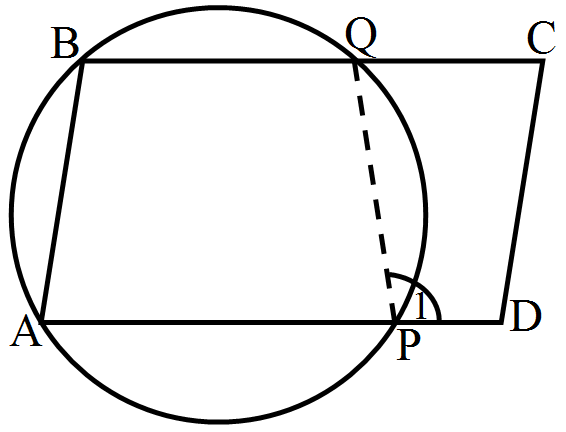
$ABCD$ is a parallelogram. $A$ circle through $A, B$ is so drawn that it intersects $AD$ at $P$ and $BC$ at $Q.$ Prove that $P, Q, C$ and $D$ are concyclic.
Answer

$ABCD$ is a parallelogram. A circle through $A, B$ is so drawn that intersects $AD$ at $P$ and $BC$ at $Q.$ We have to prove that $P, Q, C$ and $D$ are concyclic. Join $PQ.$

​​​​​​​Now, side $AP$ of the cyclic quadrilateral $APQB$ produced to $D.$
$\therefore\ \text{Ext. }\angle1=\text{int.opp. }\angle\text{B}$
$\because BA || CD$ and $BC$ cuts them
$\therefore\angle\text{B}+\angle\text{C}=180^\circ$ [ $\because$ sum of int. $\angle\text{s}$ on the same side of the transversal is $180^\circ ] $ or
$\angle1+\angle\text{C}=180^\circ\ [\therefore\angle1=\angle\text{B}\ (\text{proved})]$
$\therefore PDCQ$ is cyclic quadrilateral.
Hence, the point $P, Q$, and are concyclic.

Need a full question paper?

Generate a complete, print-ready paper with questions like this in minutes — across 16+ boards, with answer keys.
Start Generating Free

Similar questions

$P, Q, R$ and $S$ are respectively the mid-points of the sides $AB, BC, CD$ and $DA$ of a quadrilateral $ABCD$ in which $AC = BD.$ Prove that $PQRS$ is a rhombus.
A wooden bookshelf has external dimensions as follows: Height $= 110\ cm$, Depth $= 25\ cm,$ Breadth $= 85\ cm$ (See figure). The thickness of the plank is $5\ cm$ everywhere. The external faces are to be polished and the inner faces are to be painted. If the rate of polishing is $20$ paise per $cm^2$. Find the total expenses required for polishing and painting the surface of the bookshelf.
In the given figure, $CD \| AE$ and $CY \| BA$.
$i.$ Name a triangle equal in area of $\triangle\text{CBX}$
$ii.$ Prove that $\text{ar}(\triangle\text{ZDE})=\text{ar}(\triangle\text{CZA})$
$iii.$ Prove that $\text{ar}(\text{BCZY})=\text{ar}(\triangle\text{EDZ}).$
$ABCD$ is such a quadrilateral that $A$ is the centre of the circle passing through $B, C$ and $D.$ Prove that $\angle\text{CBD}+\angle\text{CDB}=\frac{1}{2}\angle\text{BAD}$
The bisectors of base angles of a triangle cannot enclose a right angle in any case.
If the medians of a $\triangle\text{ABC}$ intersect at $G,$ show that $ar\ (AGB) = ar\ (AGC) = ar\ (BGC)$ $=\frac{1}{3}\text{ar}(\text{ABC})$
A circle has radius $\sqrt{2}\text{cm}.$ It is divided into two segments by a chord of length $2\ cm.$ Prove that the angle subtended by the chord at a point in major segment is $45^\circ .$
Visualize the representation of 3.765 on the number line using successive magnification.
In a triangle, P, Q and R are the mid points of sides BC, CA and AB respectively. If AC = 21cm, BC = 29cm and AB = 30cm, find the perimeter of the quadrilateral ARPQ.