Question
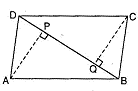
$ \text{ABCD}$ is a parallelogram and $AP$ and $CQ$ are perpendiculars from vertices $A$ and $C$ on diagonal $BD$ respectively.
Show that :
  1. $\triangle APB  \cong \triangle CQD$
  2. $AP = CQ.$

Answer

Given: $ABCD$ is a parallelogram and $AP$ and $CQ$ are perpendicular from vertices $A$ and $C$ on diagonal $BD$ respectively.
To Prove :
  1. $\triangle APB  \cong \triangle CQD$
  2. $AP = CQ.$
Proof :
  1. In $\triangle APB$ and $\triangle CQD$
    $AB = CD . . . [$Opp. sides of $|| \ gm \ \text{ABCD}]$
    $\angle ABP =  \angle CDQ . . .[$Alternate interior angles for $AB \ ||\ CD]$
    $\therefore \angle APB =  \angle CQD . . .[$Each $90^\circ]$
    $\triangle APB  \cong \triangle CQD . . . [$By $\text{AAS}$ rule$]$
  2. As $\triangle APB  \cong \triangle CQD . . .[$As proved above$]$
    $\therefore AP = CQ . . .[c.p.c.t.]$

Need a full question paper?

Generate a complete, print-ready paper with questions like this in minutes — across 16+ boards, with answer keys.

Start Generating Free

Similar questions

Express the following decimals in the form $\frac{\text{p}}{\text{q}},$ where p, q are integers and $\text{q}\neq0.$
$0.\overline{235}$
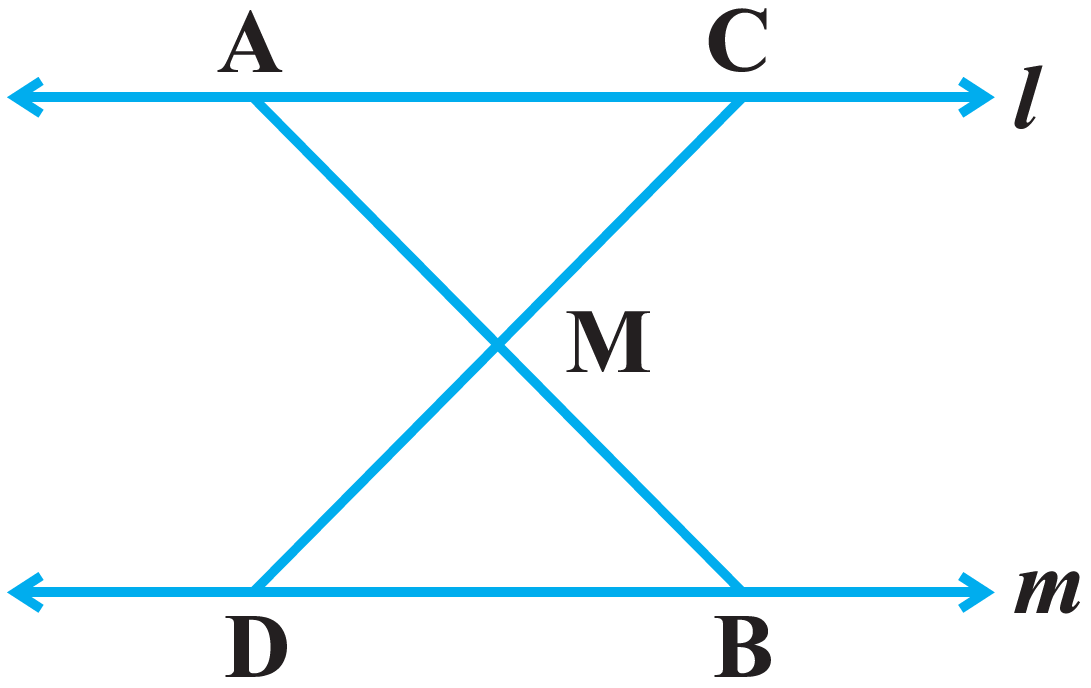
In given $\text{l}\ ||\ \text{m}$ and M is the mid-point of a line segment AB. Show that M is also the mid-point of any line segment CD, having its end points on l and m, respectively.
The percentage of marks obtained by a student in the monthly unit tests are given below:
Unit Test
I
II
III
IV
V
Percentage of Mark Obtained
69
71
73
68
76
Find the probability that the student gets:
  1. More than 70% marks.
  2. Less than 70% marks.
  3. A distinction
Express the following decimals in the form $\frac{\text{p}}{\text{q}},$ where p, q are integers and $\text{q}\neq0.$
$0.\overline{53}$
Factorize : $6ab - b^2 + 12ac - 2bc$
Find the area of an equilateral triangle having each side x cm.
An angle is equal to its supplement. Determine its measure.
Rationalise the denominator of the following:
$\frac{3\sqrt{5}+\sqrt{3}}{\sqrt{5}-\sqrt{3}}$
Prove that:
$\frac{1}{1+\text{x}^{\text{a}-\text{b}}}+\frac{1}{1+\text{x}^{\text{b}-\text{a}}}=1$
If the temperature of a liquid can be measured in kelvin units as x°K or in fahrenheit units as y°F, the relation between the two systems of measurement of temperature is given by the linear equation.
$\text{y}=\frac{9}{5}(\text{x}-273)+32$
  1. find the temperature of the liquid in fahrenheit, if the temperature of the liquid is 313K.
  2. If the temperature is 158°F, then find the temperature in kelvin.