Question
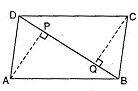
$\text{ABCD}$ is a parallelogram and $AP$ and $CQ$ are perpendiculars from vertices $A$ and $C$ on diagonal $BD$ respectively.
Show that :
$i. \triangle APB \cong \triangle CQD$
$ii. AP = CQ.$

Answer

Given: $\text{ABCD}$ is a parallelogram and $A P$ and $C Q$ are perpendicular from vertices $A$ and $C$ on diagonal $B D$ respectively.
To Prove:
$\triangle APB \cong \triangle CQD$
$A P=C Q$
Proof:
In $\triangle A P B$ and $\triangle C Q D$
$A B=C D \ldots [$Opp. sides of $\| gm \text{ABCD}]$
$\angle A B P=\angle C D Q \ldots [$Alternate interior angles for $A B \| C D]$
$\therefore \angle APB =\angle CQD \ldots\left[\right.$ Each $\left.90^{\circ}\right]$
$\triangle APB \cong \triangle C Q D \ldots [$By $\text{AAS}$ rule$]$
As $\triangle A P B \cong \triangle C Q D \ldots [$As proved above$]$
$\therefore A P=C Q \ldots [\text {c.p.c.t.}]$

Need a full question paper?

Generate a complete, print-ready paper with questions like this in minutes — across 16+ boards, with answer keys.

Start Generating Free