Question
ABCD is a parallelogram. G is a point on AB such that AG = 2GB and E is point on DC such that CE = 2DE and F is the point of BC such that BF = 2FC. Prove that:
  1. $\text{ar}(\text{ADEG})=\text{ar}(\text{GBCE})$
  2. $\text{ar}{(\triangle\text{EGB}})=\frac{1}{6}\text{ar}(\text{ABCD})$
  3. $\text{ar}(\triangle\text{EFC})=\frac{1}{2}\text{ar}(\triangle\text{EBF})$
  4. $\text{ar}(\triangle\text{EBG})=\text{ar}(\triangle\text{EFC})$
  5. Find what portion of the parallelogram is the area of $\triangle\text{EFG}.$
Answer

ABCD is a parallelogram AG = 2GB, CE = 2DE, BF = 2FC To prove: ABCD is ||gm ar(EBG) = ar(EFC) AB || CD (AB = CD)$\text{BG}=\frac{1}{3}\text{AB},\ \text{DE}=\frac{1}{3}\text{CD}$
$\therefore\ \text{BG}=\text{DE}$
$\therefore\ \text{ADEH}$ is ||gm
ar(||gm ADEH) = ar(||gm BCIG) ...(i) ar$(\triangle\text{HEG})$ = ar$(\triangle\text{EGI})$ ..(ii) ($\because$ diagonal of ||gm divided into 2 equal areas) (i) and (ii)$\therefore\text{ar}(||\text{gm}\text{ ADEG})=\text{ar}(||\text{gm}\text{ GBCE})$
Height, h of ||gm ABCD and $\triangle\text{EGB}$ is Its same Base of $\triangle\text{EGB}=\frac{1}{3}\text{AB}$ area of ABCD = h × AB$\text{ar}(\triangle\text{EGB})=\frac{1}{6}\times\text{h}\times\frac{1}{3}\text{AB}=\frac{1}{6}\text{h}\times\text{AB}$
$\text{ar}(\text{EGB})=\frac{1}{6}\text{Area}(\text{ABCD})$
let dislaver between EH and CB = x$\text{ar}(\text{EBF})=\frac{1}{2}\times\text{BF}\times\text{x}=\frac{1}{2}\times\frac{2}{3}\text{BC}\times\text{x}=\frac{1}{3}\times\text{BC}\times\text{x}$
$\text{ar}(\text{EFC})=\frac{1}{2}\times\text{CF}\times\text{x}=\frac{1}{2}\times\frac{1}{3}\text{BC}\times\text{x}=\frac{1}{2}\times\text{ar}\times(\text{EBF})$
$\Rightarrow\text{ar}(\text{EFC})=\frac{1}{2}\times\text{area of EBF}$
If g = altitute from AD to BC$\text{ar}(\text{EFC})=\frac{1}{2}\times\frac{2}{3}\text{g}\times\frac{1}{3}\text{BC}=\frac{1}{9}\text{ar}(\text{ABCD})$
$\Rightarrow\text{ar}(\text{EFC})=\frac{2}{3}\text{ar}\text{ EBG}$
$\text{ar}(\text{EFG})=\text{ar}(\text{EGB})+\text{ar}(\text{FBF})+\text{ar}(\text{EFC})$
$=\frac{1}{6}\text{ABCD}+2\text{ar}(\text{EFC})+\text{ar}(\text{EFC})$
$=\frac{1}{6}\text{ABCD}+3\text{ar}(\text{EFC})$
$=\frac{1}{6}\text{ABCD}+\not3\times\frac{1}{\not9}\times\text{ABCD}$
$=\Big(\frac{1}{6}+\frac{1}{3}\Big)\text{ABCD}$
$=\Big(\frac{1+2}{6}\Big)\text{ABCD}$
$=\frac{1}{2}\text{ABCD}$

Need a full question paper?

Generate a complete, print-ready paper with questions like this in minutes — across 16+ boards, with answer keys.

Start Generating Free

Similar questions

In a competitive examination, there were 60 questions. The correct answer would carry 2 marks, and for incorrect answer 1 mark would be subtracted. Yashwant had attempted all the questions and he got total 90 marks. Then how many questions he got wrong?
If $x-2$ and $x-\frac{1}{2}$ both are the factors of the polynomial $n x^2-5 x+m$, then show that $m=$ $n=2$
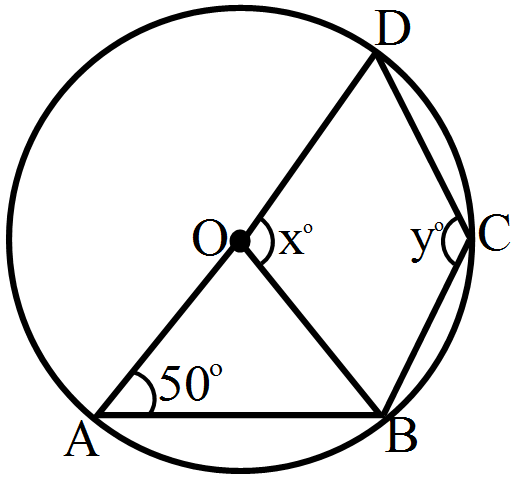
In the given figure, O is the centre of the circle and $\angle\text{DAB}=50^\circ.$Calculate the values of x and y.
If $\frac{y+z}{a}=\frac{z+x}{b}=\frac{x+y}{c}$, then show that $\frac{x}{b+c-a}=\frac{y}{c+a-b}=\frac{z}{a+b-c}$.
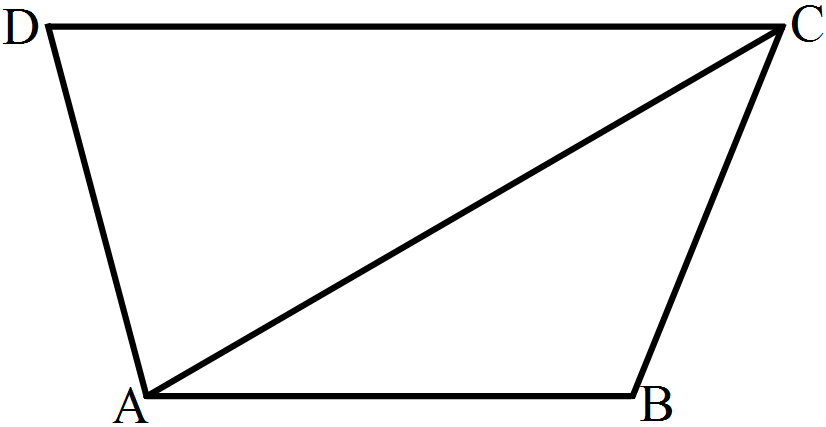
In the adjoining figure, ABCD is a quadrilateral and AC is one of its diagonals. Prove that:
(i) AB + BC + CD + DA > 2AC
(ii) AB + BC + CD > DA
(iii) AB + BC + CD + DA > AC + BD
In a quadrilateral ABCD, show that
(AB + BC + CD + DA) <2 (BD + AC).
In figure, ABCD is a parallelogram. O is any point on AC. PQ || AB and LM || AD. Prove that: $\text{ar}(||^{\text{gm}}\text{ DLOP})=\text{ar}(||^{\text{gm}}\text{ BMOQ}).​​​$
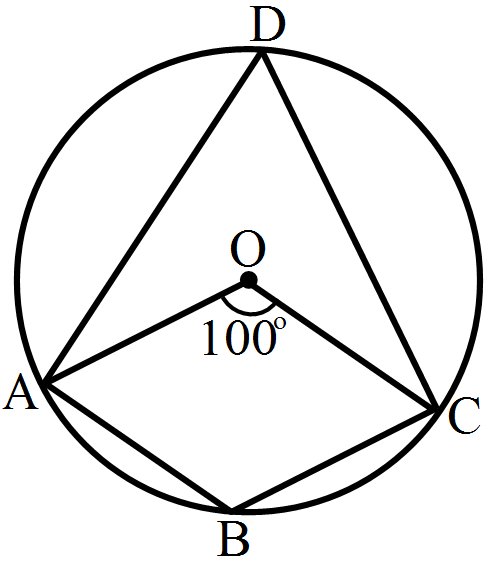
In the given figure, O is the centre of the given circle and measure of arc ABC is 100°. Determine $\angle\text{ADC}$ and $\angle\text{ABC}.$
Take different examples of sets and verify the above mentioned properties.
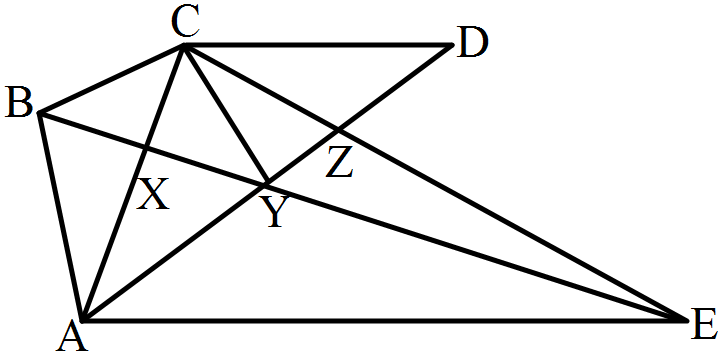
In the given figure, CD || AE and CY || BA.
  1. Name a triangle equal in area of $\triangle\text{CBX}$
  2. Prove that $\text{ar}(\triangle\text{ZDE})=\text{ar}(\triangle\text{CZA})$
  3. Prove that $\text{ar}(\text{BCZY})=\text{ar}(\triangle\text{EDZ}).$