Question
$ABCD$ is a parallelogram in which $BC$ is produced to $E$ such that $CE = BC$ (Fig.) $AE$ intersects $CD$ at $F.$ If ar $(DFB) = 3\ cm^2$ , find the area of the parallelogram $ABCD$. 

Answer

Given, $ABCD$ is a parallelogram and $CE = BC$
i.e., $C$ is the mid-point of $BE.$
 Also, $\text{ar}(\triangle\text{DFB})=3\text{cm}^2$
Now, $\triangle\text{ADF}$ and $\triangle\text{DFB}$
are on the same base DF and between parallel $CD$ and $AB.$
Then $\text{ar}(\triangle\text{ADF})=\text{ar}(\triangle\text{DFB})=3\text{cm}^2\ ...(\text{i})$ In
$\triangle\text{ADF}$ by the converse of of mid point theorem,
$EF = AF [$since, $C$ is mid-point of $BE] ...(ii)$ In $\triangle\text{ADF}$
and $\triangle\text{ECF},$
$\angle\text{AFD}=\angle\text{CFG}$ [vertically opposite angle]
$AF = EF \angle\text{DAF}=\angle\text{CEF} [$since $BE || AD$ and $AE$ is transversal,
then alternate interior angles are equal]
$\triangle\text{ADF}\cong\triangle\text{ECF} [$by $ASA$ congurance rule$]$
Then, $\text{ar}(\triangle\text{ADF})=\text{ar}(\triangle\text{CFE})$ [since, congurant figure have equal area]
$\therefore\text{ar}(\triangle\text{CEF})=\text{ar}(\triangle\text{ADF})=3\text{cm}^2 [$From EQ. $(i)] ...(iii)$
Now, In $\triangle\text{BFE}, C$ is the mid point of $BE$ then $CF$ is median of
$\triangle\text{BFE},$
$\therefore\text{ar}(\triangle\text{CEF})=\text{ar}(\triangle\text{BFC})$ [since, median of a triangle divides it into two triangle of equal area]
$\Rightarrow\text{ar}(\triangle\text{CEF})=\text{ar}(\triangle\text{BFC})$ [since, median of a triangle divides it into two triangles of equal area]
$\Rightarrow\text{ar}(\triangle\text{BFC})=3\text{cm}^2$
Now, $\text{ar}(\triangle\text{BDC})=\text{ar}(\triangle\text{CFB})+\text{ar}(\triangle\text{BFC})$
$=3+3=6\ \text{cm}^2 [$from $EQS. (i)$ and $(iv)]$
We know that, diagonal of a parallelogram divides it into two congurant triangle of equal area.
$\therefore$ Area of parallelogram $ABCD = 2 \times $ Area of $\triangle\text{BDC}$
$= 2 \times 6 = 12\ cm^2$
 Hence, the area of parallelogram $ABCD$ is $12\ cm^2.$

Need a full question paper?

Generate a complete, print-ready paper with questions like this in minutes — across 16+ boards, with answer keys.

Start Generating Free

Similar questions

Expenditure on Education of a country during a five year period ($2002-2006$), in crores of rupees, is given below:
Elementary education
Secondary Education
University Education
Teacher’s Training
Social Education
Other Educational Programmes
Cultural programmes
Technical Education
$240$
$120$
$190$
$20$
$10$
$115$
$25$
$125$
Represent the information above by a bar graph.
Two lines $AB$ and $CD$ intersect at $O$ such that $BC$ is equal and parellel to $AD$. prove that the lines $AB$ and $CD$ bisect at $O.$
Find the values of $a$ and $b$ in the following: $\frac{7+\sqrt{5}}{7-\sqrt{5}}=\frac{7-\sqrt{5}}{7+\sqrt{5}}=\text{a}+\frac{7}{11}\sqrt{5}\text{b}$
Why do we group data?
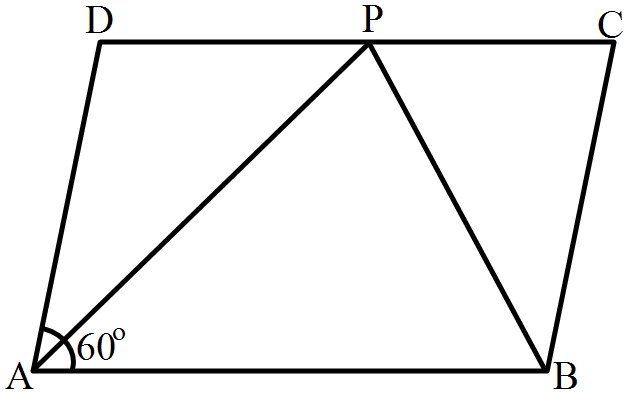
In Figure, $ABCD$ is a parallelogram in which $\angle\text{A}=60^\circ$. If the bisectors of $\angle\text{A}$, and $\angle\text{B}$ meet at $P$, prove that $AD = DP, PC = BC$ and $DC = 2AD$.
Using factor theorem, factorize the following polynomials: $y^3 - 2y^2 - 29y - 42$
Rationalise the denominator of the following:
$\frac{4}{2+\sqrt{3}+\sqrt{7}}$
Show that the line segments joining the mid-points of the opposite sides of a quadrilateral bisect each other.


The marks scored by $55$ students in a test are given below:
Marks
$0-5$
$5-10$
$10-15$
$15-20$
$20-25$
$25-30$
$30-35$
No. of students
$2$
$6$
$13$
$17$
$11$
$4$
$2$
Prepare a cumulative frequency table.
The image of an object placed at a point A before a plane mirror $LM$ is seen at the point B by an observer at $D$ as shown in figure. Prove that the image is as far behind the mirror as the object is in front of the mirror.