Question
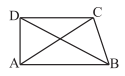
$ABCD$ is a quadrilateral. Is $AB + BC + CD + DA < 2(AC + BD) ?$
Answer

In \triangle $OAB,$
$OA + OB > AB. . .$ [Sum of the lengths of any two sides of a triangle is greater than the length of the third side]$ . . . . (i)$
In $\triangle OBC,$
$OB + OC > BC . . .$ [Sum of the lengths of any two sides of a triangle is greater than the length of the third side]$ . . . . (ii)$
In $\triangle OCD,$
$OC + OD > CD. . . $[Sum of the lengths of any two sides of a triangle is greater than the length of the third side]$ . . . . (iii)$
In $\triangle OAD,$
$OA + OD > AD . . . $[Sum of the lengths of any two sides of a triangle is greater than the length of the third side] $. . . . (iv)$
Adding $(1), (2), (3)$ and $(4)$
$2 (OA + OB + OC + OD) > AB + BC + CD + DA$
$ \therefore AB + BC + CD + DA < 2(OA + OB + OC + OD)$
$ \therefore AB + BC + CD + DA < 2(OA + OC + OB + OD)$
$ \therefore AB + BC + CD + DA < 2(AC + BD)$
Hence proved.

Need a full question paper?

Generate a complete, print-ready paper with questions like this in minutes — across 16+ boards, with answer keys.
Start Generating Free

Similar questions

Identify terms and factors in the expressions given below:
$a. – 4x + 5$
$b. – 4x + 5y$
$c. 5y + 3y^2$
$d. xy + 2x^2 y^2$
$e. pq + q$
$f. 1.2 ab – 2.4 b + 3.6 a$
$g. \frac{3}{4} x+\frac{1}{4}$
$h. 0.1 p^2 + 0.2 q^2$
Write expression for the following :
Take Ruhi’s present age to be x years.
(a) What will be her age after 5 years from now?
(b) What was her age 3 years back?
(c) Ruhi’s grandfather is 6 times her age. What is the age of her grandfather?
(d) Grandmother is 2 years younger than grandfather. What is grandmother’s age?
(e) Ruhi’s father’s age is 5 years more than 3 times Ruhi’s age. What is her father’s age?
Identify the numerical coefficients of terms (other than constants) in the following expressions.
(i) $5-3 t^2$
(ii) $1+t+t^2+t^3$
(iii) x + 2xy + 3y
(iv) 100m + 1000n
(v) $-p^2 q^2+7 p q$
(vi) 1.2a + 0.8b
(vii) $3.14 r^2$
(viii) 2(l + b)
(ix) $0.1 y+0.01 y^2$
In Fig. $A B \| C D$ and $A C \| B D$. Find the values of $x, y, z$.
Image
A doctor reports blood pressure in millimetres of mercury $(mm \ Hg)$ as a ratio of systolic blood pressure to diastolic blood pressure $($such as $140$ over $80)$. Systolic pressure is measured when the heart beats and diastolic pressure is measured when it rests. Refer to the table of blood pressure ranges for adults.
    Blood Perssure Ranges  
  Normal Prehypertension Hypertension
Systolic Under $120\ mm \ Hg$ $120 - 139\ mm \ Hg$ $140\ mm \ Hg$ and above
Diatolic Under $80\ mm \ Hg$ $80 - 89\ mm \ Hg$ $90\ mm \ Hg$ and above
Manohar is a healthy $37$ year old man whose blood pressure is in the normal category.
$a.$ Calculate an approximate ratio of systolic to diastolic blood pressures in the normal range.
$b.$ If Manohar's systolic blood pressure is $102\ mm \ Hg,$ then use the ratio from part $(a)$ to predict his diastolic blood pressure.
$c.$ Calculate ratio of average systolic to average diastolic blood pressures in the prehypertension category.
Set up an equation on the basis of the statement given at the end and find the unknown quantity in the equation so obtained: One-fifth of a number minus $4$ gives $3$
In $12.76, A B \| C D$. Find the values of $x, y, z$.
Image
A sugar bag contains 30 kg of sugar. After consuming $\frac{2}{3}$ of it , how much sugar is left in the bag?
A man goes $3\ km$ due north and then 4km due east. How far is he away from his initial position?
Expand $a^3 b^2, a^2 b^3, b^2 a^3, b^3 a^2$ . Are they all same?