Question
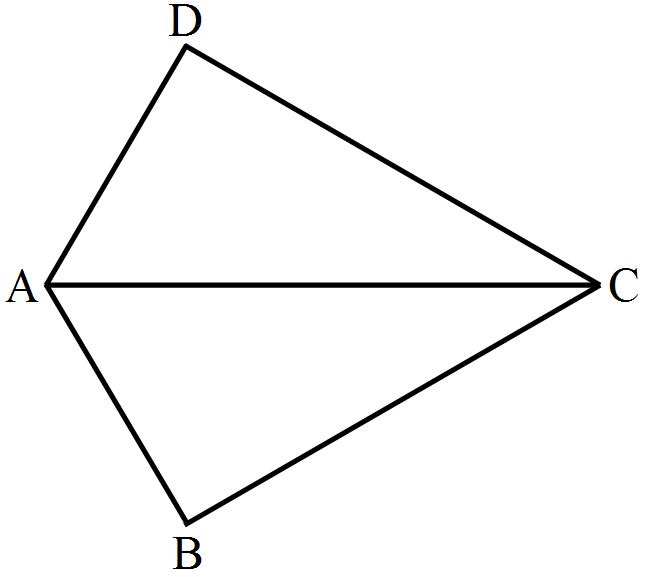
$ABCD$ is a quadrilateral such that diagonal AC bisects the angles $\angle\text{A}$ and $\angle\text{C}.$ Prove that $AB = AD$ and $CB = CD.$
Answer


In $\triangle\text{ABC}$ and $\triangle\text{ADC},$
$\angle\text{BAC}=\angle\text{DAC}$
$\big($AC bisects $\angle\text{A}\big)$
$\text{AC = AC}$ (common)
$\angle\text{BCA}=\angle\text{DCA}$
$\big($AC bisects $\angle\text{C}\big)$
$\therefore\triangle\text{ABC}\cong\triangle\text{ADC} ($by $ASA$ congruence criterion$)$
$\Rightarrow\text{AB = AD}$ and $\text{CB = CD} (C.P.C.T.)$

Need a full question paper?

Generate a complete, print-ready paper with questions like this in minutes — across 16+ boards, with answer keys.
Start Generating Free

Similar questions

Prove that: $\Big(\sqrt{3\times5^{-3}}\div\sqrt[3]{3^{-1}}\sqrt{5}\times\sqrt[6]{3\times5^6}=\frac{3}{5}\Big)$
Express the following in the form $\frac{\text{p}}{\text{q}},$ where p and q are integers and $\text{q}\neq0: .00323232...$
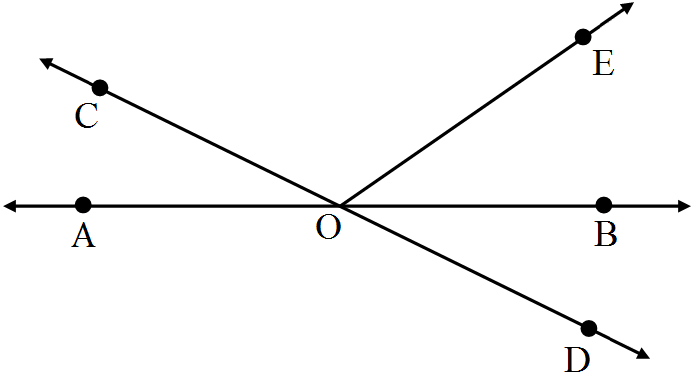
In figure, lines $AB$ and $CD$ intersect at $O$. If $\angle\text{AOC}+\angle\text{BOE}=70^\circ$ and $\angle\text{BOD}=40^\circ,$ find $\angle\text{BOE}$ and reflex $\angle\text{COE}.$
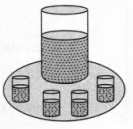
At a Ramzan Mela, a stall keeper in one of the food stalls has a large cylindrical vessel of the base radius $15 \ cm$ filled upto a height of $32 \ cm$ with the orange juice. The juice is filled in small cylindrical glasses (see figure) of radius $3 \ cm$ upto a height of 8 cm and sold for Rs. $15$ each. How much money does the stall keeper receive by selling the juice completely?
The following table shows the life expectancy (average age to which people live) in various countries in a particular year. Representing the data by a bar graph.
Country
Japan
India
Britain
Ethiopia
Cambodia
$UK$
Life expectancy
$84$
$68$
$80$
$68$
$62$
$73$
Factorise: $2(x + y)^2 - 9(x + y) - 5$
$ABCD$ is a quadrilateral such that diagonal $AC$ bisects the angles $A$ and $C$. Prove that $AB = AD$ and $CB = CD$.
A solid sphere of radius $3\ cm$ is melted and then cast into smaller spherical balls, each of diameter $0.6\ cm$. Find the number of small balls thus obtained. $\big(\text{Take}\ \pi=\frac{22}{7}\big).$
Find the area of an equilateral triangle having each side $4\ cm$.
Find the following product: $(2 x-y+3 z)\left(4 x^2+y^2+9 z^2+2 x y+3 y z-6 x z\right)$