Question
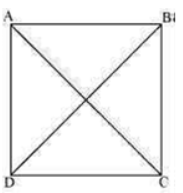
$A B C D$ is a rectangle in which diagonal $A C$ bisects $\angle A$ as well as $\angle C$. Show that:
i. $A B C D$ is a square
ii. diagonal $B D$ bisects $\angle B$ as well as $\angle D$.
Answer


Given : $ABCD$ is a rectangle,
$\angle A = \angle C$
$\frac{1}{2} \angle A=\frac{1}{2} \angle C$
To prove: $ABCD$ is a square proof:
i. $\angle DAC =\angle DCA$ ($AC$ bisects $A$ and $C)$
$C D=D A$ (Sides opposite to equal angles are also equal)
However,
$D A=B C$ and $A B=C D$ (Opposite sides of a rectangle are equal)
$AB=BC=CD=DA$
$A B C D$ is a rectangle and all of its sides are equal.
Hence, $A B C D$ is a square
ii. Let us join $BD$
In $\triangle B C D$,
$B C=C D$ (Sides of a square are equal to each other)
$\angle C D B=\angle C B D$ (Angles opposite to equal sides are equal)
However,
$\angle C D B=\angle A B D$ (Alternating interior angles for $A B \| C D$ )
$\angle C B D=\angle A B D$
$B D$ bisects $\angle B$
Also,
$\angle CDB=\angle ABD$
$BD$ bisects $\angle D$.

Need a full question paper?

Generate a complete, print-ready paper with questions like this in minutes — across 16+ boards, with answer keys.

Start Generating Free

Similar questions

In a study of diabetic patients in a village, the following observations were noted.
Age in year
$10-20$
$20-30$
$30-40$
$40-50$
$50-60$
$60-70$
Number of patients
$2$
$5$
$12$
$19$
$9$
$4$
Represent the above data by a frequency polygon.
If diagonals of a cyclic quadrilateral are diameters of the circle through the vertices of the quadrilateral, prove that it is a rectangle.
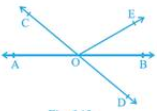
In Figure lines $AB$ and $CD$ intersect at $O$. If $\angle AOC + \angle BOE = {70^ \circ }$ and $\angle BOD = {40^ \circ }$,find $\angle BOE$ and reflex $\angle COE$
Fig.6.1.png
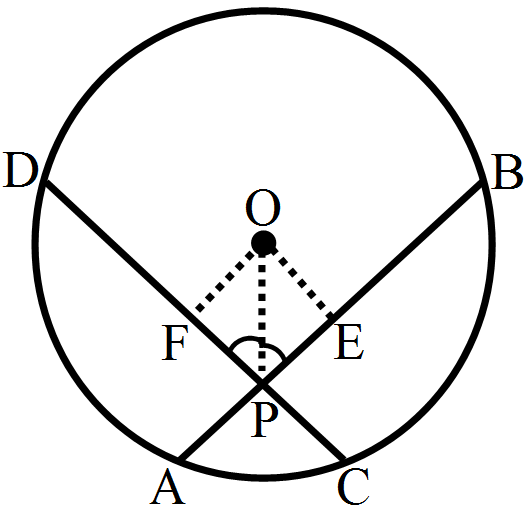
In the given figure, $O$ is the centre of a circle in which chords $AB$ and $CD$ intersect at $P$ such that $PO$ bisects $\angle\text{BPD}.$ Prove that $AB$ $= CD$.
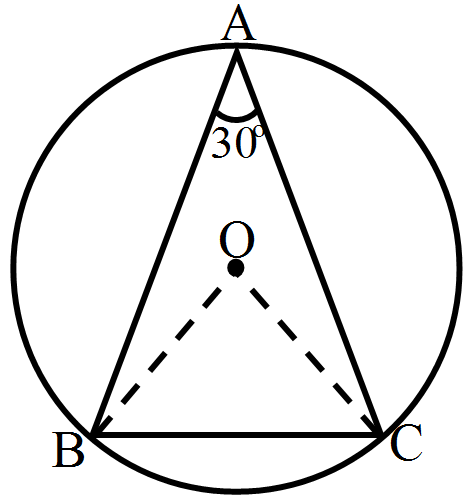
In the given figure, $\angle\text{BAC}=30^\circ.$ Show that $BC$ is equal to the radius of the circumcircle of $\triangle\text{ABC}$ whose centre is $O$.
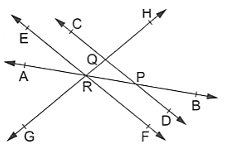
In the adjoining figure, name:
i. Two pairs of intersecting lines and their corresponding points of intersection
ii. Three concurrent lines and their points of intersection
iii. Three rays
iv. Two line segments
Image
Express $0.6+0.\overline7+0.4\overline7$ in the form $\frac{\text{p}}{\text{q}},$ where $p$ and $q$ are integers and $\text{q}\neq0.$
Find the perimeter and area of a qudrilateral $A B C D$ in which $B C=12\ cm, C D=9\ cm, B D=15\ cm, D A=17\ cm$ and $\angle ABD =90^{\circ}$.
The polynomial $p(x)=x^4-2 x^3+3 x^2-a x+3 a-7$ when divided by $x+1$ leave remainder $19 .$ Find the remainder when $p(x)$ is divided by $x +2$.
Simplify : $\frac{7 \sqrt{3}}{\sqrt{10}+\sqrt{3}}-\frac{2 \sqrt{5}}{\sqrt{6}+\sqrt{5}}-\frac{3 \sqrt{2}}{\sqrt{15}+3 \sqrt{2}}$.