Question
ABCD is a rectangle in which diagonal BD bisects $\angle\text{B}.$ Show that ABCD is a square.
Answer

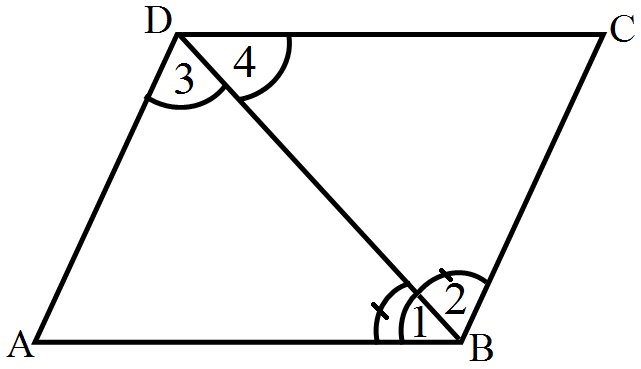
Given: A rectangle ABCD in which diagonal BD bisects $\angle\text{B}$

To prove: ABCD is a square.

Proof: DC || AB [Opposite sides of a rectangle are parallel]

$\Rightarrow\ \angle4=\angle1\ ...(\text{i})$ [Alternate interior angles]

Similarly, $\angle3=\angle2\ ...(\text{ii})$ [Alternate interior angles]

And $\angle1=\angle2\ ...(\text{iii})$ [Given]

From equation (1), (2) and (3), we get

$\angle3=\angle4$

In $\Delta\text{BAD}$ and $\Delta\text{BDC}$ we have

$\angle1=\angle2$[Given]

BD = BD[Common side)

$\angle3=\angle4$ [proved above]

So, By ASA criterion of congruence, we have

$\Delta\text{BAD}\cong\Delta\text{BCD}$

$\therefore\ \text{AB}=\text{BC}$ [CPCT]

As, adjacent sides of rectangle are equal. So, ABCD is a square.

Need a full question paper?

Generate a complete, print-ready paper with questions like this in minutes — across 16+ boards, with answer keys.
Start Generating Free

Similar questions

On a common hypotenuse AB, two right triangles ACB and ADB are situated on opposite sides. Prove that $\angle\text{BAC} = \angle\text{BDC.}$
Three girls Reshma, Salma and Mandip are playing a game by standing on a circle of radius 5 m drawn in a park. Reshma throws a ball to Salma. Salma to Mandip, Mandip to Reshma. If the distance between Reshma and Salma and between Salma and Mandip is 6 m each, what is the distance between Reshma and Mandip?
A cylinder and a cone have equal radii of their base and equal heights. If their curved surface area are in the ratio 8 : 5, show that the radius of each is to the height of each as 3 : 4
BM and CN are perpendiculars to a line passing through the vertex A of triangle ABC. If L is the mid-point of BC, prove that LM = LN.
In parallelogram ABCD, two points P and Q are taken on diagonal BD such that DP = BQ.

Show that
  1. $\triangle$APD $\cong$$\triangle$CQB
  2. AP = CQ
  3. $\triangle$AQB $\cong$$\triangle$CPD
  4. AQ = CP
  5. APCQ is a parallelogram.
P , Q, R and S are respectively the midpoints of the sides AB, BC, CD and DA of a quadrilateral ABCD. Show that:
  1. PQ || AC and $\text{PQ}=\frac{1}{2}\text{AC}$
  2. PQ || SR
  3. PQRS is a parallelogram.

In a $\triangle\text{ABC},$ it is given that $\angle\text{A}:\angle\text{B}:\angle\text{C}=3:2:1$ and $\text{CD}\perp\text{AC}.$ Find $\angle\text{ECD}.$

If $\text{x}+\frac{1}{\text{x}}=3,$ then find the value of $\text{x}^2+\frac{1}{\text{x}^2}.$
Prove that the line segment joining the mid-point of the hypotenuse of a right triangle to its opposite vertex is half of the hypotenuse.
CDE is an equilateral triangle formed on a side CD of a square ABCD. Show that $\triangle\text{ADE}\cong\triangle\text{BCE}.$