MCQ
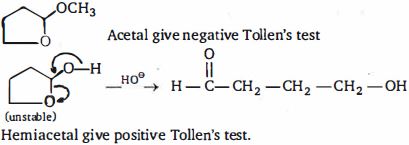
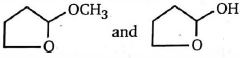
Above compounds can be differentiated by following reagent
  • A
    $2-4\, DNP$ (Brady reagent)
  • Tollen's reagent
  • C
    Lucas reagent
  • D
    $NaHSO_3$

Answer

Correct option: B.
Tollen's reagent
b

Need a full question paper?

Generate a complete, print-ready paper with questions like this in minutes — across 16+ boards, with answer keys.
Start Generating Free

Similar questions

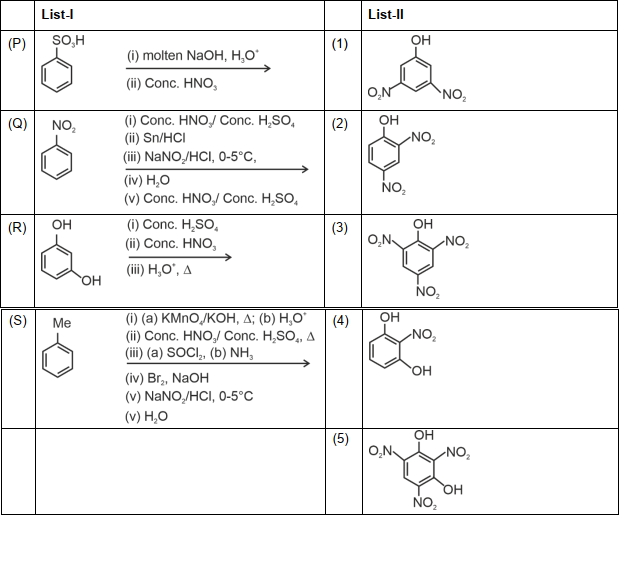
$List-I$ contains various reaction sequences and $List-II$ contains different phenolic compounds. Match each entry in $List-I$ with the appropriate entry in $List-II$ and choose the correct option.
$N{a_2}{S_2}{O_3} + {I_2} \to $ Product is
Compound Total stereoisomere
$(A)\, [Co(en)_2 \,Cl_2]^+$ $(P)\, 2$
$(B)\, [Co(en)_3]\, Cl_3$ $(Q)\, 3$
$(C) \,[Pt(NH_3)_2 \,Cl_2]$ $(R)\, 4$
$(D)\, [Pt(NH_3)_3 \,Cl_3]^+$ $(S)\, 5$

Correct code

A natural product was isolated in the laboratory and its observed rotation was $+10^o$. When meausured in a $1\,\, dm$ sample tube containing $1\, gm$ of compoud in $10\, ml$ of water. What is the specific rotation of this compound.
For a concentrated solution of a weak electrolyte ( $K _{ eq }=$ equilibrium constant) $A _2 B _3$ of concentration ' $c$ ', the degree of dissociation " $\alpha$ ' is
The highest oxidation state shown by transition elements is
Given below are two statements:Statement (I): For a given shell, the total number of allowed orbitals is given by $n ^2$.
Statement (II) : For any subshell, the spatial orientation of the orbitals is given by $-l$ to $+l$ values including zero.
In the light of the above statements, choose the correct answer from the options given below:
In a cell, the following reactions take place

$Fe ^{2+} \rightarrow Fe ^{3+} + e ^{-} \quad E _{ Fe ^{3+} / Fe ^{2+}}=0.77 \,V$

$2 I ^{-} \rightarrow I _{2}+2 e ^{-} \quad E _{ I _{2} / I ^{-}}^{0}=0.54 \,V$

The standard electrode potential for the spontaneous reaction in the cell is $x \times 10^{-2} \,V 298$ $K$. The value of $x$ is .... (Nearest Integer)

Copper sulphate solution reacts with $KCN$ to give
In esterification of an acid, the other reagent is