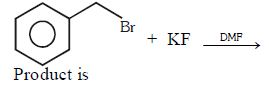
MCQ
Above transformation can be carried out by
  • A
    $H^+ / \Delta , Zn (Hg), HCl$
  • $HIO_4 , LiAlH_4$
  • C
    $HIO_4 , H^+ / \Delta $
  • D
    $H^+ / \Delta , HIO_4$

Answer

Correct option: B.
$HIO_4 , LiAlH_4$
b

Need a full question paper?

Generate a complete, print-ready paper with questions like this in minutes — across 16+ boards, with answer keys.

Start Generating Free

Similar questions

The unbalanced chemical reactions given in List $I$ show missing reagent or condition $(?)$ which are provided in List $II$. Match List $I$ with List $II$ and select the correct answer using the code given below the lists :

List $I$ List $II$
$P.$ $PbO _2+ H _2 SO _4 \xrightarrow{?} PbSO _4+ O _2+$ other product $1.$ NO
$Q.$ $Na _2 S _2 O _3+ H _2 O \xrightarrow{?} NaHSO _4+$ other product $2.$ $I_2$
$R.$ $N _2 H _4 \xrightarrow{\text { ? }} N _2+$ other product $3.$ Warm
$S.$ $XeF _2 \xrightarrow{?} Xe +$ other product $4.$ $Cl _2$

Codes: $ \quad P \quad Q \quad R \quad S $ 

Liquid $'M\ ’$ and liquid $'N\ ’$ form an ideal solution. The vapour pressures of pure liquids $'M\ ’$ and $'N\ ’$ are $450$ and $700\,\ce{mm\ Hg,}$ respectively at the same temperature. Then correct statement is$: ( x_M =$ mole fraction of $'M\ ’$ in solution $;x_N =$ mole fraction of $'N\ ’$ in solution$; y_M =$ mole fraction of $'M\ ’$ in vapour phase; $y_N =$ mole fraction of $'M\ ’$ in vapour phase$)$
The intermediate during the addition of $HCl$ to propene in the presence of peroxide is
$A $ will be
$2$ moles of $N_2$ are mixed with $6$ moles of $H_2$ in a closed vessel of one litre capacity. If $50\%\, N_2$ is converted into $NH_3$ till equilibrium, find the value of $K_c$ for the reaction, ${N_2}(g) + 3{H_2}(g) \rightleftharpoons 2N{H_3}(g)$
?
On reaction of Lead Sulphide with dilute nitric acid which of the following is not formed ?
The product(s) obtained via oxymercuration $(HgS{O_4} + {H_2}S{O_4})$ of  $ 1-$ butyne would be
$ClF _5$ at room temperature is a:
An aqueous solution of $4.5\,gm$ oxalic acid $(H_2C_2O_4)$ is made up to $250\,ml$. Calculate volume of $0.1\,N\,NaOH$, which is required to neutralise completely $20\,ml$ of this solution ...... $ml$.