MCQ
Absolute alcohol is
- ✓$100$ $\%$ pure ethanol
- B$95$ $\%$ alcohol $+$ $ 5$ $\%$ ${H_2}O$
- CEthanol $+$ water $+$ phenol
- D$95$ $\%$ ethanol $+ 5$ $\%$ methanol
Absolute alcohol is a liquid alcohol solution which contains almost more than $99 \%$ pure alcohol (ethyl alcohol) by weight. It is an important constituent of alcoholic beverages. Alcohol is prepared by the fermentation of sugar through petrochemical processes or by yeast. The alcohol obtained through this method contains some amount of water and it is removed by adding some dry slat. The dry salt absorbs the water content of the ethanol solution as it passes through and we obtain a pure alcohol, $95 \%$ alcohol $+5 \%$ water solution is known as rectified alcohol. It is a highly concentrated solution of ethanol.
$95 \%$ ethanol $+5 \%$ methanol is known as denatured alcohol prepared by adding methanol to anhydrous ethanol. Pure alcohol prepared is denatured.
Generate a complete, print-ready paper with questions like this in minutes — across 16+ boards, with answer keys.
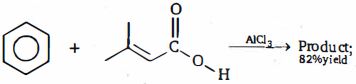

[Atomic mass : $\mathrm{H}: 1.0, \mathrm{C}: 12.0, \mathrm{O}: 16.0]$
$(i)\,\mathop {\begin{array}{*{20}{c}}
{\,\,\,\,\,C{H_3}} \\
| \\
{C{H_3} - C - C{H_3}} \\
| \\
{\,\,\,\,\,C{H_3}}
\end{array}}\limits_{(Neo - pen\tan e)\,(i)} $
$(ii\mathop {)\,\begin{array}{*{20}{c}}
{C{H_3} - CH - C{H_2} - C{H_3}} \\
{|\,\,\,\,\,\,\,\,\,\,\,\,\,\,\,\,\,\,} \\
{\,\,\,\,\,C{H_{3\,\,\,\,\,\,\,\,\,\,\,\,\,\,\,\,\,\,\,\,\,\,\,\,}}}
\end{array}}\limits_{(Iso - pen\tan e)\,\,(ii)} $
$(iii)\,\mathop {C{H_3} - C{H_2} - C{H_2} - C{H_2} - C{H_3}}\limits_{(n - pen\tan e)} $
$PCl_{5(g)} \rightleftharpoons PCl_{3(g)} + Cl_{2(g)}$
which of the following conditions are correct ?