MCQ
Absolute scale of temperature is reproduced in the laboratory by making use of a
  • A
    Radiation pyrometer
  • B
    Platinum resistance thermometer
  • Constant volume helium gas thermometer
  • D
    Constant pressure ideal gas thermometer

Answer

Correct option: C.
Constant volume helium gas thermometer
c
(c)

Need a full question paper?

Generate a complete, print-ready paper with questions like this in minutes — across 16+ boards, with answer keys.
Start Generating Free

Similar questions

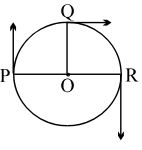
Three point particles $P, Q, R$ move in circle of radius $‘r’$ with different but constant speeds. They start moving at $t = 0$ from their initial positions as shown in the figure. The angular velocities (in rad/ sec) of $P, Q$ and $R$ are $5\pi , 2\pi$ & $3\pi$ respectively, in the same sense.  the number of times $P$ and $Q$ meet in that time interval is:
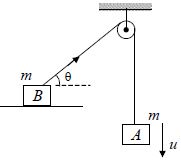
Two equal masses $A$ and $B$ are arranged as shown in the figure. Pulley and string are ideal and there is no friction. Block $A$ has a speed $u$ in the downward direction. The speed of the block $B$ is :-
Water rises in a capillary upto a height $h$ . If this capillary is tilted by an angle of $45^o$, then the length of the water column in the capillary becomes
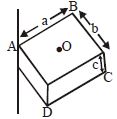
Figure shows a uniform solid block of mass $M$ and edge lengths $a, b$ and $c$. Its $M.I.$ about an axis through one edge and perpendicular (as shown) to the large face of the block is
A small block is shot into each of the four tracks as shown below. Each of the tracks rises to the same height. The speed with which the block enters the track is the same in all cases. At the highest point of the track, the normal reaction is maximum in
A wheel is rotaing freely with an angular speed $\omega$ on a shaft. The moment of inertia of the wheel is $I$ and the moment of inertia of the shaft is negligible. Another wheel of momet of inertia $3I$ initially at rest is suddenly coupled to the same shaft. The resultant fractional loss in the kinetic energy of the system is :
Which of the following properties of light conclusively support wave theory of light?
  1. Light obeys laws of reflection.
  2. Speed of light in water is smaller than the speed in vacuum.
  3. Light shows interference.
  4. Light shows photoelectric effect.
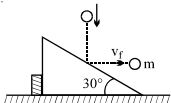
As shown in the figure $a$ body of mass $m$ moving vertically with speed $3\, m/s$ hits a smooth fixed inclined plane and rebounds with a velocity $v_f$ in the horizontal direction. If $\angle$ of inclined is $30^o$, the velocity $v_f$ will be
A body falls from a height $h = 200\,m$ (at New Delhi). The ratio of distance travelled in each $2\, sec$ during $t = 0$ to $t = 6$ second of the journey is
A particle is acted by a constant power. Then, which of the following physical quantity remains constant?