MCQ
Absolute temperature can be calculated by
  • Mean square velocity
  • B
    Motion of the molecule
  • C
    Both $(a)$ and $(b)$
  • D
    None of the above

Answer

Correct option: A.
Mean square velocity
a
(a) $\overline {{v^2}} \propto T$

Need a full question paper?

Generate a complete, print-ready paper with questions like this in minutes — across 16+ boards, with answer keys.
Start Generating Free

Similar questions

Escape velocity of a planet is v. If radius of the planet remains same and mass becomes 4 times, the escape velocity becomes:
A car travels half the distance with constant velocity of $40\, kmph$ and the remaining half with a constant velocity of $60 \,kmph$. The average velocity of the car in $kmph$ is
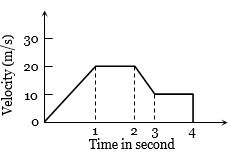
The variation of velocity of a particle with time moving along a straight line is illustrated in the following figure. The distance travelled by the particle in four seconds is.........$m$
A wheel is of diameter $1\ m.$ If it makes $30$ revolution per second, then the linear speed of a point on its circumference will be 
A small block of mass $m$ is kept on a rough inclined surface of inclination $\theta$ fixed in an elevator. The elevator goes up with a uniform velocity $v$ and the block does not slide on the wedge. The work done by the force of friction on the block in time $t$ as seen by the observer on the inclined plane will be
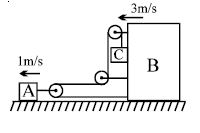
The velocities of $A$ and $B$ are marked in the figure. The velocity of block $C$ is  ......... $m/s$ (assume that the pulleys are ideal and string inextensible)
A transverse wave travels along the Z-axis. The particles of the medium must move:
  1. Along the Z-axis
  2. Along the X-axis
  3. Along the Y-axis
  4. In the X-Y plane.
A stationary source is emitting sound at a fixed frequency $\mathrm{f}_0$, which is reflected by two cars approaching the source. The difference between the frequencies of sound reflected from the cars is $1.2 \%$ of $f_0$. What is the difference in the speeds of the cars (in $\mathrm{km}$ per hour) to the nearest integer? The cars are moving at constant speeds much smaller than the speed of sound which is $330 \mathrm{~ms}^{-1}$.
A scientist performs an experiment in order to measure a certain physical quantity and takes $100$ observations. He repeats the same experiment and takes $400$ observations. By doing so,
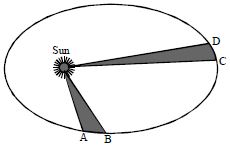
The fig. shows the motion of a planet around the un in an elliptical orbit with sun at the  focus. The shaded areas can be assumed to be equal. If $t_1$ and $t_2$ represent the  time taken for the planet to move from $A$ to $B$ and $C$ to $D$ respectively, then