MCQ
Absolute zero $(0\, K)$ is that temperature at which
  • A
    Matter ceases to exist
  • B
    Ice melts and water freezes
  • Volume and pressure of a gas becomes zero
  • D
    None of these

Answer

Correct option: C.
Volume and pressure of a gas becomes zero
c
(c) We know that $P = {P_0}(1 + \gamma t)$ and $V = {V_0}(1 + \gamma t)$

and $\gamma = (1/273)/^\circ C$for $t = - 273^\circ C$, we have $P = 0$ and $V = 0$

Hence, at absolute zero, the volume and pressure of the gas become zero.

Need a full question paper?

Generate a complete, print-ready paper with questions like this in minutes — across 16+ boards, with answer keys.
Start Generating Free

Similar questions

A load of mass $M\,kg$ is suspended from a steel wire of length $2\,m$ and radius $1.0\,mm$ in Searle’s apparatus experiment. The increase in length produced in the wire is $4.0\,mm.$ Now the load is fully immersed in a liquid of relative density $2$. The relative density of the material of load is $8$. The new value of increase in length of the steel wire is ........ $mm$
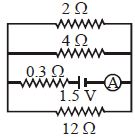
In the circuit shown in the adjoining figure, the reading of ammeter $A$ is ................ $\mathrm{A}$
A card sheet divided into squares each of size $1\,mm^2$ is being viewed at a distance of $9\,cm$ through a magnifying glass (a converging lens of focal length $9\,cm$ ) held close to the eye what is the angular magnification (magnifying power) of the lens
A Carnot's engine used first an ideal monoatomic gas then an ideal diatomic gas. If the source and sink temperature are ${411^o}C$ and ${69^o}C$ respectively and the engine extracts $1000\, J $ of heat in each cycle, then area enclosed by the $PV$ diagram is ........ $J$
Two generators $S_1$ and $S_2$ produce water wave of equal frequency. A point $P$ is located such that $(S_1P -S_2P)$ is equal to half a wavelength. When operated alone, $S_1$ produces an oscillation of amplitude $2a$ at $P$ while $S_2$ produces an oscillation of amplitude $a$ . If the generators are operated in phase, which graph correctly shows the resultant oscillation at $P$ ?
The minimum magnifying power of a telescope is $M$, If the focal length of its eye lens is halved, the magnifying power will become
The magnetic field in a plane electromagnetic wave is $\mathrm{B}_y=\left(3.5 \times 10^{-7}\right) \sin \left(1.5 \times 10^3 \mathrm{x}+0.5\right.$ $\left.\times 10^{11} \mathrm{t}\right) \mathrm{T}$. The corresponding electric field will be
A body initially at $80^o C$ cools to $64^o C$ in $5$ minutes and to $52^o C$ in $10 $ minutes. The temperature of the body after $15$ minutes will be ...... $^oC$
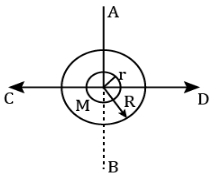
The figure shows two solid discs with radius ${R}$ and ${r}$ respectively. If mass per unit area is same for both, what is the ratio of ${MI}$ of bigger disc around axis ${AB}$ (Which is $\perp$ to the plane of the disc and passing through its centre) of MI of smaller disc around one of its diameters lying on its plane? Given $'M'$ is the mass of the larger disc. ($MI$ stands for moment of inertia)
A car is moving at a speed of $40 \,m / s$ on a circular track of radius $400 \,m$. This speed is increasing at the rate of $3 \,m / s ^2$. The acceleration of car is ....... $m / s ^2$