MCQ
Absorption co-efficient of an open window is...
  • A
    Zero
  • B
    $0.5$
  • $1$
  • D
    $0.25$

Answer

Correct option: C.
$1$
c
(c) Open window behaves like a perfectly black body.

Need a full question paper?

Generate a complete, print-ready paper with questions like this in minutes — across 16+ boards, with answer keys.

Start Generating Free

Similar questions

A big ball of mass $M$, moving with velocity $u$ strikes a small ball of mass $m$, which is at rest. Finally small ball obtains velocity $u$ and big ball $v$. Then what is the value of $v$
Time taken to heat water upto a temperature of 40°C (from room temperature) is t1 and time taken to heat mustard oil (of same mass and at room temperature) upto a temperature of 40°C is t2, then (given mustard oil has smaller heat capacity).
A rectangular block is $5 cm × 5 cm × 10cm$  in size. The block is floating in water with $ 5 cm $ side vertical. If it floats with $10 cm $ side vertical, what change will occur in the level of water?
A rod of weight $W$ is supported by two parallel knife edges $A$ and $B$ and is in equilibrium in a horizontal position. The knives are at a distance $d$ from each other. The centre of mass of the rod is at distance $x$ from $A.$ The normal reaction on $A$ is
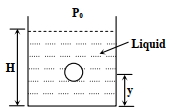
A small spherical monoatomic ideal gas bubble $\left(\gamma=\frac{5}{3}\right)$ is trapped inside a liquid of density $\rho_{\ell}$ (see figure). Assume that the bubble does not exchange any heat with the liquid. The bubble contains n moles of gas. The temperature of the gas when the bubble is at the bottom is $\mathrm{T}_0$, the height of the liquid is $\mathrm{H}$ and the atmospheric pressure is $\mathrm{P}_0$ (Neglect surface tension).

Figure: $Image$

$1.$ As the bubble moves upwards, besides the buoyancy force the following forces are acting on it

$(A)$ Only the force of gravity

$(B)$ The force due to gravity and the force due to the pressure of the liquid

$(C)$ The force due to gravity, the force due to the pressure of the liquid and the force due to viscosity of the liquid

$(D)$ The force due to gravity and the force due to viscosity of the liquid

$2.$ When the gas bubble is at a height $\mathrm{y}$ from the bottom, its temperature is

$(A)$ $\mathrm{T}_0\left(\frac{\mathrm{P}_0+\rho_0 \mathrm{gH}}{\mathrm{P}_0+\rho_t \mathrm{gy}}\right)^{2 / 5}$

$(B)$ $T_0\left(\frac{P_0+\rho_t g(H-y)}{P_0+\rho_t g H}\right)^{2 / 5}$

$(C)$ $\mathrm{T}_0\left(\frac{\mathrm{P}_0+\rho_t \mathrm{gH}}{\mathrm{P}_0+\rho_t \mathrm{gy}}\right)^{3 / 5}$

$(D)$ $T_0\left(\frac{P_0+\rho_t g(H-y)}{P_0+\rho_t g H}\right)^{3 / 5}$

$3.$ The buoyancy force acting on the gas bubble is (Assume $R$ is the universal gas constant)

$(A)$ $\rho_t \mathrm{nRgT}_0 \frac{\left(\mathrm{P}_0+\rho_t \mathrm{gH}\right)^{2 / 5}}{\left(\mathrm{P}_0+\rho_t \mathrm{gy}\right)^{7 / 5}}$

$(B)$ $\frac{\rho_{\ell} \mathrm{nRgT}_0}{\left(\mathrm{P}_0+\rho_{\ell} \mathrm{gH}\right)^{2 / 5}\left[\mathrm{P}_0+\rho_{\ell} \mathrm{g}(\mathrm{H}-\mathrm{y})\right]^{3 / 5}}$

$(C)$ $\rho_t \mathrm{nRgT} \frac{\left(\mathrm{P}_0+\rho_t g \mathrm{H}\right)^{3 / 5}}{\left(\mathrm{P}_0+\rho_t g \mathrm{~g}\right)^{8 / 5}}$

$(D)$ $\frac{\rho_{\ell} \mathrm{nRgT}_0}{\left(\mathrm{P}_0+\rho_{\ell} \mathrm{gH}\right)^{3 / 5}\left[\mathrm{P}_0+\rho_t \mathrm{~g}(\mathrm{H}-\mathrm{y})\right]^{2 / 5}}$

Give the answer question $1,2,$ and $3.$
A string $2.0\, m$ long and fixed at its end is driven by a $240\, Hz$ vibrator. The string vibrates in its third harmonic mode. The speed of the wave and its fundamental frequency is
Consider the following two statements:
  1. Linear momentum of the system remains constant.
  2. Centre of mass of the system remains at rest.
  1. ​​​​​​A implies B and B implies A.
  2. A does not imply B and B does not imply A.
  3. A implies B but B does not imply A.
  4. B implies A but A does not imply B.
An object will continue moving uniformly until
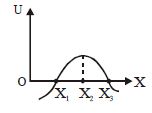
In the figure shown the potential energy $(U)$ of a particle is plotted against its position $'x'$ from origin. The particle at
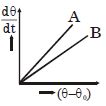
Two circular discs $A$ and $B$ with equal radii and equal mass are blackened. They are heated to same temperature and are cooled under identical conditions.What inference do you draw from their cooling curves ?