MCQ
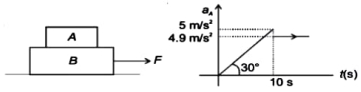
Acceleration of block $A$ varies with time as shown in figure the value of coefficient of kinetic friction between block $A$ and $B$ is the value of coefficient of kinetic friction between block $A$ and $B$ is .............. 
  • $0.5$
  • B
    $0.6$
  • C
    $0.4$
  • D
    None of these

Answer

Correct option: A.
$0.5$
a
(a)

Given: acceleration of block $A$ varies with time as shown in figure To find the value of coefficient of kinetic friction between the block $A$ and $B$ Solution:

Force is applied on block $B$. The moment when the block $A$ starts sliding is the moment when the applied force $F$ is greater than the frictional force between the two blocks.

Apply Newton's Second law of motion we get

$\operatorname{ma}_i=\mu g m$

$\Rightarrow a _{\Lambda}=\mu g$

$\Rightarrow 4.9=\mu(9.8)$

$\Rightarrow \mu=0.5$

is the value of coefficient of kinetic friction between the block $A$ and $B$
Need a full question paper?

Generate a complete, print-ready paper with questions like this in minutes — across 16+ boards, with answer keys.

Start Generating Free

Similar questions

A steel rod has a radius $10 \,mm$ and a length of $1.0 \,m$. A force stretches it along its length and produces a strain of $0.32 \%$. Young's modulus of the steel is $2.0 \times 10^{11} \,Nm ^{-2}$. What is the magnitude of the force stretching the rod is ........ $kN$
A vector has magnitude same as that of $\overrightarrow{\mathrm{A}}-=3 \hat{\mathrm{j}}+4 \hat{\mathrm{j}}$ and is parallel to $\overrightarrow{\mathrm{B}}=4 \hat{\mathrm{i}}+3 \hat{\mathrm{j}}$. The $\mathrm{x}$ and $y$ components of this vector in first quadrant are $\mathrm{x}$ and $3$ respectively where  $X$=_____.
Taking the gravitational potential at a point infinte distance away as zero, the gravitational potential at a point $A$ is $-5\, unit$. If the gravitational potential at point infinite distance away is taken as $+ 10\, units$, the potential at point $A$ is ......... $unit$
Stationary waves are formed when
A body of mass $4\, kg$ is at rest on a horizontal table. The coefficient of friction between  the body and the table is $0.2$ . A horizontal force of $6N$ is applied on the body.  The acceleration of the body is .......... $m/s^2$
A soap bubble in a form of circular tube having radius of curvature $R$ and radius of curvature perpendicular to it is $5R$ . Find the excess pressure in the bubble :
A small ball of mass $M$ and density $\rho$ is dropped in a viscous liquid of density $\rho_0$. After some time, the ball falls with a constant velocity. What is the viscous force on the ball ?
A thin hollow cylinder open at both ends:

$(i)$ Slides without rotating

$(ii)$ Rolls without slipping, with the same speed

$Assertion :$ When a beetle moves along the sand within a few tens of centimeters of a sand scorpion, the scorpion immediately turns towards the beetle and dashes towards it
$Reason :$ When a beetle disturbs the sand, it sends pulses along the sand's surface. One set of pulses is longitudinal while the other set is transverse.
In adiabatic expansion